Author name: Natalia Muntean

Art

Klara Kristalova at Venice Biennale: between desperation and dark comedy

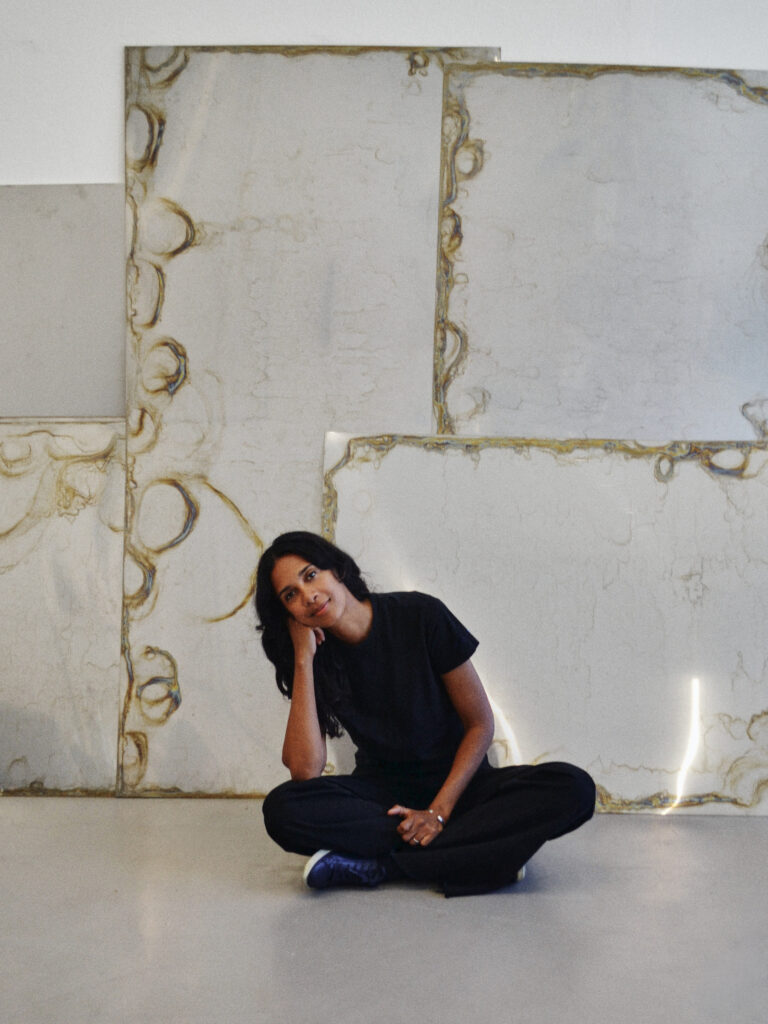
Klara Kristalova at the Venice Biennale: between desperation and dark comedy Text by Natalia Muntean Twelve metres of tree trunk, covered in hand-dyed Swedish carpets, lying on the floor of Sverre Fehn’s Nordic Pavilion like a giant. On and around it, eleven ceramic figures: a fat mouse, an apple child, a warrior woman breaking free of leaves. For Swedish artist Klara Kristalova, the invitation to represent the Nordic Pavilion at the 61st Venice Biennale was so unexpected that it stopped her working for months. Commissioned by the Museum of Contemporary Art Kiasma in Helsinki, the body of work is the most ambitious work of Kristalova’s career, hovering somewhere between desperation and dark comedy.  Natalia Muntean: Congratulations on this achievement! Klara Kristalova: Thank you! I was chosen by Finland, the country in charge of the Nordic Pavilion this year, and it was a big surprise. This was the last thing I expected. For me, it’s huge. NM: Why was it the last thing you expected?KK: I’m not the type of artist they would typically invite nowadays. I wouldn’t say I’m old-fashioned, but I work with sculpture, and my work isn’t conceptual in a developed sense. I have ideas around it, but it’s not a built concept. I think that kind of work is what gets invited more these days. So it came as a shock, and I couldn’t work for several months. I was completely stuck, thinking: This is too big for me. NM: How do you feel the three works sit together: yours, Benjamin Orlow’s and Tori Wrånes’s?KK: I think our three works function really well together. In certain details and ways of thinking, they overlap, but at the same time, they are completely different. The Nordic Pavilion looks monumental and sculptural but also very much like a fairy tale. Tori works with mythology and figures, Benjamin as well, but in a totally different way. There’s a loose shared language, but each of us uses it differently. NM: I read that you used to go to the Venice Biennale with your father. How does it feel to now be representing the Nordic countries here?KK: It’s completely surreal. From a very young age, coming here with my father was an enormous thing – to see the art that mattered in the world. I’ve continued coming as an adult, many times. You just work on your work and don’t expect to be included in something like this, because for me, it has always felt almost mythical. For me, it’s very dreamy to be here. Photo: Finnish National Gallery / Pirje Mykkänen NM: Was this a dream come true?KK: I never dared to dream it, it was too abstract that I would ever be invited. So it’s not a dream come true exactly. But when I got the call, I thought: Well, I can retire now. Of course I won’t. I don’t think an artist really retires. You just continue, maybe in a different way. If I take even a week off, I feel completely lost. The work is a way of straightening things out, not consciously; I don’t write plans or intentions, but it helps clarify the mind. NM: Do you have any rituals when you work?KK: Not really. I wake up, walk my dogs, and start. I prefer to have several things going at the same time in one day, several sculptures in progress, which also suits the material, because with clay, you can’t work too long before it needs to dry. So I do a little here, a little there, then maybe some drawings or planning for something else. I like the variety. NM: Do your sculptures talk to you while you’re making them?KK: Yes. They change a lot while I’m working. I always start with sketches – a plan, a sense of what I want. When I’m preparing for a specific place, I think about the space and let my mind make associations, then I weave that together with where I am in my life. But once I start building, it shifts, because the work develops its own voice. It’s in the material, but it also changes in my mind as my hands work. I can’t think everything out in advance and then just execute it. The hand does something to the thinking. It’s a give-and-take. Installation view: How Many Angels Can Dance On The Head Of A Pin?, Nordic Countries Pavilion at the 61st International Art Exhibition – La Biennale di Venezia. Photo: Finnish National Gallery / Pirje Mykkänen Photo: Finnish National Gallery / Pirje Mykkänen NM: What did the ones for the Biennale say?KK: They all dwell on this woman lying down, the whole world on her, and also the mother, and you don’t know if she’s fading or coming back. There’s a flat, see-through relief made of wood that’s almost like smoke, a spirit emanating from her. There’s a very fat mouse that weighs her down; he’s the male character, a dominant, guardian figure, but you don’t know if he’s a friend or a threat. He comes from a cuddly toy I had as a child. Then there’s an apple figure – taken from an older work where my mother was a deer, my father a tree, and I was the apple child. Here, only the apple child remains. It’s curious and mischievous, and partly it’s there for compositional reasons; the work is mainly brown and black, and the deep red apple is a colour note. Then there’s a large bronze warrior woman, trapped in leaves but breaking free. She has real power. I specifically wanted something raw and angry in this, not a group of cute figures. NM: Can you describe the body of work you’re showing?KK: The main piece is a very large tree trunk, twelve metres long, that is also a woman. She has a face, hair, and stands on branches like an animal on many legs, with a root at the other end. The whole structure is covered in Swedish woven

Design

Mateus Celebrates the Customers Who Never Left

Mateus Celebrates the Customers Who Never Left Mateus, the Swedish ceramics brand founded in 1993 by Teresa Mateus Lundahl, has launched a new campaign that turns its attention away from newness and toward continuity. Honoring the Long Time Clients centres on the customers who have lived with the brand over decades, building collections piece by piece, layering new colours and forms alongside old ones, never quite starting over. The campaign is told through one home. Eva Wikström, who bought her first Mateus plate 26 years ago, has spent two decades adding to her table, sometimes in the same tones, sometimes in new ones. Her daughter Linn, now 30, has started building her own collection alongside it, some pieces received as gifts, others chosen herself. It is a quiet portrait of how objects accrue meaning across a life, and across generations. “Nothing is too fine to be used. I like to set a beautiful table, whether it’s an ordinary Tuesday or when we have guests. It does something to the atmosphere,” says Wikström. The campaign reflects something built into the brand’s design logic from the beginning. When Teresa Mateus arrived in Sweden from Portugal, she saw colour and pattern beginning to enter otherwise restrained Nordic interiors, and founded the brand on the idea that each new piece should be able to live alongside what already exists on the table, not replace it. Each item is handmade and hand-painted by craftspeople in Portugal, meaning no two pieces are identical. More than 30 years and 600 products later, that founding idea is now the subject of the campaign itself.

Art

Kim Simonsson’s Moss Giants Come to Norrviken

Kim Simonsson’s Moss Giants Come to Norrviken Kim Simonsson’s moss giants were born in utopia, imagining a community without hierarchy, where every role, from philosopher to caretaker, carries equal weight. Now two of them, Nest and Thinker, have found a permanent home in the forest landscape of Norrviken in Båstad, where they stand among moss-covered stones as though they were always there. Natalia Muntean: Nest and Thinker were created for Lille3000 in 2022. How does it feel to see them move into a permanent home, and does permanence change how you think about a piece?Kim Simonsson: I am very happy that almost all of the 11 giants created for the “Utopia” arts festival in Lille in 2022 have found a permanent home. Two are in private collections in the USA; one is in the centre of the historic Austrian town of Gmunden; one is in front of a shopping mall in Roubaix; and four are in a forest near Söderlångvik Manor on Kimitö Island in southern Finland. The sculptures have found homes in a wide variety of locations, which is wonderful to see. I am very happy that they have found a new life after the main event. When they were first created, I wasn’t thinking about them being spread around the world, but I am glad that people appreciate them individually and in different settings. NM: Norrviken is a designed landscape with over a century of history. Did that context influence which two figures you felt belonged here?KS: There were only three sculptures left to choose from, but these two, by coincidence, fit the setting of Norrviken perhaps best of all eleven. One is the boy with a bird’s nest on his back – many birds are likely to nest in the forest where it is located. The other is the girl, a melancholic artist, and I’m sure there have been melancholic artistic types pondering life in the park. Part of the mythology I created for the moss giants is that they originated in the Scandinavian forests and later wandered to Lille. It is very fitting that they have now returned from their European journey to their home, a forest in Norrviken, with many stories to tell. NM: As the moss giants age in place, they will literally become part of the ecosystem. Does that feel like completion to you, or loss?KS: I would be happy if real moss and lichen began to grow on the sculptures, and if birds made nests in them. Eventually, the sculptures will become part of their surroundings, like large stones or fallen trees. NM: Each figure has a role that is described as equally essential to the group. How do you decide what roles the community needs, and how does a new figure come into being?KS: The theme of the art festival in Lille was Utopia. I began to imagine a utopian group and considered what kinds of skills would be needed within it. There was no leader, and since it was a utopian community, all skills were equally valued. There was, for example, a doctor, a gatherer, and a teacher, but also a philosopher and a girl whose role was simply to think rather than to act. The figure with the nest was the one who communicated with the animal world. NM: You started shaping figures in snow as a child, while others built snowmen. Do you think your relationship to form has changed, or is it still essentially the same impulse?KS: I am a maker, and I love being able to create the figures I imagine out of clay. My aim is to refine my skills so that I can give the figures at least a small sense of life, so they can connect with the viewer’s unconscious and perhaps take them back to a cherished childhood memory. NM: Is there a figure you have made that you found hardest to let go of?KS: For me, it is an essential part of my profession to create works for an audience, not just for myself. So I am always very happy when someone wants to live with one or more of my creations. Usually, the most important sculpture is the one I am working on at that moment.

Opiates

Lisa Yang Opens Its First Physical Store in Stockholm

Lisa Yang Opens Its First Physical Store in Stockholm Lisa Yang, the Stockholm-based fashion house known for its complete cashmere offer for women, men and the home, has announced its first physical store. The 137 sqm space will open at Birger Jarlsgatan 8 in the second half of 2026, with the retail concept developed by architectural firm Studio Anne Holtrop. Founded in 2014 by Lisa Yang and Samuel Stenberg, the brand has, until now, operated exclusively online, building a loyal following through its approach to cashmere rooted in a dialogue between Scandinavian simplicity and the cashmere traditions of Inner Mongolia. “We took our time to quietly build a brand grounded in material intelligence and modernity. Translating this sensibility into a physical environment that unites creativity, craftsmanship and connection is a deliberate and exciting step we have waited for,” says Lisa Yang, Founder and Creative Director. For CEO Samuel Stenberg, the move into physical retail is as much about deepening client relationships as it is about visibility. “Our first physical destination will not only allow us to showcase our brand strengths, but it will also allow us to build deeper relationships with our clients,” he says, noting that Stockholm, where the brand has an established customer base, was the natural starting point. The store opens at Birger Jarlsgatan 8, Stockholm, in the second half of 2026.

Fashion Articles

Hannah Blitz Heyman Lets the Silver Decide

Hannah Blitz Heyman Lets the Silver Decide Text by Natalia Muntean At fifteen, Hannah Blitz Heyman stood at an archaeological site and watched a guide pull a golden earring from the earth. That moment has stayed with her ever since. Now working from Stockholm, Blitz Heyman makes jewellery that takes the long view of metal: from ore in a mountain to something worn close to the body, processed as little as possible along the way. A graduate of CRAFT! at Konstfack, her practice sits at the intersection of jewellery and object-making, the work resisting anything too smooth or too resolved. NM: What is the first piece of jewellery you remember falling in love with?HBH: I visited an archaeological site when I was fifteen, and after digging for a while with no success, the guide showed us some objects that they’d found. After looking at some cracked pots, he pulled up a shiny golden earring with a tiny winged figure on it. The earring was shiny and had marks, but it was still an earring. The time passed between the maker and me was over two thousand years, but the metal remained. This notion has thrilled me ever since. NM: And separately, do you remember the first thing you made that felt like yours, like the beginning of a language you recognised?HBH: Definitely! It’s a ring made from castings of my house key. At that point, I had been a goldsmith apprentice for a few years, meaning slow processes and lots of patience. Casting jewellery felt so liberating. It was fast and allowed more shapes to take form. The ring is super sloppy, but reminds me of the importance of exploration for my making.  NM: You say art school is where your aesthetic found its foundation, but that before that, it was hard to know where your work fit. What did “not fitting” feel like – was it the work itself, or the context, or both? And what shifted?HBH: The shift, I think, came from not working for someone else. Before art school, my time as an apprentice meant mainly producing work for my teacher and designing things reminiscent of hers. It took a while to figure out how to use the same skills for myself.  To some extent, I think I’ll always feel like I don’t fit in. It’s more of a state of mind rather than a factual reality. In the beginning, it was that my idea didn’t come across in the finished piece, and I had to develop tools of communication within my making. The feeling can be aspirational instead of defeat, because now I think that these tools are part of the Blitz Heyman expression. There will always be people who don’t connect to what I do, but I try to focus on the ones who like what I create and find spaces together with them.  NM: You describe your process as intuitive – do you ever lose a piece to the process, something that slipped away because you followed an idea?HBH: Absolutely! But I try not to look at it as something I lost. It’s more of a stepping stone to arrive somewhere else. It’s never been any piece that I’ve mourned the loss of. The sense of being in a flow state while I work feels too good, and the initial idea still exists.  Photos by Vasilissa Sadikova NM: The friendship heart necklace came from splitting a pendant at a friend’s request, almost by accident. What is it about friendship specifically, rather than romantic love or family, that feels worth marking with an object?HBH: I never meant to call it a friendship necklace. Other people have given it that name. In all of my notes, the necklace is called </3 necklace. This makes more sense to me and also opens up the idea that the necklace is for more than friendship: just any type of relationship with another person you feel connected to. But it’s lovely to make something that people share with a friend, since there are no big life events that celebrate friendship comparable to weddings. NM: Sand casting and silver seem central to your practice, but is there a material you haven’t worked with yet that you think about?HBH: I would love to work with stones. But I can’t decide if I want to sculpt large ones or if I should study to become a geologist. Hopefully, there’s time for both! NM: You talk about the wish that whoever wears a Blitz Heyman piece feels like an enhanced version of themselves, but who do you picture when you imagine that person?HBH: I’m so thankful for every person who likes what I do and is able to buy a piece. Everyone has their own reason for buying a piece made by me, so I don’t have a specific person in mind. Blitz Heyman was born organically from my making and continues to evolve together with the people who wear my jewellery.   NM: Once something is made and sold or given away, do you stay curious about where it goes and what it accumulates? Or does the piece become separate from you at a certain point? HBH: Being a jewellery lover, I know how much information can exist within a tiny object. And the amazing thing with working with precious metals is that they’ll probably outlive me. So when a piece leaves my bench, I’m like ”Bon voyage” and filled with excitement for what is to come.  Jewellery that people buy for themselves might be my favourite thing to make. They usually symbolise a big thing for that person. I’m working on a ring to celebrate a graduation that I’m super excited about! Of course, I wonder where a piece of mine ends up, but I can’t allow myself to be that sentimental about my work. Custom pieces never belong to me because the intended wearer is part of the process from the get-go. But then other pieces are harder to let go of. Usually, it’s the ones that

Design, Uncategorized

Hästens and Ferris Rafauli Elevate the Art of Sleep

Hästens and Ferris Rafauli Elevate the Art of Sleep Hästens, the Swedish family company founded in 1852, has introduced updated versions of its two signature products: the Grand Vividus and the Dreamer. Both were refined through 2024 and 2025 and have been entering selected partner stores since then, this is the first time the full story is being told publicly. The campaign was developed in collaboration with world-renowned designer Ferris Rafauli. The Grand Vividus remains the highest expression of Hästens’ craft: a handmade bed built in Sweden from natural materials including horsehair, wool, cotton and flax, with up to 600 hours of handiwork in every piece. The Dreamer applies the same philosophy in a more accessible form, composing support, sleep climate, and recovery into a single integrated experience. “The bed is not just another element in the room. It’s the reason the room exists,” says Rafauli. The collaboration with Rafauli shapes the campaign’s central argument: that the bedroom should be designed around the bed, not the other way around. It is a shift from decoration to purpose. The campaign also features Wayne and Janet Gretzky, whose presence connects the product to a broader conversation about preparation, discipline, and sustained performance. The underlying claim is straightforward: sleep is not a passive activity but an active investment in how the next day is lived. “Not preparing is preparing to fail. Sleep is one of the most powerful and effective forms of preparation” says Gretzky. The new Grand Vividus and Dreamer are available through selected Hästens partner stores.

Culinary

Stockholm Welcomes Brasserie Astrid

Stockholm Welcomes Brasserie Astrid Set to open at the end of May in the heart of Slussen, Brasserie Astrid positions itself as a new all-day destination where international brasserie culture meets the rhythm of Stockholm. Located in the heart of Stockholm, the restaurant aims to capture the city’s flow, offering a space that moves effortlessly from long lunches to late evenings. With generous opening hours, the vision is to create a social hub where guests come to stay. Behind the concept is restaurateur Napolyon Sürer, a longstanding figure on Stockholm’s dining scene, joined by partner Marius Kababji. Together, they bring a focus on the full experience, where food, music, and energy intersect. “It’s not just about the food, but the rhythm of the room and the feeling when you walk in,” Sürer notes. The kitchen is led by head chef Robert Lindberg, working alongside Magnus Karlqvist to deliver a broad, approachable menu. Classic dishes are reinterpreted with modern touches, while Swedish ingredients take centre stage, particularly in fish, seafood, and carefully selected cuts of meat, many of which are prepared on the grill.  Spanning three levels, each floor of Astrid carries its own identity. From the lively entrance bar to more intimate dining spaces below, and a lower level with panoramic waterfront views, the design encourages both spontaneity and extended stays. The interior, developed in collaboration with Millimeter Arkitekter, draws on the timeless character of global brasseries while embedding references to Stockholm’s urban history. With its combination of location, scale and ambition, Brasserie Astrid sets out to become an iconic meeting point in a rapidly evolving part of Stockholm.

Opiates

BHBD launches Deep Cleanse & Care Duo

BHBD launches Deep Cleanse & Care Duo Stockholm-based hair brand BHBD introduces a new addition to its professional lineup with the launch of the Deep Cleanse & Care Duo, a two-step system designed to reset and restore hair at its most foundational level. Positioned as both a salon essential and an elevated at-home ritual, the duo pairs a high-performance clarifying shampoo with an intensive conditioner. Together, they aim to strip away buildup, from product residue to metals and environmental impurities, before replenishing the hair with hydration, strength, and elasticity. The result is hair that feels lighter, more responsive, and visibly healthier, without added weight. Developed with professional use in mind, the system is intended to prepare hair for technical services such as colouring, treatments, or extension work, ensuring a clean and even base. At the same time, it speaks to a growing consumer desire for “reset” moments within beauty routines – a deliberate pause to restore balance when hair becomes dull or overloaded. Beyond functionality, the sensory dimension is central to the experience. Notes of almond and coffee open into a floral heart of rose, jasmine, and tuberose, grounded by tonka, amber, and white musk, transforming a technical treatment into something closer to ritual.

Art

Shared Realities: CHART Art Fair Looks Outward for 2026

Shared Realities: CHART Art Fair Looks Outward for 2026 Now in its twelfth year, CHART Art Fair continues to redefine what a Nordic art fair can be. Since the final edition of CHART Architecture, a ten-year collaboration that invited young architects to create pavilions in the Charlottenborg courtyard, the Copenhagen-based fair has shifted its public programme outward: into metro stations, onto running routes through the city, and toward a new total installation format under the banner CHART Public. In 2026, the theme is Shared Realities. Julie Quottrup Silbermann, Director of CHART Art Fair, describes the shift as a response to something urgent. “We’re in a time of so many crises, with everyone attached to their phones and living in an AI-mediated world. We want to create an environment where people actually want to come together and interact with one another – to share a moment, listen to music, talk about art. That’s what Shared Reality is about.” Alongside the new courtyard installation, the 2026 edition will expand its performance programme beyond Charlottenborg, deepen its collaboration with the Copenhagen Metro, and build on the Start Collecting initiative now entering its fourth year. Meanwhile, plans for an independently published art book fair in November signal CHART’s ambition to remain active and visible throughout the year, not only during the four days each August. Natalia Muntean: Last year marked the end of CHART Architecture and the introduction of CHART Public. What was the thinking behind that transition?Julie Quottrup Silbermann: After ten years of inviting young architects to create pavilions, we felt it was time for something new. CHART Public came out of that – an open call for a total installation in the courtyard, open to architects, designers, and artists. We were looking for something that could frame the entire public programme, serve as a kind of wayfinding through the spaces at Charlottenborg, and leave no waste. Sustainability was a hard requirement from the start. Photographer: Joakim Züger BARSK Projects We received an impressive number of proposals very quickly. An external jury of architects, a designer, and a theatre director with a background in scenography selected British architect Samuel Charles Barratt. His installation, Re-Route, drew on the visual language of the surrounding streets: scaffolding systems and traffic cones brought into the two courtyards, creating a wave of cones hanging from the entrance toward Kongens Nytorv and through to the second courtyard. Everything was rented and returned to the municipality. There was no waste at all. NM: And the 2026 installation – what can you share about it?JQS: We’re continuing with the same format: an open call for a total installation in both courtyards. The theme this year is Shared Reality. We want to create a room, or really a set of rooms, where people genuinely want to linger, talk, listen to music, and be present. We’re also encouraging applicants to work across disciplines, bringing together designers, architects, and artists in a single proposal.  NM: You’re not on the selection jury yourself. Why not?JQS: I don’t want to be the one making the final call. Last year’s jury was deliberately diverse – people who understand how things are actually built and who can support the winning team through the process. I want external eyes that can assess what would genuinely work in those two courtyards, rather than just what I find beautiful. The jury can also see the sustainability question from a practical angle: what can actually be built, used, and returned. NM: The Nordics have strong ties to design, film, and performance. How is CHART pushing the boundaries of the fair format itself?JQS: Performance is going to be a much larger part of the public programme this year, and we want to move it beyond the walls of Charlottenborg, into Kongens Nytorv and, importantly, into the Copenhagen Metro. We started working with the Metro last year: during CHART, video works ran on screens across all stations between the regular commercial content, and we had one performance take place inside a station. It generated a lot of interest. So now we’re in dialogue about how to develop that further. Bringing art into the commute rather than waiting for people to come to us. We are also expanding the running tours we launched last year. Three routes, between five and twelve kilometres, are mapped on Google with notes on every artwork you pass. We want to extend these to other Nordic capitals; we are a Nordic art fair, and there’s so much public art across those cities. And this year we’re adding a strand to the programme called ‘Wellness in Art’, drawing on research around how art affects wellbeing. It gives all of this, the runs, the performances, the public programme, a shared conceptual thread. NM: What’s the current status of the Tivoli collaboration?JQS: We are exploring something more focused than before: rather than placing works across the whole of Tivoli, the idea is a dedicated sculpture garden near the lake, working with the garden itself as the context. If it comes together, it would again extend beyond the four days of the fair. The Tivoli exhibition last year ran for a month afterwards, which creates a real difference. August is so dense with openings and events, and having something that continues into September, when things quiet down, has its own value. Photographer: Joakim Züger BARSK Projects NM: The Start Collecting initiative is now entering its fourth year. What impact have you seen?JQS: The galleries report more sales from that section each year, which is the clearest measure. Last year, we moved it into the chapel, The room between the two courtyards,  and created a more considered environment with seating, so people could actually sit with the works. It’s become a recognised part of the fair; people come back to it specifically, and they know it as the place where unique art is available at more accessible price points. There’s also a broader shift happening. You can see more media coverage of collections starting,

Opiates

 Happy Socks Debuts Football Fanatic Collection

 Happy Socks Debuts Football Fan-atic Collection Happy Socks has announced the release of a new limited-edition sneaker sock collection inspired by iconic national football teams. The Football Fan-atic Sneaker Socks Collection includes styles for 13 nations: Argentina, Brazil, Canada, England, France, Germany, Italy, Japan, Mexico, the Netherlands, Portugal, Spain, and the USA. According to the brand, the collection is designed for football fans and draws inspiration from legendary jerseys and team colours. Each design features a football mascot with 90s-inspired aesthetics and displays the team’s nickname, such as Die Nationalmannschaft for Germany, Three Lions for England, or Gli Azzurri for Italy, on the front of each sock. The socks are made from a combed cotton blend and include reinforced heel and toe for durability, integrated arch support for a secure fit, and a ribbed texture for a classic athletic look. The Football Fan-atic Sneaker Socks Collection is available from today at HappySocks.com, Happy Socks concept stores, and selected retailers worldwide.

Scroll to Top