Klara Kristalova at the Venice Biennale: between desperation and dark comedy
Text by Natalia Muntean
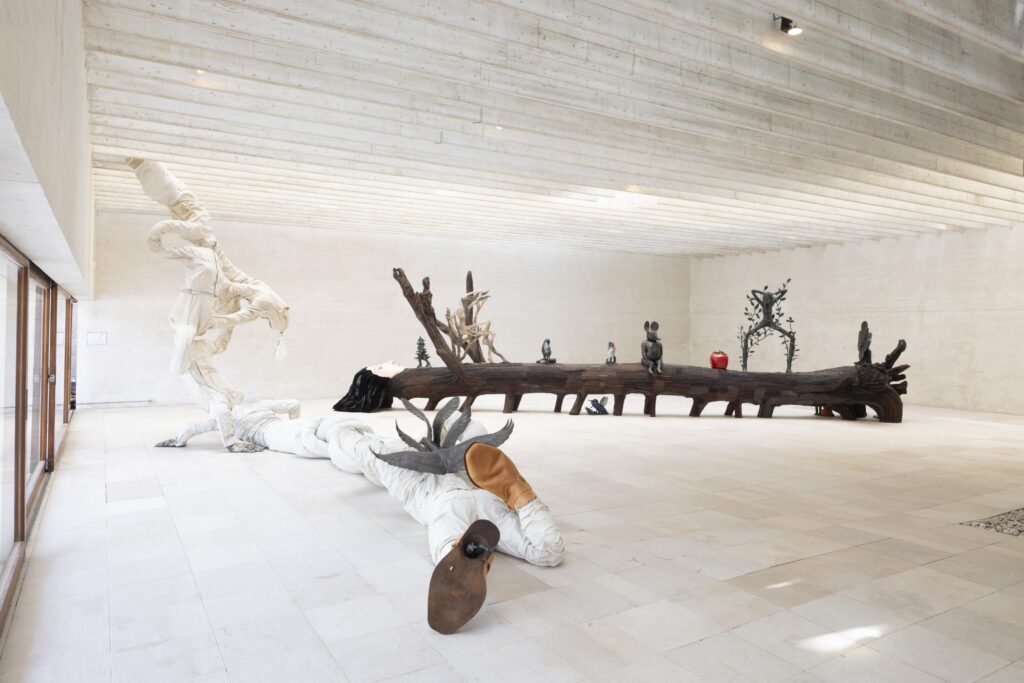
Twelve metres of tree trunk, covered in hand-dyed Swedish carpets, lying on the floor of Sverre Fehn’s Nordic Pavilion like a giant. On and around it, eleven ceramic figures: a fat mouse, an apple child, a warrior woman breaking free of leaves. For Swedish artist Klara Kristalova, the invitation to represent the Nordic Pavilion at the 61st Venice Biennale was so unexpected that it stopped her working for months. Commissioned by the Museum of Contemporary Art Kiasma in Helsinki, the body of work is the most ambitious work of Kristalova’s career, hovering somewhere between desperation and dark comedy.
Natalia Muntean: Congratulations on this achievement!
Klara Kristalova: Thank you! I was chosen by Finland, the country in charge of the Nordic Pavilion this year, and it was a big surprise. This was the last thing I expected. For me, it’s huge.
NM: Why was it the last thing you expected?
KK: I’m not the type of artist they would typically invite nowadays. I wouldn’t say I’m old-fashioned, but I work with sculpture, and my work isn’t conceptual in a developed sense. I have ideas around it, but it’s not a built concept. I think that kind of work is what gets invited more these days. So it came as a shock, and I couldn’t work for several months. I was completely stuck, thinking: This is too big for me.
NM: How do you feel the three works sit together: yours, Benjamin Orlow’s and Tori Wrånes’s?
KK: I think our three works function really well together. In certain details and ways of thinking, they overlap, but at the same time, they are completely different. The Nordic Pavilion looks monumental and sculptural but also very much like a fairy tale. Tori works with mythology and figures, Benjamin as well, but in a totally different way. There’s a loose shared language, but each of us uses it differently.
NM: I read that you used to go to the Venice Biennale with your father. How does it feel to now be representing the Nordic countries here?
KK: It’s completely surreal. From a very young age, coming here with my father was an enormous thing – to see the art that mattered in the world. I’ve continued coming as an adult, many times. You just work on your work and don’t expect to be included in something like this, because for me, it has always felt almost mythical. For me, it’s very dreamy to be here.
NM: Was this a dream come true?
KK: I never dared to dream it, it was too abstract that I would ever be invited. So it’s not a dream come true exactly. But when I got the call, I thought: Well, I can retire now. Of course I won’t. I don’t think an artist really retires. You just continue, maybe in a different way. If I take even a week off, I feel completely lost. The work is a way of straightening things out, not consciously; I don’t write plans or intentions, but it helps clarify the mind.
NM: Do you have any rituals when you work?
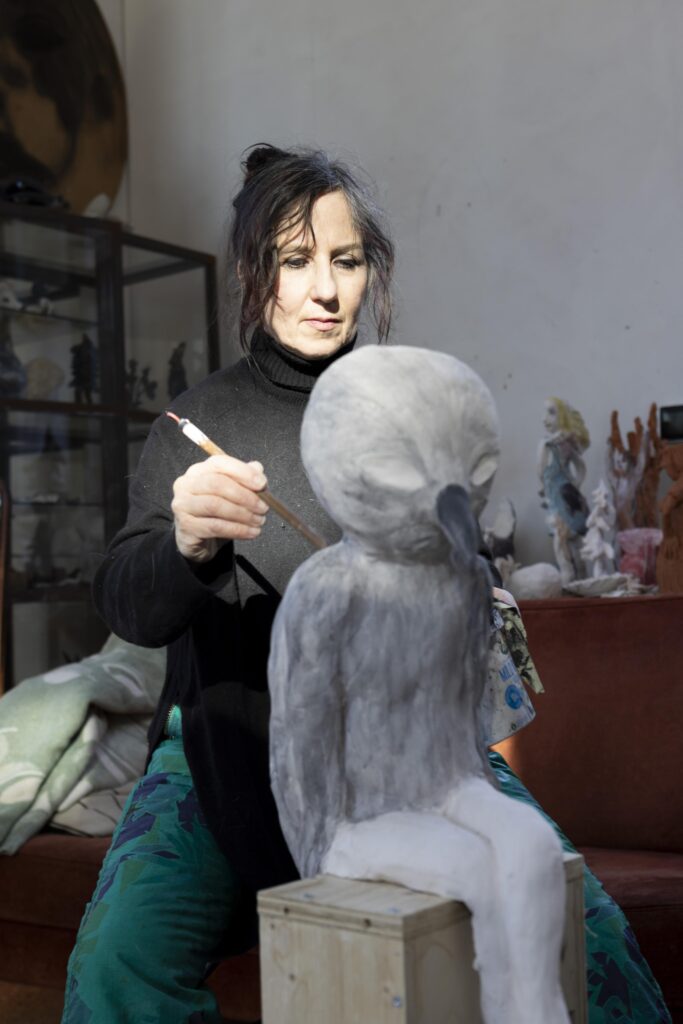
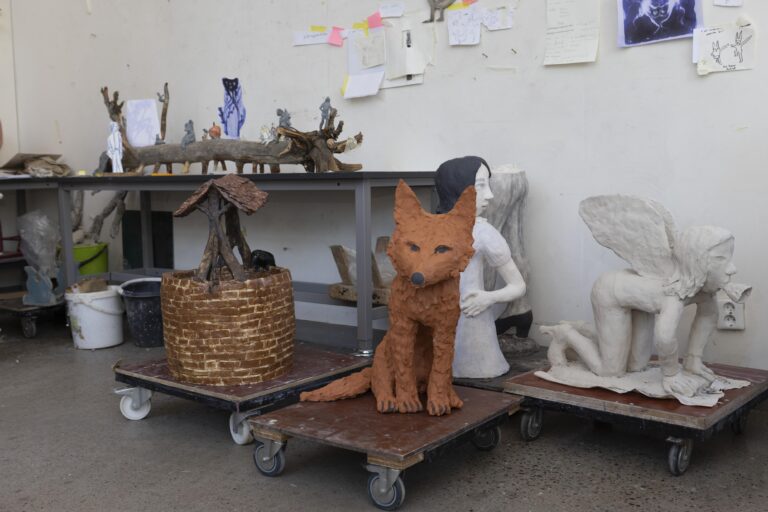
KK: Not really. I wake up, walk my dogs, and start. I prefer to have several things going at the same time in one day, several sculptures in progress, which also suits the material, because with clay, you can’t work too long before it needs to dry. So I do a little here, a little there, then maybe some drawings or planning for something else. I like the variety.
NM: Do your sculptures talk to you while you’re making them?
KK: Yes. They change a lot while I’m working. I always start with sketches – a plan, a sense of what I want. When I’m preparing for a specific place, I think about the space and let my mind make associations, then I weave that together with where I am in my life. But once I start building, it shifts, because the work develops its own voice. It’s in the material, but it also changes in my mind as my hands work. I can’t think everything out in advance and then just execute it. The hand does something to the thinking. It’s a give-and-take.

NM: What did the ones for the Biennale say?
KK: They all dwell on this woman lying down, the whole world on her, and also the mother, and you don’t know if she’s fading or coming back. There’s a flat, see-through relief made of wood that’s almost like smoke, a spirit emanating from her. There’s a very fat mouse that weighs her down; he’s the male character, a dominant, guardian figure, but you don’t know if he’s a friend or a threat. He comes from a cuddly toy I had as a child. Then there’s an apple figure – taken from an older work where my mother was a deer, my father a tree, and I was the apple child. Here, only the apple child remains. It’s curious and mischievous, and partly it’s there for compositional reasons; the work is mainly brown and black, and the deep red apple is a colour note. Then there’s a large bronze warrior woman, trapped in leaves but breaking free. She has real power. I specifically wanted something raw and angry in this, not a group of cute figures.
NM: Can you describe the body of work you’re showing?
KK: The main piece is a very large tree trunk, twelve metres long, that is also a woman. She has a face, hair, and stands on branches like an animal on many legs, with a root at the other end. The whole structure is covered in Swedish woven carpets that I bought a lot of second-hand and dyed them all a deep brown, a very similar tone across all of them. That was the best way I could find to express tree bark. I had never done that before, so it was an experiment, but it worked well. When you get close, the material is beautiful, the stripes still come through, and the colour shifts. Then on this structure live about eleven or twelve smaller sculptures, and three more stand on the floor beside her. She’s a kind of mother figure, or a desperate one – cut down, not knowing if she can come back. It has to do with my thoughts about ecological ignorance, but in a very oblique way. And she’s also an ageing woman, like myself, in some kind of act of desperation, not without humour though. It’s not entirely pathetic.
NM: Your individual work is titled Lust for Life. How did that come about?
KK: I like titles that are a little ironic but carry real energy, titles that refer to songs, because there’s something alive in that. Lust for Life has all of it: the fear, the anger, and at the same time, this very powerful will to be here. The dark parts and the love and the wildness all at once. That felt right for this body of work.
NM: One of your figures, the warrior woman, you described as rawer and uglier than your usual ceramic work. What drove that shift?
KK: I wanted to make it in its original raw form from the beginning, but I couldn’t do that in ceramics. In ceramics, things tend to become a little more decorative than I intend. The material is beautiful; it softens things. In bronze, I could finally make her as raw as I wanted. I wanted something angry and powerful in this room, not a funny group of cute figures. The world right now, I think, we need that energy. I wanted to show that you can break free from it somehow.
NM: Do we need anger for things to change?
KK: Yes, I think so.
NM: What did you leave behind, and why?
KK: There was a small white dog I’ve used many times – it’s one of the oldest sculptures in my studio, based on my first dog. I wanted to include it, but in the end, it wasn’t needed. And then there was a sculpture from when my children were small – it was me with three little heads growing out of my own head, one for each child. I love that piece; the glaze is very runny. But when I placed it on the tree, it felt like it belonged to another period of my life. I sometimes think I never change as an artist, but looking at that work here, I thought: no, I’m somewhere else now. So I packed it away. Maybe that was the real lesson of this process – that I’ve finally shifted a little.
NM: The work couldn’t be fully assembled until you arrived in Venice, so were you working blind in a sense?
KK: Yes. The tree trunk was built in one location while the sculptures were made separately, and the bronze pieces were too heavy to move once cast. We couldn’t see everything together until we got here. My brother, who is also an artist, and my husband, who is my assistant, worked on the tree while I worked on the figures. It was very nerve-wracking. I normally see my work before I send it anywhere. I had a long experience to trust, but the doubt was very strong anyway. I think I need that doubt. If I felt safe, I might just produce and produce, and it wouldn’t be the same.
NM: How did the collaboration with Orlow and Wrånes shape what you made?
KK: At the first meeting, Benjamin and Tori already knew what they wanted to do and where. Tori’s work goes through the wall and out. Benjamin wanted the space behind the trees. I was still completely stuck. I had several ideas and couldn’t decide. So I didn’t fight over placement. Then I landed on the tree, and once I did, I thought a lot about the room. Sverre Fehn’s pavilion is a very difficult space – so beautiful and aesthetic that it almost doesn’t need anything in it. The light changes completely from morning to evening. It’s like an artwork itself. I decided I needed to make something large, because the scale of their works was so massive that anything small would disappear. And this time, the stage, the scenario I usually build as a backdrop for my sculptures, also became a sculpture. The whole home for the figures became one of the figures. I took more risks than I usually do, which was good for me. It felt like liberation, actually. I could do anything.
NM: How did the Kalevala enter your process, as source material, or more as atmosphere?
KK: Atmosphere. I’ve tried to read the Kalevala several times, even as a comic book, and it never really gripped me. But I like the atmosphere, the failures and the doubt in it – that speaks to me, because I’m always afraid of failing. And the trees, the nature, the sense that something could be living in the water. I live in the woods normally, I look at leaves and seasons and the depth of the lake. Kalevala felt natural in that sense. But I couldn’t really decode it, so I referred to it only vaguely.
NM: What was the lesson, if there was one, in making this body of work?
KK: That I can do more than I thought. I stretched. I really needed to do that now, and I feel that I did. That’s a very good feeling.
NM: When visitors leave the Nordic Pavilion, what do you want to still be with them an hour later?
KK: I want them to feel the power of it and also the humour, both at once. The works are monumental and serious, but they have a twist of playfulness. I want that double feeling: it’s powerful and frightening and also funny. Like life is right now. The world is threatening, you’re shocked every day, and at the same time, there’s hope and lust and laughter. Our pavilion holds all of that. I think that’s what it should be.