Author name: Natalia Muntean

Art

Gavin Gleeson’s Partial Parade Offers a Playful Pause

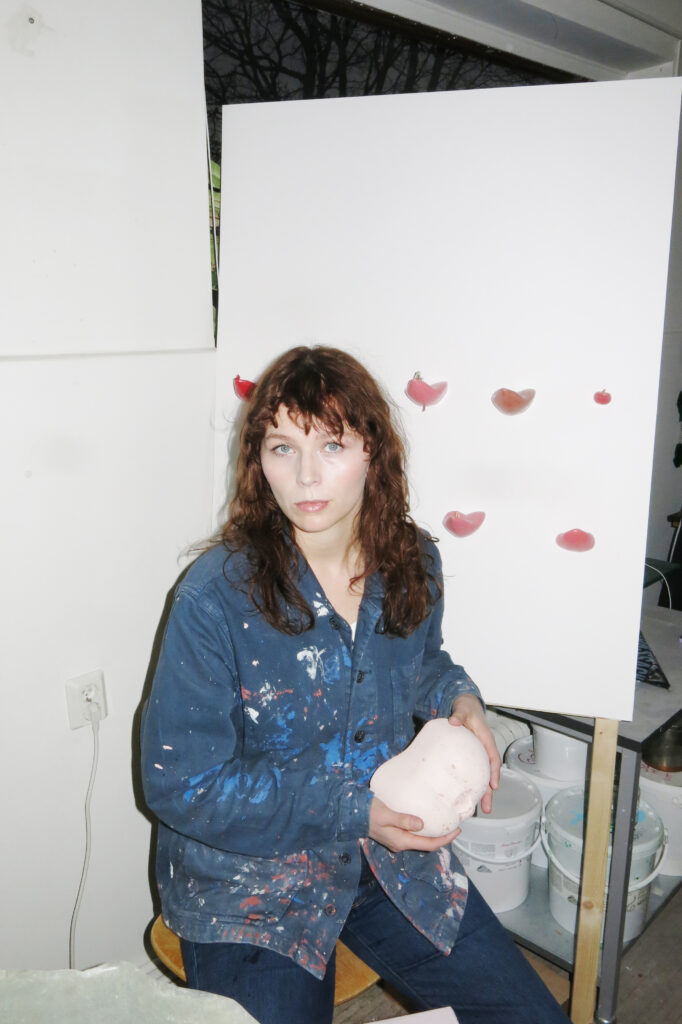
Gavin Gleeson’s Partial Parade Offers a Playful Pause text Natalia Muntean “Too far Jacob” Gavin Gleeson found painting at twenty-seven. Or perhaps, painting found him. “I was in Paris, working a remote job, and I had taken a few drawing classes, but I just decided to pick up some paint for the first time and did a little watercolour. That was really the first time I painted,” he says. Born to Irish parents and raised in Kentucky, Gleeson grew up between worlds. “Growing up as a first-generation Irish American definitely gave me a sense of feeling a little bit abnormal,” he says. What began as a peek into painting became a path of its own, leading him away from business and into an intuitive studio practice where, he explains, “I like coming into the studio as if it’s an improvisation session.”  He never imagined it would carry him as far as a master’s degree at the Royal College of Art. Now presenting his first solo exhibition, Partial Parade, at Saskia Neuman Gallery in Stockholm, Gleeson translates how he experiences the world into canvases, inviting the viewer to join him in a “playful pause.”  Muntean Natalia: You picked up a brush at 27, and at 30, you have your first exhibition?Gavin Gleeson: I’m pinching myself, definitely! Growing up, my next-door neighbour was a lawyer by day but painted in his spare time. I would see him paint or make sculptures, so I was aware of it, but I didn’t think anybody painted full-time.  NM: But was there something that made you pick up the brush?GG: Honestly, boredom. I wouldn’t start work until the afternoon and just wanted something to do, so I signed up for a class. Later, back in Ireland, I reached out to a second cousin who’s a painter. He told me what to buy, a few basic colours, and I started painting in my Nana’s garage, using old bottles and family photos as references.Eventually, I found a one-year course at the Burren College of Art, a tiny village on Ireland’s West Coast. When 250 Ukrainian refugees moved in during the war, the population doubled overnight. I would drive past the playground, the kids playing, the women smoking, against this bleak, windy landscape. That contrast between playfulness and heaviness really stuck with me. There was also a Ukrainian artist at the school, in his seventies. We would talk through Google Translate. His work filled whole walls – huge pieces. Even without understanding the words, I could feel the weight of them. It taught me that emotion can be grasped through marks and strokes alone. Portrait by Pelle Nisbel Fjäll NM: Let’s talk about your show, Partial Parade – what does this moment mean for you? And how did you land on that title?GG: It’s very exciting because I waited so long to get started. The show came together at a good time because it can be tough when you’re coming out of your master’s degree, a bit aimless, and you’re just making work to have a portfolio and get by. When it comes to the title, it came from its dual meaning – partial as in incomplete, and partial as in biased. It felt cheeky. Is it a parade or a protest? I like that ambiguity. Humour is a big part of my Irish culture. It’s an invitation to improvise, to question. I ask myself, where am I being partial? Coming from business, from a place of privilege, there are a lot of questions we’re all facing. NM: And does painting give you the answers?GG: Maybe just better questions. A place of refuge and questioning. I think art’s inherently political. I think it’s a really important time for art and painting. For me, it’s a reflection of what’s going on. I feel proud to be a painter right now. I very much feel like a member of a choir more than someone trying to prove a point. And I think that’s really important to me: one of many. NM: Do you have a routine? Is it like a nine-to-five for you?GG: I wish. That’s the goal. It’s a balancing act in London. Initially, it was part-time jobs, jumping in the studio when I could. Now I work full-time and come in on weekends or an evening. I have the attention span of a puppy in the studio, which is good and bad. But with that excitement of, “Oh my god, there’s so much to paint,” it feels like I could keep going, which is a nice feeling. I’m quite a prolific painter. When I go to the studio, I get my painting clothes on and listen to music very loudly. There’s a getting stoked aspect, like getting psyched up for a game. It becomes like a spiritual practice, searching for truth from the unknown. My mantra is “trust the hands.” They’ll lead you where you need to go. “Timorous Machination” “Red Rover” NM: What role does playfulness have in your process?GG: Coming into the art world, I found it overwhelming with all the rules. Then you see a kid with a sketchpad just doing their own thing. My cousin, for example, has autism and is an amazing artist with no agenda. We had this moment of communication through art when we drew one of his cartoon characters. That was right before art school, and that started from play, as so many ideas do. Things get legs on their own.  NM: Who or what influences you the most?GG: Music. My brother’s a musician, my dad works in music now, and my best friend back home is one too. When we were younger, he’d be looping tracks in one room while I drew in another; we would feed off each other’s energy. That rhythm and spontaneity are what I try to capture when I paint. Growing up in Kentucky also shaped me. There’s a strong punk and DIY culture there – that “just make it” attitude. It taught me not to wait

Art

Alexandra Karpilovski Is Knocking at Her Door 

Alexandra Karpilovski is knocking at her door text Natalia Muntean Photo by Elvira Glänte “It’s about looking for yourself, trying to find your place,” says Swedish artist Alexandra Karpilovski. I met her amid the creative chaos of building her show’s universe, Howling to My Window and Knocking at My Door. My initial impression of chaos gave way to certainty: she knew exactly what she wanted to do. “I make a plan during the process, but it usually comes quite late,” Karpilovski tells me. Her process rests on intuition – a belief that each impulse carries its own reason. “I have things I want to make, and then maybe something else along the way evolves into something different. It’s very intuition-based and from my own heart.”  The title itself sounds like an instinct, something raw, almost animalistic. It began, she explains, with a painting she made years ago, Howling to My Window, that she never showed. After a period when life was intense and took another turn, she added Knocking at my door. Karpilovski keeps a mental archive of words and fragments until they find a place in her art. “The part I added really spoke to me because it’s like I’m knocking at my own door,” she says.  The show’s DNA grows from her paintings, words, painted lamps, and fabrics, but equally from the small objects she’s gathered across her life: pieces from her grandparents’ estate, her travels, or secondhand shops. When she began preparing for this show, life had unmoored her, and she didn’t quite know how to begin again. Her way back into work was simple, almost ritualistic. “My daily thing was just walking,” she says. “I would go to a thrift store and just find things I feel a small connection to, even without knowing why. But then they somehow fall into place.”  Tenderness runs through Karpilovski’s process – in the way she collects and arranges, giving space to what might be overlooked. In a poignant contrast to the visceral title, the act of choosing becomes a quiet conversation between what remains and what’s been lost.  “They may seem silly, but then they become special. They accompany the works for me. They bring a physical, human touch because somebody had them before.” For Alexandra, exhibiting her work is about finding connection: “I think this is what we all want.” The works, she notes, represent different emotional states, her brushstrokes navigating the space where humour and gravity meet. “I take things from myself, but I think there are a lot of universal things that people can connect to.”  The exhibition is on view October 10–19, 2025, at Doubble Space, a venue housed in a former gasworks with raw concrete walls and dramatic light, a setting both industrial and ghostly. “You have to embrace it as it is,” Alexandra says. She saw the space as a psychological ‘alley,’ a journey that starts airy and moves toward the heavier emotions, creating a sense of flow where visitors wander through different states of mind. The works, she explains, act “like windows, looking into people’s different situations.” To complete the experience, a forty-five-minute sound composition threads through the exhibition, made with her friend Danilo Colonna for their music project, Private Parts. “I wanted to create a gathering place, a moment of joy,” she says.  Born in 1988 in Kyiv, Karpilovski says she doesn’t remember drawing much as a child, but recalls a defining moment at seventeen when she saw Marie-Louise Ekman’s Hello, Baby, a work that sparked something in her. She later studied at the Gerrit Rietveld Academie in Amsterdam and spent several years abroad. Now, returning to Stockholm feels like a homecoming after years of movement.  Alexandra’s wish for those who see Howling to My Window and Knocking at My Door is simple: “I hope they leave with a sense of openness – to feel more, relax and loosen up. And maybe they might go on their own journey within themselves.” Recreating spaces, stages and scenes.  Through shifting states, we walk this way, where lines will blur and drift away.
Where in meets out, and ends begin, where dreams and choices lie within. There’s clarity, a trace of might, 
Long sleepless hours before the light. 
We watch, we walk, we let things go, we dare, we reach, we let it show Alone is where we once were two 
Just for a moment — something true. Alexandra Karpilovski

Art

The Art of Resistance: A Conversation with Carouschka Streijffert

The Art of Resistance: A Conversation with Carouschka Streijffert For over five decades, artist Carouschka Streijffert has made her mark within the Swedish art scene, working at the intersection of sculpture, architecture and scenography. In a world saturated with the new and the digital, Streijffert’s practice is a testament to the poetry of the discarded. She does not simply reuse materials; she listens to their history, taming cast-off fragments of metal, wood, and paper into objects, giving them new meaning. As Drivkraftens seger över motståndet (The Victory of Urge over Resistance) opens at RAVINEN Kulturhus, we talked to an artist for whom creation is a vital, almost philosophical act. The exhibition is titled “The Victory of Urge over Resistance.” What does “resistance” mean to you in your creative process? Is it a physical property of the materials, a mental state, or both?It is in the psychological resistance that creativity arises. It is in the friction, in the complexity, that the work grows, takes shape, is born, and comes into being. To eliminate resistance is to embrace laziness, and then the result becomes polite and empty. To create is presence – a driving force that shows direction. You are alive. You exist. For over five decades, your work has centred on reclaimed and found objects. What is the “call” you feel from a discarded piece of metal, wood, or paper? What makes you know an object has a place in your art?The world is flooded with used-up material, and it’s hard to ignore. I choose to see the possibilities in the discarded, details of beauty, regardless of the material’s properties. My aesthetic brings together the fragments, a dialogue between the hand and the gaze. The feeling of holding and weighing the discarded in my hands, of not wasting matter already charged with obscure experiences. I tame and shape the cast-off into an existence in the present. A collage. A sculptural object. The passion reflects my feelings, experiences, and memories. Portrait taken by Thoron Ullberg Your practice spans art, architecture, and scenography. How does your thinking about space and environment influence the individual objects you create, and vice versa?I create for the person who inhabits the spatial environment. It’s about proportions, the individual in the space. What is the room going to be used for? Here, function is the guiding factor. The financial framework, the size of the surfaces, and the amount of light entering. Is it a permanent room? A temporary room? A scenographic design has the task of framing or enhancing a drama. Scenography is meant to help the actor in the performance and give the viewer, the audience, a visual enhancement. Here, there are no boundaries. Architecture is a form of mathematics, logical analysis. The building, its function, reflects the volume of the rooms and how they interact with each other. The façade and the interior are in dialogue. The visual and functional expression of the materials should strengthen the human presence in the architectural space. Your work is described as both “raw” and “precise.” How do you balance intuitive, raw expression with the technical skill and precision of a craftsperson?A determined skill of interaction between my hands and a sharp eye. The visual must constantly speak to me. Analogue work has been performed by humanity since our beginnings. That talent must not be destroyed or erased. Intuition and skill arise and are maintained through constant practice, and then the difficult becomes a certainty of precision. The simple, bare, and obvious can be interpreted as rawness. Something that is not hidden or disguised by external cosmetics is automatically natural beauty, a form of truth that speaks to us. Much of your work feels like a preservation of memory and history. Do you see yourself as an archivist of sorts, giving a new life to the fragments of our time?Humour and playfulness are constantly connected to the seriousness of my artistry. Valuation and selection are continuously applied in my search for why and how to transform the urban waste into a new existence. This pursuit and stewardship are similar to an archivist’s logical sorting of the past. I house my finds in self-built archives, with a structure based on the qualities, colours, and properties of the materials. It is in these collections that I can repeatedly pick and replenish from the treasure trove of lost and found objects, year after year. The creation is endless. It becomes my own decay that will eventually bring a brutal end to the creativity of documentation. In an age of mass production and digital saturation, why do you believe your analogue, hands-on approach feels so relevant and urgent to contemporary audiences?The movements of the hand, the tempo, create reflection, not nostalgia, but trust. Craftsmanship requires time, a tactile substance. Not like our world’s clicking in front of glaring screens, where we are bombarded and slip off the rapid-fire impressions we rarely can avoid. This makes us blind and deaf to actual reality. Mass production and endless online shopping of unnecessary products will deteriorate our mental health and the Earth’s resources. Thousands of massive cargo ships float daily in our oceans, filled to the brim with newly manufactured “trash.” Why? Humanity has forgotten that the hand is our best tool. Working analogue today is not a retreat but a direction forward.

Art

 Jenny Kaiser wants to bring back the punk at Fotografiska 

Jenny Kaiser wants to bring back the punk at Fotografiska Text by Natalia Muntean “People have never been more alone than we are today. That’s a huge strain on society,” says Jenny Kaiser, newly appointed Director of Fotografiska Museum in Stockholm. Kaiser didn’t come from the art world. She came from advertising, from one of Sweden’s largest agencies, and she arrived at Fotografiska with a clear-eyed diagnosis: that in an era of endless images, the experience of actually standing in front of one has never mattered more. Located on the edge of Södermalm, on the shore of the Baltic Sea, Fotografiska has just celebrated its 16th year. Kaiser is now steering it into the next chapter with a mandate to sharpen, provoke and, in her own words, get the punk back. Natalia Muntean: In these seven months, what was one achievement you’re proud of or that surprised you in how things turned out?Jenny Kaiser: One thing I’m very proud of, and that was also a key reason I came here, was getting the team aligned on a joint direction for the future. We’ve actually just celebrated our 16th birthday. One of the tasks I was given was to define what Fotografiska will become in the next 15 years. What was quite evident to me was that we have a fantastic base to build from, from a branding perspective, a destination perspective, and a photography perspective, but we lacked a clear direction. Where are we heading? Why? Who are we here for? What kind of experience do we want to offer? That’s something we’ve worked on together, not just in the management team but across the entire organisation. We’ve only just gotten started, but I’m proud that we’re already here, because a lot has been happening in terms of getting to know the company, the brand, the culture, the people, the business, the guests, the art, the exhibitions and the artists. Photos by Saskia Clarke NM: You come from the advertising world, so you have a bit of an outsider perspective. What has that allowed you to see when it comes to leading Fotografiska? JK: Having worked as a consultant for many years, I was trained to ask questions before giving answers. I’m very curious about what’s working, what isn’t, what we’ve done before, what we’ve learned, and what happens if we approach things differently. Not coming from the art world, but from business, leadership, and the creative sector, gives me a clear path in what I see and acknowledge. I also believe in organisations that dare to bring in new people who break convention, because that’s crucial for any industry today. Everything moves so quickly, and with that, you need to adapt, while also protecting what’s really the strength of your business, your model, and your brand. NM: It sounds like a tricky task – progressing while maintaining the core and the essence. You don’t come from the art world and now you work with a museum. Is that ever intimidating?JK: Not intimidating. I have huge respect for those who work with exhibitions, both strategically and from a curatorial knowledge perspective; that’s their real expertise. But running a museum goes beyond that. We’re not just a museum; we’re a destination where photography, art, and culture come together. I’m also, in some ways, a member of the general audience. I don’t know as much as our curators and experts about art of course, but I really love and appreciate art. I think culture and art are really important for people, especially now, when we need to come together, reflect, get inspired, have conversations, and meet each other in person. That’s what matters when it comes to what we offer through exhibitions, but we are much more than a museum, and we need to secure that going forward. NM: You mentioned the next 15 years. What do you have in mind, and what would success look like? JK: Success goes way beyond growing in the number of guests. It’s about humanity and emotions. It’s about being a place where people come together: companies, individuals, cultures, opinions. It’s important that we continue to be a force in Stockholm’s cultural life, and that the city acknowledges what culture adds to the broader perspective of Stockholm. Culture has always been important here, but it becomes even more important now, in the context of transformation. Another aspect: sometimes a museum is perceived as being in contradiction with having a financially healthy business and I don’t think that’s a contradiction at all. You need financial stability to be able to progress and continue to invest in what you’re doing. That’s also something we need to secure going forward. Fotografiska has always been a societal brand that hasn’t been afraid of going into subjects that are sensitive or that raise big questions. That’s a force we need to continue to be, not for its own sake, but because that’s the role of art, storytelling, and creativity: to share a perspective, a view of the world today, what we see in the future, what’s happening in a contemporary context. When we use art and culture to nurture those conversations, the world becomes a better place. What Fotografiska does, and will continue to do, is bring different perspectives under one roof. Regardless of why you’re here, you might visit the restaurant and unexpectedly experience an exhibition you never would have sought out, or come for one exhibition and be surprised by another. That’s what it’s all about: perspective, storytelling, different viewpoints coming together. Inclusiveness is essential. NM: We’re living in an era of extreme image saturation. What does that mean for a place like Fotografiska? JK: We’re almost fed up with images. If you go into social media and all the different digital spaces, I think it’s made us numb. The role we play, which is so important, is the emotional part. A small image of Martin Parr on a mobile phone for half a second in a tiny

Art

What the Mind Protects: Elin Fiorentino on DIAGNOSIS and What Comes Next

What the Mind Protects: Elin Fiorentino on DIAGNOSIS and What Comes Next Text by Natalia Muntean “I want people to leave with less shame and more compassion, both for themselves and for others,” says Stockholm-based artist Elin Fiorentino about her debut solo show, DIAGNOSIS. Eight video works, each one a different trauma response: dissociation, flashback, altered perception, were built from saturated colour and glitching texture into a space designed to materialise the ways of  an altered mind. For Fiorentino these trauma responses are not pathologies, but more of an evidence of the mind’s own intelligence at work. Natalia Muntean: DIAGNOSIS mapped eight distinct trauma responses: intrusion, dissociation, flashback, altered perception. How did you decide which symptoms to portray, and was there one that proved the most difficult to translate?Elin Fiorentino: It was less of a conscious decision, more of an observation of what felt most present and persistent to me at the time. But the most difficult piece to translate was ‘Perceive Or Receive’. Unlike something more tangible, such as flashbacks or intrusive thoughts, altered perception or depersonalization affects the way reality itself is perceived as well as how you see yourself. I wanted to communicate that unsettling feeling of existing in a familiar world that suddenly feels foreign. Finding a visual language for something so internal and abstract was very challenging. NM: You describe the mind’s symptoms and trauma responses as forms of intelligence rather than failures. Where did that understanding come from, and how does it shape what you want a viewer to take away from your work?EF: It comes from being an observer of my own mind and experiences. During the period that inspired DIAGNOSIS, it became clear that I wasn’t consciously choosing these reactions. I could intellectually understand that I was safe, while my body and mind would respond as if I wasn’t. Even though it was very difficult to navigate at the time, I was able to observe my trauma responses and see them as adaptations designed by the brain to protect me. Which, to me, translates to something fundamentally human, a form of survival intelligence, rather than something broken. Seeing the symptoms this way allowed me to study what was happening rather than being consumed by it. Instead of asking, ‘What’s wrong with me?’ I wanted to focus on understanding what my mind was doing. That shift in perspective became an important part of both my healing process and the development of the work itself. This perspective is also what I hope viewers take away from DIAGNOSIS. I want people to leave with less shame and more compassion, both for themselves and for others. I believe understanding trauma responses and identifying when they occur in yourself or in others is an important step towards creating a safer world. NM: Your visual language is very specific: bichromatic saturation, pixel aesthetics, organic abstraction colliding with pop references. Was that a deliberate construction, or did it show up intuitively?EF: My visual language mainly unfolded over time intuitively. There are aspects of how I express myself creatively that tie back to the first paintings I ever made, which is something I can´t really explain. But I think it also took form through experimentation and allowing myself to explore different tools and techniques that interest me.   I think finding your voice in any art form really comes down to repeatedly doing, trying, failing and obsessing over it. I´m not one of those people who like to know exactly where I’m going before I start. I love it when there is an aspect of exploration into the unknown. With that said, I think personal taste inevitably shapes the direction of the work too. I tend to be drawn to visuals that feel nostalgic, surreal or emotionally resonant. I love abstract and fractal geometry, high contrasts, bright colours, particles and find a lot of inspiration through cinema. Each of these elements resonates with me for different reasons, and over time, they have naturally become part of my visual language and the world I want to exist in. NM: You perform live as a VJ as well as making exhibition work. How do those two sides of your practice relate to each other?EF: I always aim to create an emotional experience and communicate something internal, whether it’s in the form of an installation or a live performance. But despite the intention being the same, they do also feel like parallel forms of expression to some extent. My exhibition pieces function more like moving paintings or worlds to step into. I spend more time in the creative process and have more freedom in expression and combining different disciplines. When vj-ing, the work emerges through a dialogue between myself, the music, and the surrounding environment. Performing live taught me to let go of perfectionism and to trust intuition. In a live setting, there is no time to refine or second-guess decisions. You’re constantly responding to the music and atmosphere, anticipating movement, and trusting your instincts.  Photo by Elis Lindsten The experience changed the way I approach video art altogether. I tend to tap into this approach when I work with installation, too. Focusing less on how something should look and more on how it makes you feel and what it communicates. There is something magical about letting go of control and just allowing yourself to express. It’s in those moments of freedom where you create with the most honesty.  NM: DIAGNOSIS was your first solo exhibition. What did making it clarify about where your practice is heading?EF: I always had a vision of creating space for reflection, conversations and bringing people together. It was one of the things that felt the most important to me with this exhibition. Making the room itself become part of the conversation. Which it did, and I feel very grateful for that. It became clear to me that it is possible and important to follow the ideas you hold, especially if they appear impossible. Always find a way to

Art

Making Room for Play: Design through the eyes of childhood

Making Room for Play: Design through the eyes of childhood Text by Astrid Birnbaum Puzzle Shelf by Gustaf Westman Box Stool by Max Lamb INNER CHILD: Playing with Design is the title of Artipelag’s major autumn exhibition. Curated by trend forecaster and design curator Lidewij Edelkoort and curator, art historian, and trend analyst Philip Fimmano, the show brings together more than 100 designers from around the globe. Longtime collaborators, the two have worked together on a number of international exhibitions exploring design and material culture. Structured across eight thematic sections, the presentation explores play, making, and curiosity through furniture, textiles, objects, and installations. “Through works by established designers and new creators, this exhibition offers an uplifting sense of hope,” say curators Edelkoort and Fimmano. The exhibition design has been developed by Dutch designers Kiki van Eijk and Joost van Bleiswijk together with their two children. The family collaboration echoes the subject of the show, not only in the works on view, but in the way it has been conceived. Among the participants are Maarten Baas, Yinka Ilori, Max Lamb, Gustaf Westman, Victoria Yakusha, Pierre Yovanovitch, and numerous other designers and makers. “The exhibition is an international investigation into design and fantasy as a creative force in our challenging times,” says Dragana Kusoffsky Maksimović, Artipelag’s newly appointed museum director. INNER CHILD: Playing with Design opens at Artipelag on October 10, 2026, and remains on view through April 11, 2027.

Scroll to Top