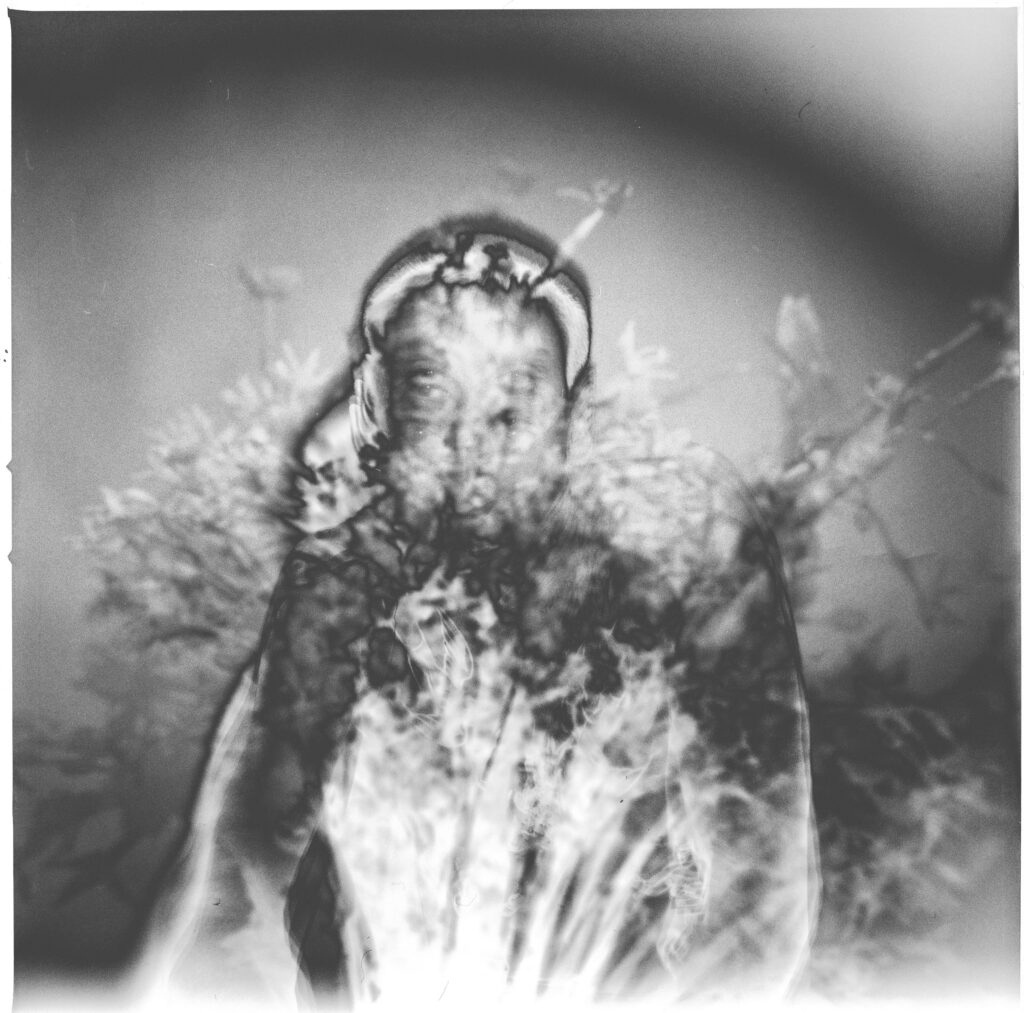
Sheree Hovsepian is (still) becoming text Natalia Muntean photography Saskia Clarke “I never considered myself a photographer,” Sheree Hovsepian tells me. The camera is just one of the tools. Photographs, hand-shaped ceramics, string, bronze, she brings them together until they become something they weren’t on their own. Becoming is Hovsepian’s first exhibition at Carling Dalenson Gallery in Stockholm, and its title names what her practice has always been about: not arrival, but the ongoing act of taking shape. Natalia Muntean: The exhibition is called Becoming. Can you tell me a bit more about that choice and how it reflects the body of work you’re presenting? Sheree Hovsepian: It’s from a quote by Simone de Beauvoir. “One is not born, but rather becomes a woman.” That act of transition, of being in flux, of growing into something else, felt very pertinent to my work. Because of the nature of assemblage, a few things put together that become something else, and because the core of the work is very feminine, I thought it really resonated with these pieces, with the collages in particular. NM: Did you make new work for this exhibition, or was there a selection process?SH: All of the collages are unique, even though I reuse photographs at times. Because I’m making all of the ceramic shapes by hand, everything is different; they’re all one-of-a-kind pieces. This is from a body of work I’ve been developing for a few years. Similar work was included in the Venice Biennale four years ago. So it’s an ongoing series.The sculptures are relatively new. The first editions were made for a show I had in New York this past May. They look great in this gallery, and I’m so glad we paired them with the collages. NM: Can you tell me a little about your process? What does a day in your studio look like? Do you go in with a plan, or do you allow yourself just to explore?SH: Lately, I’ve been fortunate enough to be working towards shows. When I’m working on the collages, I make the different pieces separately. I use my sister as a model. When she comes to visit, I’ll shoot her in the studio and make many images of her. Then I’ll choose which ones to print and make many prints from those. With the ceramics, it’s similar. I’ll make a lot of them, bring them to the studio, and then I have my string and other materials there too. When it’s time to put everything together, it’s really about play. Very hands-on, moving things around, changing them, seeing what this looks like next to that. It’s actually quite antithetical to photography in a way, but I really love this additive process of bringing things together. For me, making the collages is a bit like the idea of an exquisite corpse: building a body, assembling a figure out of disparate parts. NM: How did you arrive at this place in your practice, working across string, photography, ceramics and sculpture?SH: I studied photography in college and grad school; that was my focus. But I never really considered myself a photographer in the traditional sense, someone who goes out into the world and takes pictures, which feels like a very subtractive process. My sensibility has always been more additive, more akin to painting or sculpture, because it’s about building something. Photography just became one of the tools I use. With ceramics, I was drawn to it because I love working with my hands, and I love the idea of making something that carries a residue, a residual effect of having been touched. There are also some interesting parallels between ceramics and photography: both can take an impression, both go through a chemical process, and both carry a threat of failure. You don’t know what you’re going to get. I’m talking about analogue photography, which is what I use for this work. I use silver gelatin paper specifically: the weight of it, the depth, the tonal range, the drama. I love the theatrical nature of it, the romance of photographing my sister in the studio, this kind of intimate dialogue between us that feels like a dance, a choreographed sequence. NM: Why your sister specifically? You’re both the observer and the observed, in a way.SH: When you’re working with a body, so many questions come into play: whose body is it, where did you find this body, what colour is it, what’s the gender? But when you’re talking about yourself, all of that falls away. You can just focus on the self, on your own subjectivity. These works are really about how I interpret life. So it makes sense to think of them as a kind of self-portrait. I use my sister because she’s physically very similar to me. It allows me to be behind the camera and in front of it at the same time. It’s also a mediated process. It’s easier to look at her in the negatives than it would be to look at myself, which I’ve tried and rejected. You’re more critical of yourself. Using her gives me a little more freedom. And I always joke that it’s the only time she actually listens to me, when I’m directing her in front of the camera. It becomes a very special time between us. NM: You moved from Iran to the Midwest when you were very young. How has that shaped your work and the subjects you return to?SH: I think very much, though not directly, more indirectly. Being someone in the diaspora made me very aware of my own physical presence, my physicality, the way I move through space. I grew up in the Midwest, where I lived was very homogenous, very white. There weren’t many people of colour around me when I was young, so I could always feel my difference. I think that created a hypersensitivity around my body and my presence and how I existed in that space. NM: The half-moon shape appears throughout your work. Is that connected to