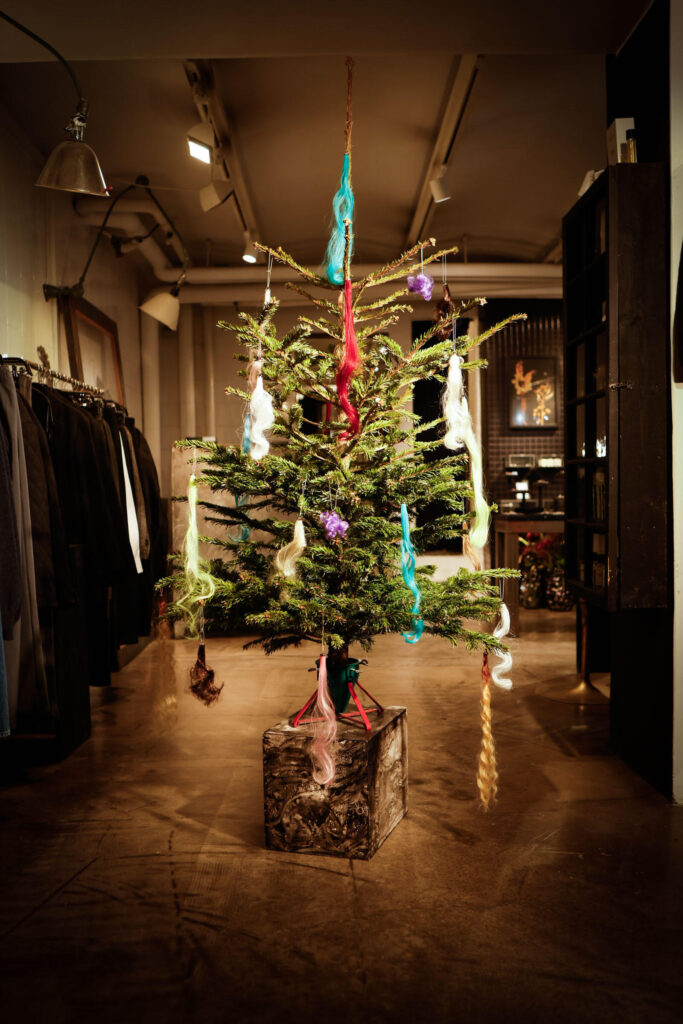
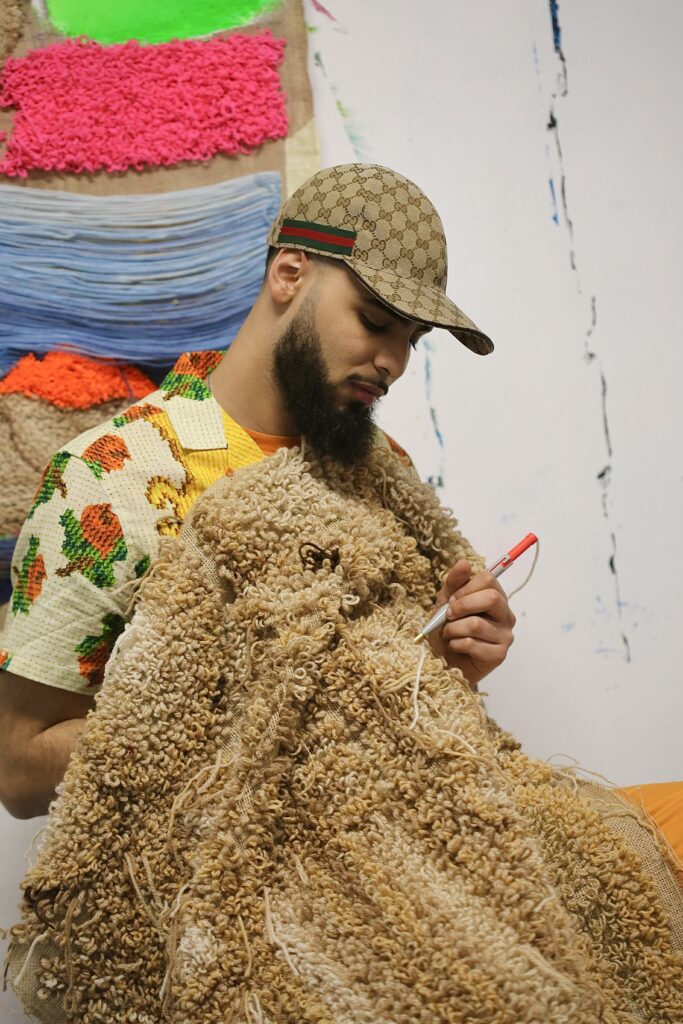
Tillsammans – Group Exhibition at JUS text Natalia Muntean “This exhibition is about celebrating all those years we’ve known each other and collaborated in various forms.” Ann-Sofie Back’s words set the tone for Tillsammans, a group exhibition at JUS that functions as a gathering of “different kinds of eras.” Bringing together Ann-Sofie Back, Diana Orving, Horisaki, Lotta Jansson, Lovisa Burfitt, Martin Bergström, and Yasar Aydin, the exhibition features seven practitioners whose work moves fluidly between fashion, art, jewellery, and objects. Hidden away on a back street in central Stockholm, JUS has for more than thirty years functioned as both destination and platform—a space where fashion, jewellery, objects, scent, and art coexist. Rather than presenting fashion as a fixed system, JUS has long embraced a layered, intuitive approach. For many of the artists, the space is inseparable from their own histories. Material sensitivity and process run throughout the exhibition. Yasar Aydin presents one-of-a-kind silver jewellery, “a twist on something recognisable as me,” while Martin Bergström shows woven works rooted in calmness, nature, and long-standing material exploration. For Aydin, JUS has been foundational. “Without JUS, I wouldn’t be where I am,” he says, describing how his practice shifted from art jewellery toward a more material-driven, handcrafted approach through years of showing and selling his work at the store. “JUS has been number one for me to develop and be successful in that sense.” Showing work alongside other makers is, for him, about exchange: “To interact with each other, to talk about materials and techniques.” photography Henrik Halvarsson For Ann-Sofie Back, the exhibition became a marker of a relationship that began in the late 1990s when Ulrika Nilsson bought her graduate collection. “This exhibition is about celebrating all those years we’ve known each other and collaborated in various forms,” she explains. Her contribution to Tillsammans, a sculptural Christmas installation made from repurposed wigs, reflects her shift from fashion to interior objects. Currently focusing on objects rather than garments, Back describes her new work as “super decadent” and “vain.” She describes the process as spontaneous and playful, shaped by what materials could be found rather than by a fixed plan: “Now that I don’t have to work with the body, it’s freer. I can objectify the object instead.” For Martin Bergström, the exhibition is a celebration of a relationship with JUS that has “grown together for years,” beginning in the 1990s. He likens the exhibition to a “shared garden” where “everyone grows in their own way, yet we share the same soil.” Working freely across fashion, art, and interiors, Bergström presents Reflections of My Shoes, a series of jacquard weaves born from a specific moment of connection. “I was on the phone with Ulrika Nilsson, sitting on a jetty at Pålsundet in Stockholm. When I looked down, the water reflected my shoes. I translated that reflection into jacquard weaves.” Bergström views JUS as a “collective lab” and a home that “holds the fragile patterns within us.” His history with the space is marked by moments of deep inspiration, from the time he showed his “poisonous plants” to discovering the writer Vivi Täckholm at the store, who became one of his greatest sources of inspiration. To him, the space remains a “calm and kind place” that addresses the “quite quiet” atmosphere of an institution that has remained “solid for so long.” For less established voices, the exhibition carries a sense of trust. Lotta Jansson speaks of being encouraged rather than judged: “Ulrika just said: ‘Don’t worry, people are kind.’” That atmosphere, supportive, confident, and unselfish, was repeatedly described as central to the JUS experience. Jansson highlights the unique confidence Ulrika projects: “She’s become very confident in her way of thinking and choosing… that’s also how she shares her confidence with you.” Regarding the theme of the exhibition, Jansson suggests that the “togetherness” might be more about the curator’s perspective than the artists’ own connections: “I think we all individually represent togetherness for her, more than us together.” For Horisaki, whose crushed and reshaped hats form one of the exhibition’s most tactile installations, Tillsammans marks a return to an aesthetic first shown at JUS more than a decade ago. “We’ve always done crushed hats,” they explain. “It’s about making hats that are not fragile. You can sit on them, pack them, reshape them, and they’ll still look great.” The hats are described as carrying “the memories of life, time and randomness” in their structure, objects shaped by use rather than preservation. That philosophy extends beyond the objects themselves. “We don’t believe in competition or sharp elbows,” Horisaki says. “Everything is better when you collaborate and work together.” In this sense, the title Tillsammans is not symbolic but practical, describing a way of working grounded in openness and shared experience. “The installation reflects what we have sought since our very first hats: the beauty of patina, of hats that are crumpled, worn, and cherished… We aim to highlight the hats’ functionality, how they can be worn and reshaped in countless ways, always changing yet remaining true to their character. This last part also applies to how we perceive JUS.” Beyond retail, JUS has long positioned itself as a space for education and exchange, hosting exhibitions, talks, workshops, and art history courses throughout the year. Tillsammans embodies this role not through a single curatorial statement, but through presence: works shown side by side, conversations unfolding quietly, and histories intersecting. More than a group exhibition, Tillsammans became a reflection on continuity – on what it means to build something over time, and how creative practices, like places, can remain open, generous, and alive by growing together.