Author name: Kaat Van Der Linden

Cinema, Uncategorized

The Art of Pretending – Mecenaten by Julia Thelin

image courtesy TriArt Film image courtesy TriArt Film photography Johan Hannu The Art of Pretending – Mecenaten by Julia Thelin text Kaat Van Der Linden In October 2024, a small film crew gathered on Gotland to create something both dark and strangely beautiful. Working in Visby, the cast and crew relied on each other completely, the isolation shaping not only the production but the emotional temperature of the film itself. As the cinema release approached on March 20th, director Julia Thelin and actors Carla Sehn and Maxwell Cunningham reflected on the experience: the strange intimacy of the shoot, the trust it demanded, and what they hope audiences carry with them after watching Mecenaten.   Thelin has spent more than seven years shaping Mecenaten into the film she wanted it to be. Cunningham and Sehn joined the project in 2023, after an audition process that was anything but conventional. “Julia wanted to see me be a bad dancer, but try anyway, and that made me feel beautifully seen.” Sehn said. “That’s a dream for me, a director who looks at me with beautiful eyes and sees me for all my mistakes.” But her audition didn’t end there. After her first tape, the team didn’t think she was the right fit as Thelin had written the character as older. Sehn, however, couldn’t shake the feeling that she belonged in this film. “I called the producer and said, ‘I think you made a mistake – I think this part is mine.’” And she was on to something, Sehn’s interpretation of the character had stuck with the team. ”It was just obvious how Carla understood something about this character that was crucial” Thelin says. photography Johan Hannu photography Johan Hannu The cast joked that the production felt less traditional and more like a crew of pirates trying to hold a ship together. “We were somewhere on the edge of the world, trying to conquer the world with no money, it felt like. So that was how I would describe it. And in those kinds of situations, you become really close, because you have to depend on each other completely in order to do these kinds of scenes.” The combination of a small team, harsh weather and the isolation created a strange sense of solidarity. According to Thelin, every film develops its own kind of DNA through collaboration, but atmosphere plays an equally important role. “I appreciate focus – you need to preserve your energy and put it in the right places,” she says. On Gotland, that atmosphere came almost effortlessly. As Cunningham put it, “It was easy to tune into the core of the film just by being there, left alone with each other.” Coming into these particular characters wasn’t easy for everyone. Cunningham explains that the hardest part was stepping into someone far more passive than himself: “What felt unfamiliar for me was to depend on other people to make decisions. I have four younger siblings, so I never hesitate to make decisions. But my character is very codependent. He’s very shy. So that was something I had to grow into.” Sehn could easily step into the loneliness her character carries – “that’s a place I know really well,” she said – though laying that loneliness bare before an audience pushed her into unfamiliar ground. The film also gave Cunningham the chance to play a type he had never been offered before: “I’ve never been asked if I could play an art student. A lot of times, you’re just cast because you look a certain way. So I’m very thankful to Julia for trusting me.” photography Lucas Lynggaard Tønnesen image courtesy TriArt Film image courtesy TriArt Film Much of this intensity came from the way Thelin works. Her direction is rooted in instinct, attention and a kind of quiet precision. “These three actors are in almost every scene, and they all work very differently,” she said, describing the balance she had to maintain. What she aimed for was a mix of “focus, but also playfulness.” Many of the film’s most charged moments, the long gazes and the tension between characters, weren’t planned. “A lot of the gazing in the film is real,” says Sehn. “We were processing things she said to us in the moment itself.” In the end, they each hope the film leaves audiences with something slightly different. For Thelin, it is a kind of bittersweet release, “a sensation of being liberated by this character’s adventure with themselves, to have the audacity to take control of their own life and question all the stupid rules.” Sehn adds to that, hoping viewers feel a pushback against the people who doubt or diminish them. And Cunningham keeps it simple: “I’d love for people to have more fun… if that’s the thing they can gather from this film, just try to have more fun.”

Opiates, Uncategorized

Inside the Louis Vuitton Hotel

Inside the Louis Vuitton Hotel In Mayfair, Louis Vuitton opens a townhouse shaped by 130 years of the Monogram — a symbol that has travelled the world and returned to London, the site of the House’s first step beyond Paris. The Louis Vuitton Hotel unfolds as an immersive journey through heritage and imagination, where each floor becomes a chapter in the Art of Travel. Rooms dedicated to the Speedy, Keepall, Noé, Alma and Neverfull trace the lives of the House’s most recognisable bags. The Keepall Lobby evokes departures and arrivals; Café Alma carries the quiet geometry of Paris; the Speedy Room hums with the energy of movement; the Neverfull Gym plays with abundance and ease; Bar Noé glows with the intimacy of a champagne bar rooted in a 1932 idea made modern again. Throughout the townhouse, the Monogram appears not as a motif but as a living presence — restored in the Care Services atelier, reimagined through exclusive personalisation, and woven into every gesture of hospitality. The experience feels both historic and immediate, a meeting point between craft and culture. Open for two months, the Louis Vuitton Hotel stands as a temporary home for the Monogram’s past, its present, and the journeys it continues to inspire. images courtesy Louis Vuitton

News, Uncategorized

Saatchi Yates × Isamaya Ffrench: Studio Iron

Saatchi Yates × Isamaya Ffrench: Studio Iron Saatchi Yates and Isamaya Ffrench open Studio Iron, the first exhibition of Ffrench’s new design gallery, bringing together works that blur the line between art, design and object. Steel and iron dominate the space, forming a stark, post‑industrial landscape where function and non‑function collide. Jannis Kounellis contributes a heavy steel work rooted in Arte Povera. Paul McCarthy’s reflective inflatable sculpture twists pop culture into something absurd and hollow. Jordan Wolfson’s sticker‑covered chair becomes a chaotic surface of competing messages, while Anne Imhof’s readymade benches evoke the eerie stillness of transitional spaces. Marina Abramović’s levitating kitchen scene adds a note of domestic surrealism, and Nico Vascellari’s Visita Interiora Terrae pushes the body into physical and psychological extremity. Additional works by Hannah Levy, Kelly Wearstler, Marco Panconesi, Miriam Cahn, Marlene Dumas, Peter John and Anselm Kiefer deepen the exhibition’s atmosphere of unease. As an opening statement for Studio Iron, the exhibition imagines a world where art and design collapse into one another; brutal, austere and stripped of ornament. photography Hugo Yangüela

Opiates, Uncategorized

McQueen: Beneath the Surface

McQueen: Beneath the Surface McQueen unveils Beneath the Surface at Fotografiska Shanghai, an exhibition that traces the origins and emotional undercurrents behind the house’s singular aesthetic. The space explores the tension between interiority and exteriority, and the beauty and volatility of nature, through the Autumn Winter 2026 collection and the Manta bag. Inside the exhibition, the Manta appears in multiple iterations, its sculptural folds echoing the architecture of aquatic life. The forms sit alongside the season’s collision of raw realism and curated self‑presentation, a dialogue that has long defined McQueen’s visual language. The opening marked Seán McGirr’s first visit to Shanghai as Creative Director. The afterparty extended the house’s Reverb series, bringing together its local community with a live performance by Mo La Guai Le featuring Amber Kuo. Actors Zhou Yutong, Xiang Hanzhi and Qu Chuxiao were among the guests, underscoring the cultural energy surrounding the house’s arrival in the city. McQueen: Beneath the Surface ran from 18 to 20 April at Fotografiska Shanghai, offering an intimate look at the house’s evolving codes and the creative tensions that continue to shape its identity. image courtesy McQueen

Design, Uncategorized

Dior Presents the Corolle Lamps by Noé Duchaufour‑Lawrance

Dior Presents the Corolle Lamps by Noé Duchaufour‑Lawrance For Salone del Mobile 2026, Dior Maison continues its ongoing dialogue with designer Noé Duchaufour‑Lawrance, unveiling a new series of Corolle lamps that merge couture sensibility with sculptural light. The pieces draw on the designer’s belief that light is as expressive as material itself, becoming a language that shapes form, mood and space. The lamps reinterpret the curves of Christian Dior’s Corolle skirt, translating its movement into mouth‑blown Murano glass. Each bell‑shaped shade carries the imprint of artisanal technique, revealing subtle shifts in transparency, reflection and texture. The result is a silhouette that feels both airy and precise, echoing the elegance of the New Look while standing firmly in the present. Available as table lamps and portable versions, the designs come in Dior’s emblematic shades of grey, pink and white. Details such as engraved “CD” buttons and refined handles underscore the house’s commitment to craftsmanship. Duchaufour‑Lawrance also expands the collaboration with a series of pieces crafted in Japan using traditional bamboo basketry. Madake bamboo is cut, refined and woven into forms that evoke Dior’s cannage motif, linking ancestral technique with contemporary design. Together, the creations reflect a shared devotion to savoir‑faire; patient, meticulous and rooted in gesture. In Duchaufour‑Lawrance’s hands, light becomes material, and material becomes a quiet tribute to Dior’s enduring artistry. photography Eduard Sanchez Ribot

Beauty Editorial, Uncategorized

I FOLLOW RIVERS

skin Cle’ De Peau radiant cream foundation ochre 20 Rare Beauty liquid luminizer enlighten art Diamond FX aquacolor black lips M.A.C Cosmetics sheer lipstick dubonnet Sugarpill loose shadow asylum   top Airi skin Cle’ De Peau radiant cream foundation ochre 20 Rare Beauty liquid luminizer enlighten art Make Up For Ever flash color palette black lips Pat McGrath Labs matte trance lipstick vendettanails Mika Ochi skin Cle’ De Peau radiant cream foundation ochre 20 Rare Beauty liquid luminizer enlighten art Diamond FX aquacolor black lips  M.A.C Cosmetics sheer lipstick dubonnet Sugarpill loose shadow asylum top Airi skin Cle’ De Peau radiant cream foundation ochre 20 Rare Beauty liquid luminizer enlighten eyes Mehron metallic powder gold lips Pat McGrath Labs matte trance lipstick mcmenamy Girlcult lipgloss shimmery black red   dress Issey Miyake skin Cle’ De Peau radiant cream foundation ochre 20 Rare Beauty liquid luminizer enlighten art Make Up For Ever flash color palette black lips Girlcult lipgloss plasma red dress Donna Vivid skin Cle’ De Peau radiant cream foundation ochre 20 Rare Beauty liquid luminizer enlighten art Make Up For Ever flash color palette black lips Pat McGrath Labs matte trance lipstick fever dream dress Issey Miyake skin Cle’ De Peau radiant cream foundation ochre 20 Rare Beauty liquid luminizer enlighten art Diamond FX aquacolor black lips  M.A.C Cosmetics sheer lipstick dubonnet Sugarpill loose shadow asylum top Airi skin Cle’ De Peau radiant cream foundation ochre 20 Rare Beauty liquid luminizer enlighten art Make Up For Ever flash color palette black lips Girlcult lipgloss plasma red dress Donna Vivid

Opiates, Uncategorized

Susie Cave Presents Weddings and Funerals

images courtesy Susie Cave Susie Cave Presents Weddings and Funerals Susie Cave opens a new appointment‑only space in Kensington, marking the beginning of a distinct chapter in her creative world. SUSIE CAVE, WEDDINGS AND FUNERALS introduces a demi‑couture offering shaped by the designer’s desire to return to something elemental and personally driven. The pieces carry the familiar tension and elegance of her earlier work, yet stand apart with a sharper, more intimate focus. The shop invites visitors into a subtly surreal environment where black and white form the foundation of a new visual language. Despite the name, the designs are not traditional bridal or funeral attire. Instead, they explore the ceremonial and performative nature of clothing — from minimal monochrome mini‑dresses to elaborate, sculptural silhouettes. The debut collection consists of 25 designs, each custom‑tailored and fully personalisable. The approach reflects Cave’s wish to step away from the industry’s relentless pace and create garments rooted in intention rather than demand. Opening in mid‑late May 2026, SUSIE CAVE, WEDDINGS AND FUNERALS offers a space where ritual, imagination and craftsmanship meet on their own terms.

Music

Anna-My

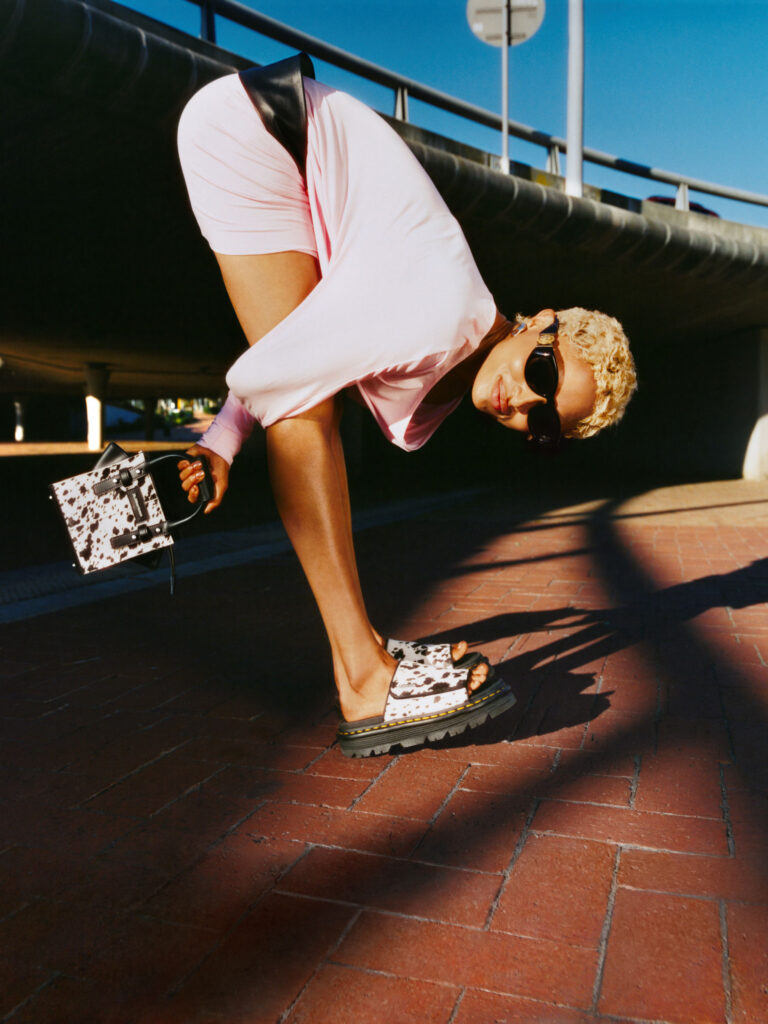
dress ARKET shoes Adidas socks H&M sunglasses Prada Drifting Across Genres AN INTERVIEW WITH ANNA-MY photography Sandra Myhrberg / Agent Bauer fashion Olivia Bohman hair and makeup Katarina Ohlsén  Emerging from Sweden’s west coast and shaped by formative years in Stockholm, London, and New York City, Anna-My has cultivated a sound that moves fluidly between underground club culture and deeply personal expression. With roots in Gothenburg’s electronic scene and early inspiration drawn from platforms like Boiler Room and NTS Radio, their approach to DJ-ing is guided as much by instinct and emotion as by technical precision.   Blending hypnotic rhythms with an intuitive sense of movement, Anna-My creates sets that feel both expansive and intimate, shaped by influences ranging from UK innovators like Four Tet and Caribou to early memories of discovering The Knife. As their international presence continues to grow, their work remains grounded in a simple yet powerful intention: to translate feeling into sound.     Sandra: Your career spans Stockholm, London and New York. How did each city shape your sound and approach to DJ-ing?Anna-My: Stockholm, London and New York probably shaped me more than I realised at the time. I moved when I was 22 and spent such formative years in both London and New York. At that age, you’re constantly discovering things for the first time—everything feels new, everything feels huge. Every track I heard felt like its own piece of art, and experiencing that kind of art every day was almost overwhelming. I’m from a small town on the west coast of Sweden, where there wasn’t really a scene or people who shared my pull toward electronic music. I found my space through Boiler Room and NTS. That feeling—that the world suddenly opened up and that I could feel so much through sound—has definitely shaped both my sound and the way I DJ. Sonically, I think UK artists like Four Tet and Caribou have had a huge influence on my own music-making. dress ARKET shoes Adidas socks H&M sunglasses Prada top Arakii skirt Anna Danielsson S: You started DJ-ing at 17 in Gothenburg’s underground scene – what was that early period like for you?A-M: So fun. I wasn’t interested in anything that wasn’t electronic music—it was the only thing I cared about. I spent hours lying on the floor of my room in the collective I lived in, just listening and listening. It was a completely new world opening up. I miss that sometimes—being 17 and discovering something as big as music. S: You’ve warmed up for artists like Olof Dreijer and Eli Escobar. What do you focus on when preparing a warm-up set compared to a headline set?A-M: It feels important to tune into the DJ’s sound and match it to some extent, but without stepping away from my own identity. I try not to overthink it. S: What inspires you to create music and where do you find that inspiration most strongly? A-M:I find inspiration everywhere—in myself and in others, in memories and dreams. It often comes from fragments of things that have been and things I long for. When I make music, I’m basically just trying to translate feelings, memories and dreams into sound. That material is always around me, and in me. S: Your music blends tech house with hypnotic rhythms and swinging beats. How would you describe your signature sound in your own words? A-M: I’m trying to make music that moves across genres. I don’t want to get stuck in one lane—I want to let myself drift freely. I don’t really know how to describe it. All I know is that I like movement. Forward, backward, but never still. I hope that comes through in the music. vest Anna Danielsson skirt ARKET shirt Tiger Of Sweden trousers ONO Ateliers sunglasses RayBan S: Your love for music started with your father’s record collection. Which artists or albums from that collection still influence you today? A-M: He was probably one of the first people in Sweden to discover The Knife. We listened to them when he drove me to school. I especially remember one morning—it was still dawn, the road went through a big field, and the fog was low, almost magical. We listened to The Knife and something happened in me. Maybe my first big musical experience. I’ll remember that morning in the car forever.   S: How do you keep your sets fresh and evolving after a decade in the scene? A-M: I do it without thinking. Music is the only thing I know. It’s just everywhere—either I find it or it finds me.   S: You helped build Boiler Room when it was still a new concept in New York. What was that experience like, and how did it influence your understanding of club culture? A-M: It was, of course, incredibly exciting. I helped build the first studio in Williamsburg. There were only three of us on the New York team at that time, and everything was just beginning. Boiler Room was so forward-thinking and groundbreaking, and being surrounded by people who only cared about music and underground culture was transformative. It felt like the world became bigger through music and culture. A lot of people think Boiler Room was only a space for electronic music, but we worked with all kinds of underground music. We spent quite a bit of time in Harlem working with local jazz musicians, and in Atlanta documenting the growing hip hop and rap scene. dress Hanna Rothstein trousers & Other Stories shoes Calvin Klein dress Hanna Rothstein trousers & Other Stories shoes Calvin Klein blazer COS sunglasses Prada S: You’ve built a strong international reputation. What’s the most memorable crowd or club moment you’ve had so far? A-M: I played the opening night at PLX this summer on a new stage. It was a tropical night, and almost the whole festival came to my set. It was nothing but magical.   S: If you could play anywhere in the world

News, Uncategorized

Desenio establishes Desenio Art Awards

images courtesy Desenio Desenio establishes Desenio Art Awards Desenio is taking another step in its commitment to contemporary art by launching the Desenio Art Awards, a global initiative with the ambition to identify, elevate and support the next generation of artists, photographers and creators in the long term. With a growing international presence and an established position in accessible art, Desenio continues to develop its role as a platform for artistic expression. The Desenio Art Awards are part of this work, where new voices are given space to reach a wide audience and become part of a global context. Artists are invited to apply with their works through six categories. New Talent, Illustrator, Photographer, Graphic Artist, Mixed Media Artist and Street/Urban Artist. Selected entries will be exposed internationally, and the final winners will be integrated into Desenio’s creative universe as part of the brand’s continued artistic development. An internal jury with expertise in art and visual culture nominates six artists per category. The process is then opened to public voting, allowing for both industry and public perspectives in the selection. The application period for the Desenio Art Awards is now open and will end on April 19, 2026. Entries are submitted via Desenio.com/art-awards. 

Art, Uncategorized

Gallerist Georgina Pound Honors Mexico’s Surrealist Female Artists

Gallerist Georgina Pound Honors Mexico’s Surrealist Female Artists text and photography Sanna Fried Mexico City Art Week 2026 was a beautiful and eventful journey of art, parties, earthquakes, and bad phone service.  Much to my delight, this year turned out to be the year of the figurative painters, with women leading the way. It was also the year to celebrate the female historical surrealist painters of Mexico City, notably Leonora Carrington, whose work I saw presented in no fewer than six galleries throughout the week.  A woman who has also been shaped by this wave of female painters sweeping across Mexico is the British gallerist Georgina Pounds. For her, the female surrealist artists, with Leonora Carrington at the forefront, have become a source of inspiration that she has carried forward and developed into a contemporary gallery rooted in Mexico’s cultural past. One of my highlights from Mexico City Art Week was meeting the ever-so-inspiring and energetic Georgina Pounds.  Mexico City is in a moment of transformation, yet Roma Norte, the area where Georgina Pound Gallery is located, continues to hold a quiet connection to its past. The Colonia’s architecture is evolving and adapting to new uses and rhythms, but when we look closely, it remains grounded in a city shaped as much by memory as by development.  When Pounds was given the opportunity to open a gallery at Casa Lamm, a large and beautiful historic building, built in 1911 as a private palace, she knew it was the right time. She had been dreaming of a project that was personal and aligned with her own history.  She decided to keep the rooms’ original names:  Frida Kahlo, Nahui Ollin, Marguerite Yourcenar and Luis Cernuda, each carrying their own symbolic presence into the new gallery. Pound also preserved the building’s original 1911 features: high ceilings, moulded detailing, and herringbone wooden floors, and in many ways, its usage and artist memory. Casa Lamm is a remarkable building, rich with history and culture. For decades, it functioned as a cultural centre, housing a library, classrooms, and a restaurant. It is said that this restaurant was a favourite of the artist Leonora Carrington.  Pounds holds a deep admiration for the women surrealist painters who lived and worked in Mexico during the first half of the 20th century. Pounds explains that the story of Leonora’s favourite restaurant being inside Casa Lamm became a meaningful and symbolic sign for Georgina to take the leap and establish her own space right there, where Carrington had her beloved meals.  During the first half of the 20th century, Mexico City became a creative hub and a sanctuary where many women felt free. Pounds sees clear parallels between the artistic circles that gathered in Mexico at that time and today’s new wave of artists and cultural practitioners. For her, women surrealists like Leonora Carrington, Leonor Fini, Remedios Varo, Dorothea Tanning, and the support they offered one another remain a key source of inspiration.  Pounds believes there are clear parallels in the connections she sees between the artistic circles that gathered in Mexico during that time and the new wave of artists and cultural practitioners from Europe and America arriving in Mexico City today. Her vision for the gallery at Casa Lamm is to reflect that same spirit of openness and artistic community, as well as to echo the building’s past as a cultural centre. She wants the gallery to be a living, welcoming space filled with movement, gatherings, and events, such as the free guided meditation she organised on International Women’s Day.   Before moving to Mexico City, eight years ago, Pounds studied architecture at The Cass in London. She believes that having an eye for architecture is imperative in Mexico City, a city where it blends seamlessly and constantly with the visual arts. The gallery’s first show at Casa Lamm, featuring British painter Vanessa Raw, solidified this idea, with Raw’s romantic and classic work speaking intimately with the architecture of the space. Spanning three rooms, Raw’s large-scale oil paintings featuring landscapes, animal or female nudes are a blend of Greek mythology, Mexican traditions and the natural world, oozing poetry, sensuality and vulnerability. Simultaneously, Casa Lamm is hosting another show, which brings together works by young painters and sculptors from Europe and Mexico, such as María Kalach, Fredrik Nystrup Larsen and Tali Lennox, with artists connected to the historical surrealist movement in Mexico City. Especially touching, Kati Horna’s photography features Carrington and serves as a reminder of the importance of sisterhood and friendship between artists. “I grew up in Sussex, in the same village where the poet and surrealist patron sir Edward James grew up”  Pounds explains with pride in her voice. James specifically supported one artist… guess who- Leonora Carrington. Perhaps it is because of Georgina’s upbringing that she has developed such a strong, lifelong connection to surrealism. Georgina’s love for Carrington’s work, an interest cultivated throughout her upbringing, became the catalyst for discovering another important figure of the Surrealist movement – Sofia Bassi. Bassi, unlike many of the artists in Mexico City’s Surrealist movement, was Mexican. Her paintings carry many layers and a sense of darkness, with many of them being produced while she was imprisoned, after being convicted of murdering her daughter’s husband.  Sofía Bassi and Kati Horna were close friends, and now in April, Georgina Pound Gallery will present works by both artists. The show will bring together voices, histories, and relationships of women who shaped Mexico’s Surrealist movement and today’s art scene.  In many ways, Georgina Pound Gallery feels like part of a larger moment in Mexico City, where history, identity, and new artistic voices are being woven together. In a city constantly shifting between past and future, Pound seems to move effortlessly between both. Her gallery is not just a space for art, but a continuation of something that has always existed here – a quiet thread of connection between artists, histories, and women who found their freedom in Mexico City. Looking back at a

Scroll to Top