Literature

Literature

This Woman’s Work – An Interview With Lynne Tillman

Ulrika Lindqvist: You first released Weird Fucks in the magazine Bikini Girl in 1980. How has the response, both critically and from readers, shaped your perception of the novel over time? Lynne Tillman: In 1980, “Weird Fucks” was published in a pink magazine called BIKINI GIRL, edited by Lisa Baumgardner. Lisa and Bikini Girl were associated with Club 57, a punk place. Weird Fucks, in manuscript was 62 pp in manuscript but it was printed in 7 pt type on very wide pages, so it almost disappeared in the mag. Very disappointing. It didn’t circulate well, maybe 500 or 1,000 copies. No one really saw it. So I’d say it wasn’t published, in a way. I gave readings from it, so if people knew about it, that’s how, and not from reading it themselves. Other people did artist or limited editions, I’d call them; Jim Haynes did one from Paris. Again, no visibility or distribution in the usual sense. In New Her- ring Press (2014), a small, indie press, published it in its correct form, that is, with a few changes I made. Artist Amy Sillman did the amazing cover and all the illustra- tions – a beautiful book, but again in a limited edition. So, there was little to no response to Weird Fucks until Peninsula Press published it in 2022. Oddly, it became a bestseller, which amazed me. Then responses came, reviews, social media, emails, the lot of it. Artist Hilary Harkness’s cover, based on her Stein/Toklas series of paintings were also amazingly helpful to the book. Wild and fascinating and gorgeous. So, responses, yes, finally. I had little perception, in the way you mean, before then. I believed it could appeal to contemporary readers. I wrote it with an eye to univer- sals, and by that I mean, things and events that happen again and again in people’s lives. In 1980, maybe, maybe fewer guys would have read it. Now, it’s a novel that has crossed over that arbitrary, highly gendered border. Thankfully. UL: What a journey Weird Fucks has had! Also,the cover is really amazing. I think Weird Fucks is very contemporary, it aligns with authors like Sally Rooney, Ottessa Moshfegh and Emma Cline, but you wrote it so long before. Maybe that tells of the timeless troubles of being a young woman? Or just a young human? LT: Of being human, and young, and a young woman, and a man who has sex with a woman, maybe one he’s just met, etc. Sex is universal. There are different ways to do it, and queer women and men also relate to Weird Fucks, because the weird is the situations and conditions of encounters around sex. What’s most important, I think, is the style of Weird Fucks. It took me two years to write it, my first longish thing, and every word was considered closely. Style was very important. I wanted it to be tough and also lyrical. I mostly left room for readers. UL: Now that Weird Fucks is being translated and reaching entirely new audiences more than 50 years after its original release, what is it like to witness the novel take on this second life? LT: It’s really having its first life. UL: And finally, that is! You have written several other novels – No Lease on Life was a finalist for the National Book Critics Circle Award in fiction. Have these other novels started living their first lives earlier, and how does that experience differ from the one with Weird Fucks? LT: Let’s see, I’ve written six other novels, starting with Haunted Houses and, most recently, Men and Appari- tions, which is very much about young men. Peninsula Press is giving them life in the UK, and I hope other foreign presses will consider them. And they all had first lives in the US, and a few were published in the UK in the early 1990s, but they had a very small impact, very few readers. Weird Fucks became a bestseller. None of the others have…yet. photography Craig Mod UL: What was the inspiration behind Weird Fucks? Did any particular events, ideas, or themes inspire you more during the writing process? LT: The sexual revolution, the pill, feminism, questioning gendered roles, these were changing — and still are — and I didn’t see fiction that, to my mind, took on what was happening, how girls, women, boys, men were being affected. The novels that did represent young women’s lives were, for me, not interesting formally, as writing, and were usually too sentimental, and too much about women as victims of the changes. The birth control pill was revolutionary, when you realise that over millennia, women couldn’t control their pregnancies. Having unwanted babies enslaved women to their bodies. We couldn’t talk at all about gender without the pill allowing women this very urgent freedom. UL: That’s really a big change for women, in society as well as in personal lives. Do you have any artists or authors whose work inspire you? LT: Oh, too many to mention, really. In fiction, most important, Jane Bowles, her stories and her one and only novel, Two Serious Ladies. Reading it openedup a uniquely written world in which her girls and women characters stretched the bounds of female representation. Her writing is stark, unsentimental, and often hilarious. Bowles is very smart, very different — her dialogue, no one writes anything close to its unusual brilliance. Bowles’ mind, her language, her way of seeing human beings… Kafka, Thomas Mann, Colette, Jean Rhys, Joseph Roth, Flaubert, again, too many. Visual artists, four going back into history, Caravaggio, Velázquez, Courbet, and Matisse. dead contemporary painters: Peter Dreher, Susan Rothenberg… I’ll leave it there. And there’s installation and sculpture and video…. Photography: Diane Arbus, Robert Frank; Pictures Generation, including Cindy Sherman, Barbara Kruger, Laurie Simmons, Stephen Shore, and newer photographers, etc. Film: Ozu, Hitchcock, Chantal Akerman, Agnes Varda, Fassbinder, Suzanne Bier, many others. I haven’t even mentioned doc filmmakers. Warhol radically
Literature

Times Like These

Times Like These text Janae McIntosh In her debut novel, The Ministry of Time, Kaliane Bradley blends history, science fiction, and an inti-mate exploration of migration and belonging. The novel follows time-travellers displaced from their respective eras, thrust into modern Britain, and forced to navigate their new reality under the watchful eye of a mysterious government ministry. In thisconversation with Ulrika Lindqvist, Bradley discusses the emotional heart of her novel, the complexities of language, and the personal inspirations that shaped her storytelling. From British polar exploration to generational trauma, and even her admiration for Terry Pratchett, Bradley offers insight into her writ- ing process, the themes that drive her work, and what we can expect from her next book. Ulrika Lindqvist: The Ministry of Time covers time- travelling and early on in the book, the narrator states that we don’t need to know how thisworks, is that a way for you to not go into the sci-fi elements or physics too much?Kaliane Bradley: Exactly, so even though I was very interested in the sci-fi tropes it was important to me that the book was understood as someone’s emotional journey. So I wanted to foreground the emotional journey of time travellers rather than the physics of time travel and the kind of hard sci-fi prospects of time travelling. And that’s not because I don’t enjoy reading about that but I think it wasn’t what I wanted to focus on for this book. And so, it’s a slightly cheeky way to signalto the reader early on “Sorry this isn’t straight science fiction, you’re getting a mixture of genres here”. UL: There are so many themes going through this novel but one that stood out to me was linguistics. A big discussion is what to call the migrants, which is the word used in the Swedish translation. KB: That’s so interesting! In the English version, they’re called expats, which is a very politically loaded word. It’s generally applied to people from very privileged backgrounds in the sense that they can move wherever they want and return anytime they want, often in the UK it’s applied to white British people. Whereas there’s a conversation very early on in the book where they start arguing about the word refugee, one of the characters describes the time travellers as refugees, not expats because they can’t go home again. They have to stay here, they’re being pulled out of their culture, out of the life they had, and they have to assimilate – they’re refugees. And the ministry is very keen to make these people feel like no matter the time period they’re in, they’re British. And so, they’re only ever expats. It’s propaganda to persuade them to assimilate and to persuade them to accept 21st-century Britain as their home. UL: That’s what is really unique with this novel, often you can tell how important language has been to the author but in this novel, the language is actually discussed within the story. Another thing I found interesting is when Commander Graham Gore realises that his private correspondence has been read by the ministry and feels uneasy about that, what inspired this storyline?KB: I started writing the original version of The Ministry of Time for some friends. During lockdown, I got very interested in British polar exploration. And because of the lockdown, I couldn’t go anywhere, I couldn’t research and so I found this online group of people who were also polar exploration enthusiasts and we all followed a TV show called The Terror about British polar exploration and they were so generous, they shared their research with me and really made me feel welcome, so I started writing the book as a sort of playful gift to them. So, the very first version of the novel was written for people reading the private correspondence of these polar explorers or their diaries. One of the first things I was given was a scan someone had taken of a polar explorer’s diary and it’s just so strange to have that level of access to people – to be able to see someone at so many points in their life, confessing to things so privately, different letters to different people. In life, when you meet someone you don’t have that level of access. But the level of access that the ministry is given when it comes to Graham is incredibly unusual and makes him feel like he’s being studied because it’s weird for someone to have read your private correspondence that’s being exhibited in a museum. I think we felt both romantically about that but also maybe guilty. It’s a strange feeling; historical and biographical research. Feeling so close to the person you’re studying but they will never know you. It’s one of the frictions in the ministry that I try to convey in the book, that it can be almost depersonalising, alienating to study someone who feels intimate but you don’t know them intimately if you’re just studying their old letters because you’re not trying to connect with them. UL: Graham is the only character in the book that’s based on a real person, and I found myself googling a lot. I think a lot is commonly known in the UK but as a Swede, I didn’t know of the Franklin Expedition, for example. Is it widely known internationally? KB: I think it’s not so widely known anymore. It is one of those Victorian embarrassments that may have recededinto the past. By contrast, I think it’s very well known in Canada because the wreck is there. Margret Atwood apparently is a huge Franklin Expedition fan. When I do book events in the UK, I get a real mix of people who are interested in the idea of a sci-fi book or romance book but don’t know about the expedition and then I had someone come to my event in Edinburgh wearing a badge that said “ask me about polar exploration”. UL: Did you consider basing the other expats on historical characters or did you want to create them based on historical research?KB: I just wanted to have
Literature

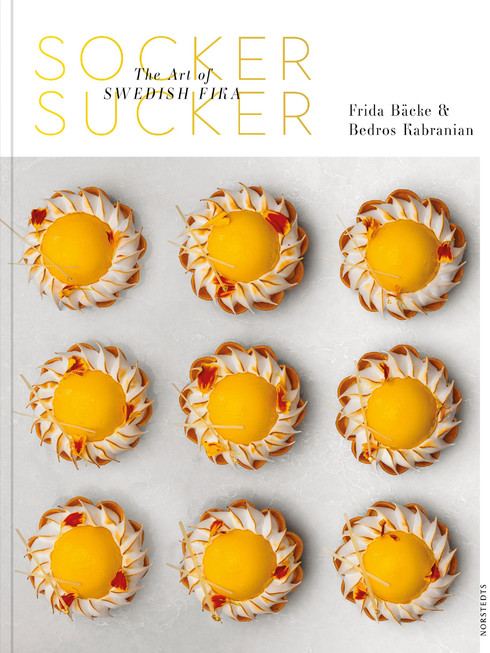
Socker Sucker: The Art of Swedish Fika

Socker Sucker: The Art of Swedish Fika text Ulrika Lindqvist Socker Sucker in central Stockholm has been a go-to destination for innovative and delicious pastries since opening its doors three years ago. Now, founders Frida Bäcke and Bedros Kabranian have collected a range of their recipes and step-by-step guides into a book, giving home bakers the tools to recreate their celebrated pastries at home. Odalisque sat down with the duo to talk about their inspirations and what they hope readers take away from the book. UL: What was the driving force behind writing Socker Sucker? Was there a particular moment of realization that made you want to share these recipes in a book? Bedros Kabranian: Not really, we got a great offer and it felt like there was space for it. Frida Bäcke: Exactly, and it also felt like a beautiful way to sum up our careers. We’ve been working for a long time, and this feels like the next chapter, to wrap it all up in a book in a nice way because we don’t really know what’s coming next. BK: Also, when this idea came up in the past, it didn’t feel like the right time. But now everything aligned, and it just felt right. UL: Many of these recipes have a luxurious twist. Can you give us an example of a classic pastry that you’ve reimagined in a surprising way? BK: Everything from the cinnamon bun, really, we changed the shape just to break the norm. It’s super simple but just changing the form makes it into something else. FB: And the Napoleon is another classic that’s always been done a certain way, and that we’ve also reworked. It really represents both of us with its lamination, filling, and flavour. It’s definitely one of those classics we’ve reinvented. But we’ve also taken flavour inspiration from the classics. BK: We’ve said before that we break a classic down into its different flavour elements, and then rebuild it. A lot of our work comes from that approach. Everything, I’d say, is in some way reinterpreted from a classic. UL: You draw inspiration from global influences. Which international flavours or techniques have influenced your recipes the most? BK: For me, it’s the Middle East. That’s where my foundational palette is, along with the rest of the world. For you (Frida), it’s the forest and your childhood in Dalarna, picking things yourself, spruce tips, berries… FB: Yes, exactly. It becomes more of a blend between the two of us, and that makes it special in a way. Also, during the pandemic when we couldn’t travel, we pulled in flavours from other parts of the world. But we really work with ingredients when they’re at their seasonal best, wherever they happen to come from. UL: The book covers baked goods for every season, from Semlor to Christmas saffron buns. How did you approach balancing tradition with innovation in these beloved recipes? BK: It actually wasn’t too hard. We set some boundaries for ourselves so we wouldn’t stray too far. And once we were in it, it was about small adjustments like swapping raisins for cranberries. Not just for the sake of it, but because we think it adds a different effect and taste. We kept the Semla pretty classic, it’s a classic, after all. FB: It’s the little things we do, like toasting and refining ingredients in the best way. BK: Yes, instead of regular sugar you might use a different kind. Or instead of butter, browned butter. Seeds and flours can be toasted. It’s those kinds of things. FB: It feels more thoughtful. Considering today’s ingredient shortages, it seems like a shame to waste good ingredients. We want to really care for what we have. BK: We’re always respecting the original. We’re not butchering The Classic, we’re elevating it. And sometimes adding a flavour twist or a visual twist. UL: Step-by-step guides are a key feature of Socker Sucker. Which techniques do you think home bakers will find most useful or most challenging? BK: Lining a tart shell. I think that’s something many struggle with. FB: Exactly, you cut it into strips and stamp it out. BK: And just having someone show you, that’ll be an aha moment for many. FB: Yes, like not pressing it all the way down. BK: Right, because you’ve done that your whole life. And then it cracks and looks bad. Just thinking a bit differently makes a huge difference. And chocolate lamination, of course. FB: Yes, chocolate lamination. We actually put the hardest ones at the beginning of the book to try and show them clearly. BK: There’s already a lot out there, but showing readers that we ourselves do it this way and get these results, I think that matters. UL: Your professional backgrounds and competition experience clearly show in your expertise. Are there any secrets or pro tips in the book that most home bakers wouldn’t usually have access to? FB: Oh, I feel like the whole book is full of that kind of candy, really. BK: Right at the beginning, we’ve got a section with tips on everything from liquids to temperatures, and how to think about small details. But each individual recipe also has tips that are second nature to us but might be crucial. Everything from proofing to contact loading. When I started working in the industry, so many times I had those “aha” moments, like, “of course, why didn’t I do it this way before?” Because you’re stuck in your habits. I think just seeing a different way opens up your thinking. FB: Exactly. And we’re still learning those things all the time. That’s why this profession is so fun. You keep discovering things. This book represents how far we’ve come now—and there will be more. BK: Volume one. UL: Precision and perfection seem to be hallmarks of Socker Sucker’s baking. What small details make a big difference in achieving bakery-quality results at home? FB: Read everything through first, have a plan. Don’t decide to make an entire cake in one day, plan it out. Maybe make the fillings and interiors on Tuesday, the sponge on Wednesday, assemble on Thursday, and glaze it on Friday. Planning your bake makes it much more enjoyable, instead of cramming it all into one day. BK: With buns and things like that,

Literature

An Interview with Daniel Nordgren, founder of Nord Books

An Interview with Daniel Nordgren, founder of Nord Books text Ulrika Lindqvist What truly makes a city feel alive is the diversity of independent shops, cafes, and other ventures. About a year ago, Stockholm was fortunate to gain a little gem of a bookshop: Nord Books. Specializing in a curated selection of books in English, Nord Books has quickly become a cherished spot. We sat down with founder and owner Daniel Nordgren to reflect on his first year as an independent shop owner. Ulrika Lindqvist: Have you always wanted to work with books? How did you get started in this industry? Daniel Nordgren: No, not really. I’ve always wanted to run a shop, for some odd reason. I have a very romantic idea of having a small business that is enough to sustain me and my family. I got into reading quite late and I’m not from an academic background so books became a way to self-educate myself. They became a way to discover stories, in form of fiction as well as non-fiction about art, philosophy, film, music and things like that. I think the shop is a product of that constant search of knowledge. UL: Before opening Nord Books, you spent many years at the renowned bookshop Söderbokhandeln. How did you know it was the right time to start your own bookshop? DN: In all honesty, I don’t think that there’s ever a” right time” to open a bookshop. I felt that I needed some sort of change, a space opened up and it happened quite spontaneously. I had seen a kind of bookshop in other cities, bookshops that carried what struck me as a very personal selection. Small bookshops in London and Paris represented something that I missed in Stockholm and when the tiny space on Sankt Paulsgatan became available I decided to give it a try. UL: What are the most important criteria for your book selection? How do you go about curating the store? DN: I guess the most important criteria is excitement or befuddlement. Some books I get instantly excited by and others lead to some sort of curious confused feeling that needs to be dealt with. That usually leads to rabbit hole reading and more books being bought for the shop. No books exist in a vacuum so what makes my job fun is to try to figure out where a book is coming from and try to have some of the other titles that it is in dialogue with. I also like to look at publishers a lot. The shop carries a big selection of independent publishers from the UK, the US and Europe and I try to follow the ones I like and take on their new titles as much as I can. But basically, I just want books that makes me interested. UL: As a Stockholm-based shop, what inspired your decision to exclusively sell English books? DN: I guess I’ve always been a huge anglophile. Growing up in Gothenburg gives you a certain interest in British culture from the start. Having studied English literature and worked with the English selection for Söderbokhandeln for a long time, it sort of became my thing. And I firmly believe that if you’re going to have a shop, it should be full of stuff that you know something about. Not just something that is in demand at the moment but something that you are excited about. UL: Are there any particular bookshops or other stores that influenced or inspired Nord Books? DN: There is a shoe shop called Lester in Gothenburg, where I’m from, that I’ve always loved. I think that’s where I first got the idea to be a shop owner. They just seemed to love their job and their selection of shoes so much. As far as bookshops go, I learned my trade as Söderbokhandeln so they were a big influence on me as a bookseller. The same goes for the people of John Sandoe Books in London who have been very supportive. But if I’m going to mention bookshops that influenced my selection it would have to be Donlon Books in London and After 8 Books in Paris. The way they curate and arrange their selection is very inspiring. Two incredible bookshops. UL: Could you share a memorable moment or event from Nord Books’ early days? DN: The first event we had is a bit special to me. American poet Wendy Lottermans came by and did a talk and a reading from her brilliant collection A Reaction to Someone Coming In (Futurepoem Books 2023). Everything just came together that night. The shop was packed with people (and a dog), another great poet called Matthew Rana held the talk and read some of his own poems. It was just a perfect night at the bookshop. UL: You showcase artists’ work on the store’s walls—can you tell us about the current artist on display? DN: Well, that whole thing started out by me seeing a painting by Olle Halvars that I wanted to buy. I’ve never been a person that buys art and I really couldn’t afford it now so I asked him if I could borrow the painting and have it in the shop for a few months. Then that led to me asking some artist that I liked if they would want to hang some paintings in the shop. We’ve had eight” shows” this year and we have a bunch planned for next year. Right now, we have prints from an artist called Tova Fransson. She works with printmaking and creates beautifully graphical shapes inspired from the printing press in itself. She feels very based in craft, which I admire a lot. Her bold prints often look like some sort of ancient alphabet, portrayed in a very industrial way. It’s such a pleasure to have works from artist like Tova around me in my workplace. UL: Who are your customers? Are they primarily Swedish, or has an international clientele discovered the shop? DN: I’d say it’s about 50/50. A lot of non-Swedish speaking people based in Stockholm have found their
Scroll to Top