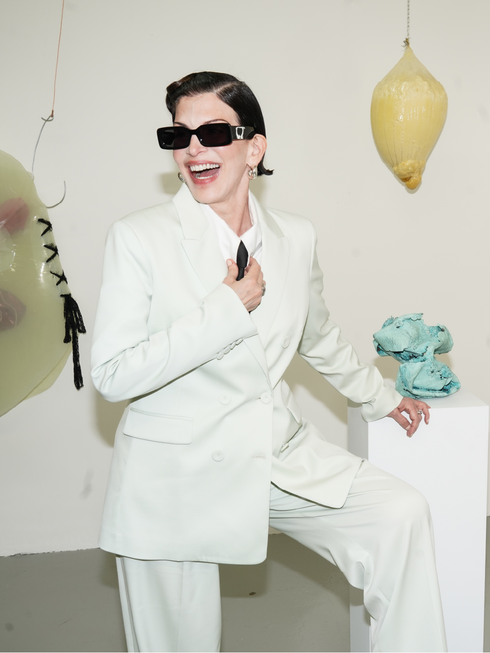
Two New York Feminists Discuss Their Booth at Future Fair text Zohra Vanlerberghe New Yorkers, whether they are born or bred, are a certain kind of breed. They know what they want and are not afraid to go get it. For those in the creative sphere, this means a work and life that is curated, full of collaboration, and where art often spills into personhood—Lesley Bodzy, is no exception, exceptionally chic (we love the photos that accompany this piece), she always looks impeccable and put together, with Jackie O as her ultimate inspiration. “What can I say, I love style,” she told me on the phone while we were discussing this Odalisque feature. Her sculptural work tackles themes of youth, beauty, time, and aging with deft, subtlety, and humor through material exploration, incorporating materials as diverse as latex, meat hooks, ribbons, acrylic paint pours, paper bags, bronze, glitter, and resin. It is daring to uncover societal pressures, fears, and hopes head-on and to dismantle what she calls the ‘artifice’—our second skin. Erica Criss, an artist and curator, has found her livelihood in supporting artists through her consultancy Criss Collaborations, and is showing Bodzy’s work during New York’s Art Week in May.. Criss has curated more than thirty exhibitions, of which three were with Bodzy. Both are unapologetically feminist. I invited them to discuss their newest show that will be opening on May 7th at Future Fair. Lesley Bodzy: Someone asked me how I came up with curating my work on multiple levels, eye level, above-head, and on the floor. This is really something that curators have led me to do. Including you, Erica. I see the role of the curator as enhancing my work and bringing it to the public eye in ways I can not even imagine. I think you should tell Odalisque’s readers more about your curatorial vision for Future Fair and how you think about curating, because it is very interesting. Erica Criss: My vision for Future Fair is to continue the conversation that was started last year between you and Katie Commodore in Womanhood 102—titled like a university class. You have both been hard at work creating new pieces, and I’m excited to debut several of them at the fair. I love how your works speak to each other. When curating a show like this, or any show really, I am considering the space, the artworks, and the audience. I am always thinking about how I can activate the space, how the works play off of each other, and what is going to draw people in. It is kind of like thinking of the exhibition as an artwork itself. I paired you as artists who both explore vulnerabilities from a place of strength. You both approach your subject matter boldly and make interesting use of your materials. Commodore’s meticulous peyote stitching and your free ideation of latex and resin, in new ways, made for an interesting contrast. What I didn’t expect was Commodore’s work, which is overtly sexual, bringing more covert aspects out of your own. Can you speak about the overt and covert nature of your work and its material? LB: My work is about aging and its effect on female beauty and sexuality. The latex works are wrinkled and deflating, yet still beautiful and compelling. As we age, women should still be considered attractive and desirable—that is, both the covert and the overt message. I think of myself as two-faced, my real self and my artifice, the latter are the more performative aspects of who I am. Women are encouraged more than men to develop their artifice, but men can hace very sophisticated ones too. How long have we worked together? And how many exhibitions of my work have you curated? EC: We were just talking about this the other day and couldn’t believe we’ve been working together for three years. Including Future Fair, I have curated three exhibitions with you. However, we have collaborated on over thirty exhibitions. So much goes into curating a show; it is not just about choosing the artworks. We work together on everything from digital marketing and installation logistics to graphic design. LB: Yes. You have supported so many artists. From your time at Manhattan Graphics Center as director of operations and chief curator, and at Kent State University, where you curated The Women’s Printmaking Invitational 2022 with over 100 artworks, and now your independent curatorial work. The world is always changing, as is the art world—what do you think artists need right now? EC: The art world is always changing, but what hasn’t changed is the artists’ need for support. I am also an artist and received an MFA from KSU. Having both experiences, as an artist and art administrator, I realized that the majority of artists do not think of their practice as a business. Traditionally, galleries handle all of the artist’s “business needs” like online presence, artist statements, marketing, sales, and more. The competition for gallery representation (and opportunities in general) is so oversaturated that the artist now has to be their own business to compete. This is one of the main reasons I started Criss Collaborations—to offer individual artists all of the services a gallery would offer, plus more. LB: Why did you decide to curate another feminist show? We have spoken about feminism at length together, and I think readers need to hear your opinion. How do you define your own feminism? EC: For myself, feminism is about recognizing women for their talents, uplifting the female voice, and redefining narratives to fit the female perspective. It is also about just being true to yourself. Last year, I showed you and Katie together for the first time in Womanhood 102. When I started that show, I felt a little scared at first because your work was so different visually. I wasn’t sure I’d be able to make the connections for the audience. But the more I spoke with both of you, the more I realized you were tackling the same overarching issues through different lenses. The show was so powerful, in both its