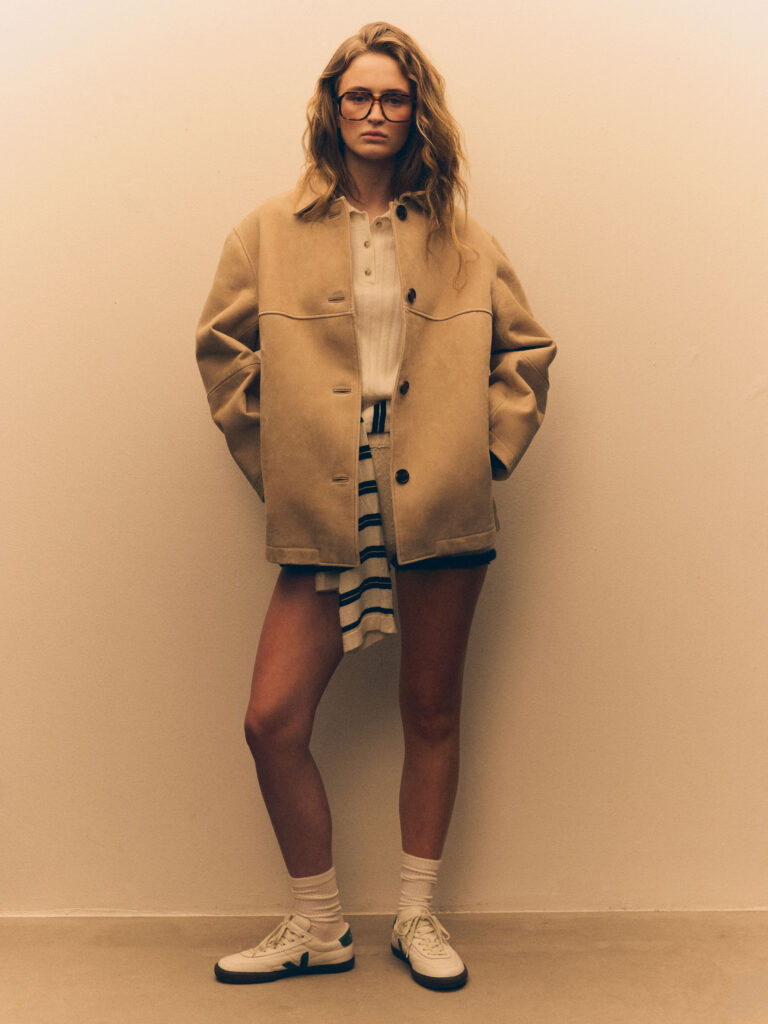
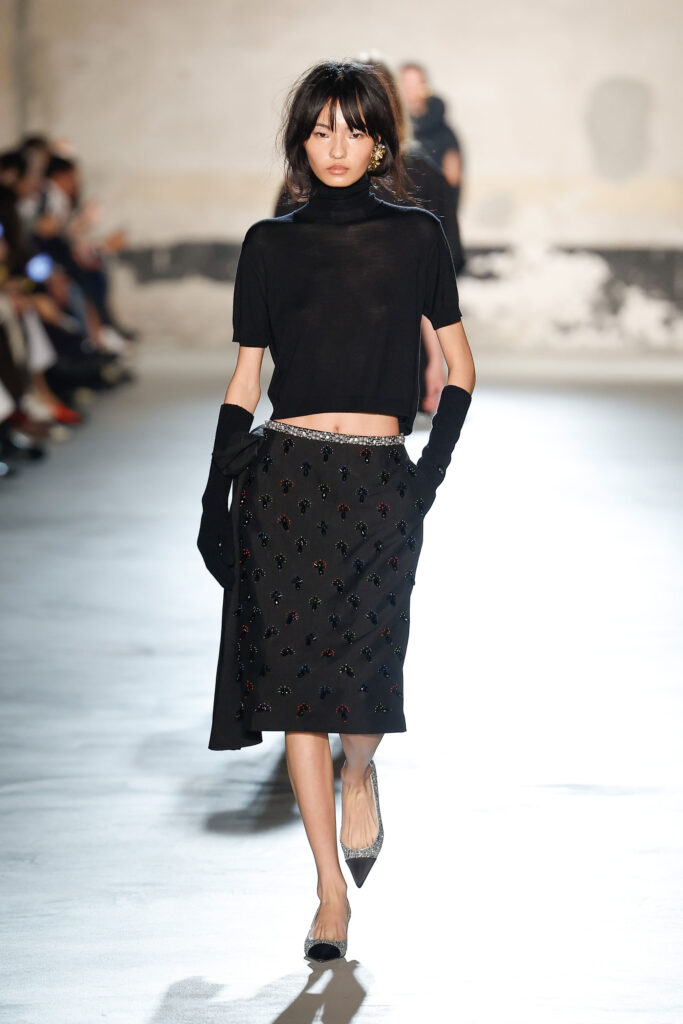
photography Ashley Jahncke The Architecture of 1. cre ar+ {Uno Crear Más}: Designed by Yola Colón 1. cre ar+ {Uno Crear Más} by YOLA COLÓN grows out of a practice that blends architecture, art history, and a deep respect for materials. Founder Yolanda Colón‑Greenberg studied architecture at Cornell and later completed a Master’s in Art History at NYU’s Institute of Fine Arts. That background shapes the way she builds garments: intentional, memory‑driven, and made to last. Her work doesn’t follow seasons. Instead, it grows as an archive: slow, iterative, and guided by the surplus textiles she chooses to work with. Puerto Rican heritage, an architectural eye, and long‑standing relationships with New York workrooms give the brand its quiet, precise language. In this conversation, she reflects on rebuilding her practice after Hurricane Maria and the pandemic and on how sustainability, material scarcity, and hands‑on making guide her work today. fashion Yola Colón (1.cre ar+ {uno crear más})hair and makeup Andrea C. Samauelsmodel Sylvia Gao / ONE Models You’ve described your garments as “living archives.” What does that idea mean to you?1. cre ar+ {Uno Crear Más} by YOLA COLÓN is built as an ongoing body of work rather than a sequence of seasons. A living archive reflects a consistent brand ethos centered on elevated workwear and enduring pieces. Core staples are produced in editions that respond to available materials, while new designs are introduced as layers rather than replacements. Instead of adhering to the traditional fashion cycle, the work develops cumulatively, allowing form, material, and identity to deepen over time. How does your Puerto Rican heritage shape the way you think about clothing as a form of memory? For me, clothing preserves meaning through reinterpretation—carrying the memory of an original form while allowing it to evolve. The Guayabera—traditionally a tailored Caribbean shirt defined by vertical pleats, embroidery, and four front pockets—is an early example of this. Growing up in Puerto Rico, I observed it was worn almost exclusively by men, with no equivalent worn by women. That absence stayed with me and led me to reimagine the form for women. My architectural training reinforces this approach, treating garments as constructed forms shaped by use, proportion, and context. This way of thinking—of caring for memory through form and material—is how I approach fashion pieces as concepts. 1. cre ar+ {Uno Crear Más} Guayabera Editions rework the traditional silhouette through fit and scale, using surplus cotton voile and its iconic pintucked stripe locally crafted in New York artisanal workroom. Realizing that many other women shared the same desire to wear it affirmed the relevance of carrying that cultural memory forward through construction and recontextualization rather than replication. When working with excess or historical textiles, what kinds of cultural or personal histories are you intentionally preserving or reactivating? I work with textiles that have been left behind—materials displaced by time or shifting systems of value. Discarded tablecloths at a market point to gatherings that no longer take place: the dressed table, embroidered initials, stains, repeated washing, starching, and pressing. I imagine how those surfaces might move again on the body. The same logic applies to Japanese selvedge denim sourced from closed or overstocked warehouses—fabric rooted in workwear, durability, and labor, produced with precision and then rendered surplus. Reworking these materials returns them to use, shifting them from dormancy back into circulation. You rebranded 1. cre ar+ {Uno Crear Más} by YOLA COLÓN after the Covid pandemic. What pushed you to make that change? The shift began earlier, after Hurricane Maria devastated Puerto Rico while my parents were there and unreachable. That experience heightened my awareness of environmental instability, intensifying storms, and the urgency of rethinking priorities—including the impact of fashion systems. During the Covid lockdown, the pause created space to reflect more deeply. I took a virtual course at LIM College (The Business of Fashion and Lifestyle division) focusing on sustainability, and while many businesses in the fashion district shut down, the period also led to a renewed reconnection with specialized workrooms I had collaborated with before. Around the same time, reading H of H Playbook by Anne Carson—and encountering her drawing of red overalls—sparked a decisive moment. In the context of Herakles, it suggests a figure carrying burden after devastation. For me, the simple sketch defined an outline of labor, vulnerability, and endurance. That image resonated deeply. It led me to restart with a single workwear piece: the overalls. That garment became the foundation for the rebrand—designed to be sustainable, long-lasting, and highly tailored, using utilitarian hardware and refined details like piping to elevate function into an enduring form. What does the new identity represent for you personally, especially after such an uncontrollable period? I think less about representation and more about how the work feels in practice. The new identity is grounded in direct local engagement—with pattern makers, specialized artisans, and cut-and-sew rooms, whether the process involves pleating, embroidery, or laser etching. Being present, asking questions, and refining details alongside the people who make the garments restores a sense of agency through process, and that closeness is also what makes the practice sustainable. Your practice focuses on reclaiming surplus textiles and working with material intelligence. What does ecological responsibility mean to you, and how is it interpreted in your atelier? Ecological responsibility is not a marketing position for me—it’s a design constraint. The work is made locally in New York, in high-standard workrooms, in small batches and editions where what evolves is the material rather than making collections. By working with surplus textiles, the practice reduces the need for new material production. Forms are repeated and refined through reinterpreted fabrics, and leftovers are intentionally used for belts, bags, or panel-pleated skirts. Production is highly finished and tailored so pieces are built to last, often made on demand thus no need to discard of inventory. Every decision privileges longevity, care, and precision over speed. You studied architecture and art history. How do those two backgrounds come together in your design process? They converge through structure