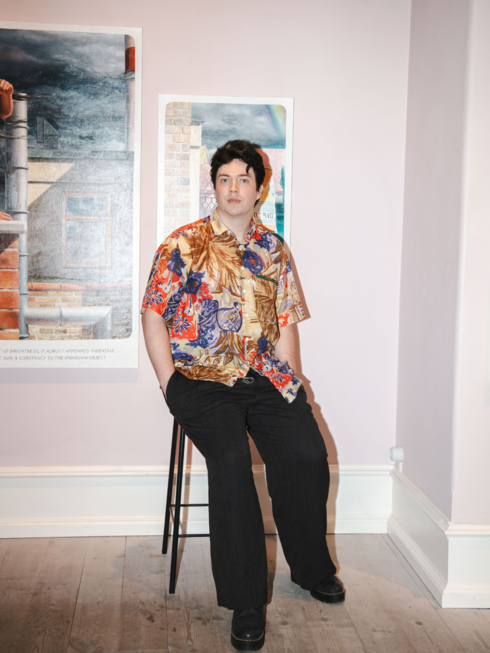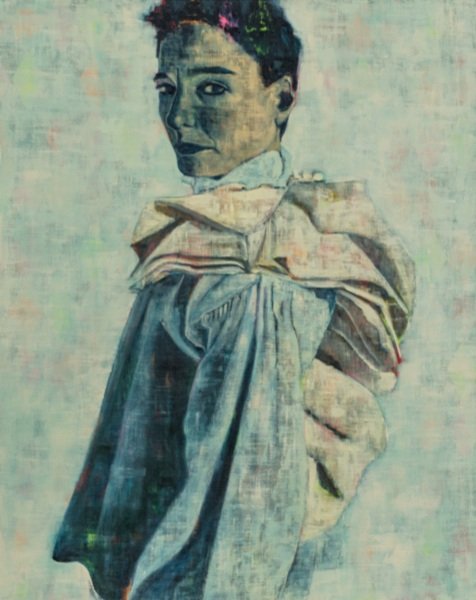
“The Erosion of Reason”: Gustaf Lilliestierna on Blurring Reality and Imagination text Natalia Muntean In his latest exhibition at WAY Gallery in Stockholm, titled The Erosion of Reason, Gustaf Lilliestierna invites viewers into a world where reality and imagination blur, creating a “parallel sense of time” that feels both familiar and foreign. His paintings, which he describes as “hyper images,” are more than just visual representations, they are layered with fragments of memory, ideas, and visual impulses that challenge our understanding of what is real. “I enjoy the childish qualities,” he admits, reflecting on the playful yet profound nature of his work. “I want it to be as enjoyable for a six-year-old as it is for a sixty-year-old theorist.” Gustaf’s process is deeply intuitive, often starting with a single image or idea that leads to another. “One thing just leads to another,” he explains. “I might have 50 ideas, and then I’m trying to understand how these ideas relate to each other. How can they be combined?” For Gustaf, the act of painting is as much about discovery as it is about creation. “They are always a mystery,” he says of his works. “I do wish to see them, so I make them. But in the end, they become material for new thoughts.” Through evocative painting and a deep engagement with nostalgia and inspiration, Gustaf’s art invites viewers to explore the spaces where reality and imagination intersect. Natalia Muntean: How did you develop the concept of “hyperimages,” and what is the most challenging part of creating them? Gustaf Lilliestierna: “Hyperimagery” started as a term I used once, and I noticed how helpful it was. Without it, I could describe my practice as a problematisation of referencelessness, or perhaps referential ambiguity, in visual representation. Or, I could say it’s a playful attempt to provoke new mental images through depiction. But neither explanation fully captures my practice, and they’re unfair to the immediate experience of my pieces. I often spiral when asked, “What do you do?” So, I embraced the term “hyperimagery,” which popped into my head, and it’s been useful ever since. When I use it, I’m referring toimages that are intuitively, and perhaps even ontologically, perceived as more than one image. NM: How do you define the relationship between reality and imagination in your work? GL: This question is larger than life! Every attempt to define this relationship pushes the line that represents the “between.” If we assume reality is everything that exists independently of our thoughts, then no such line can exist without us imagining it. A perspective from that line—bordering reality on one side and imagination on the other—would inevitably come from a position within the “non-real.” Any answer inspired by this juxtaposition will be unsatisfactory. We must consider whether we’re answering from individual, separate realities and imaginations, positioned behind a line we can’t fully access. If so, it’s hard to say anything definitive about “the” or “a” reality. If we still believe we can describe “the” reality we all share without including imagination, our book of knowledge would be very thin. Perhaps I’m too cautious to answer this question. But I can say this: I love being a mind. And as a mind, I find myself superpositioned between these fields, though I try to avoid the border between them. NM: How do you decide on the colour palette and composition for a piece? GL: I always start by drawing. Sometimes the final product of this ‘thinking by doing’ activity consists of several, usually 5-10, drawings. Sometimes it results in depictions of buildings, people, streets, objects, or just faces. This collection gives me an idea (if I’m not currently under the influence of one). The idea however is never better than the composition and is only worth realising if I’m pleased with the aesthetic quality of the visuality in a given form. I therefore make a lot of lines and measurements within a drawn dimensional frame. It is perhaps a golden ratio fetish, but I need it for motivation. When the proportions of my ‘abstract composition’ correspond with my collection of imagery nicely, I compose the image using the chosen means. I then translate the drawing into an oil painting. I try to keep it as mind-dependent as I possibly can, but sometimes I do real-life drawing, and build models or digital illustrations as support. The colour palette depends on the mood, which is revealed by the scene. It always ends up in a certain place, at a certain hour. NM: How do you know when a painting is finished, especially when dealing with such abstract and elusive concepts? GL: It’s a question of just stopping. In one way, they’re never thematically finished. I finish the drawing when it’s close to what I had in mind, and I finish the painting when it looks cool and convincing. Sometimes I manipulate the idea, maybe adding a road sign, a lamp, or another figure. But this is risky, and when it happens, I often start over. I do a lot of work outside the studio: thinking, drawing, reading, exploring, and writing. I usually trust the process once I pick up the brush. I also evaluate my process between paintings, being careful about the direction a series is headed. NM: What does the title The Erosion of Reason mean to you, and how does it reflect the themes of the exhibition? GL: I wanted a title that reflected my previous claims about the immediacy of artistic experience. I wanted to align this with the view that every artwork represents a possible antithesis to a possible linguistic conclusion. I decided that “The Erosion of Reason” was a good fit, since it packs several punches: “The Erosion of Motive”, “The Erosion of Cause”, and “The Erosion of Rational Thinking”. In the case of art, something like an erosion of reason (as the erosion of motive, cause, and rational thinking) becomes beneficial if we wish to see, experience and feel without limitation. In such cases, the erosion of reason occurs