"A Race Against Time": Ryan Koopmans on The Wild Within
Text by Natalia Muntean
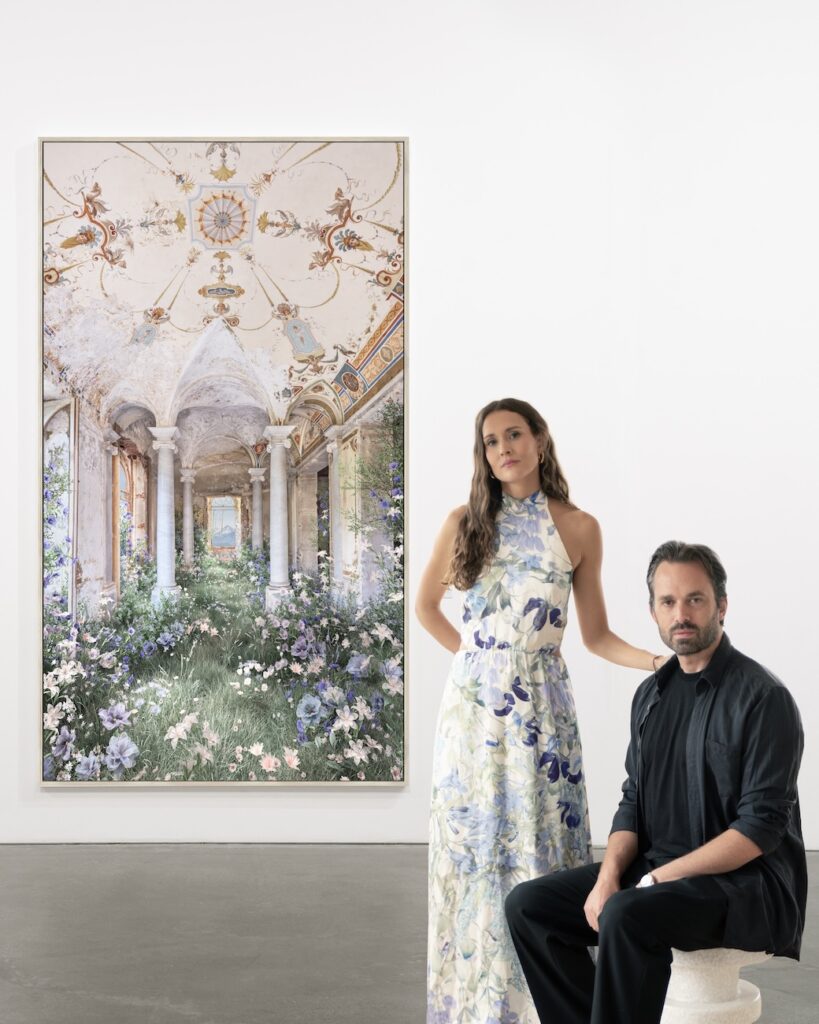
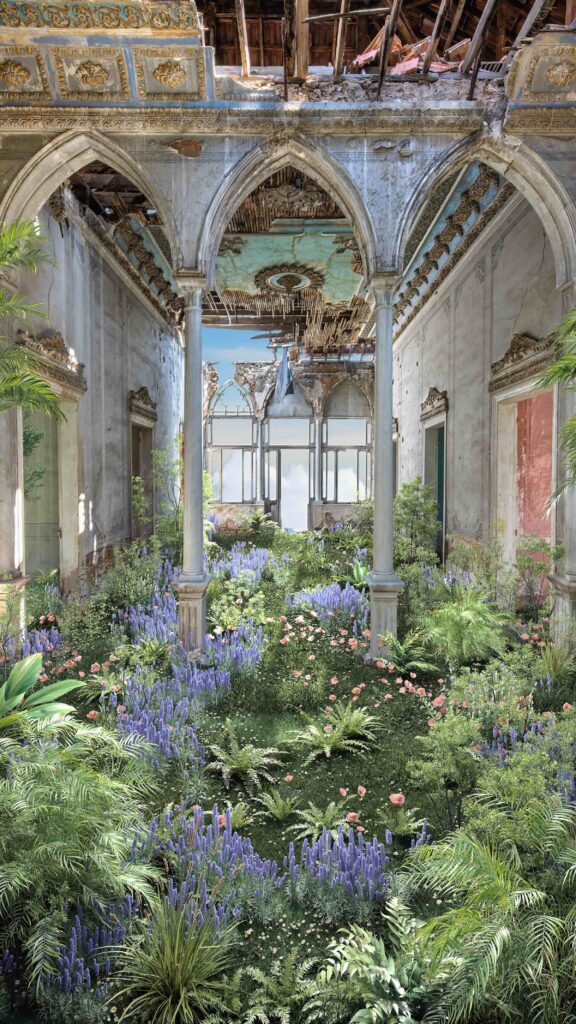
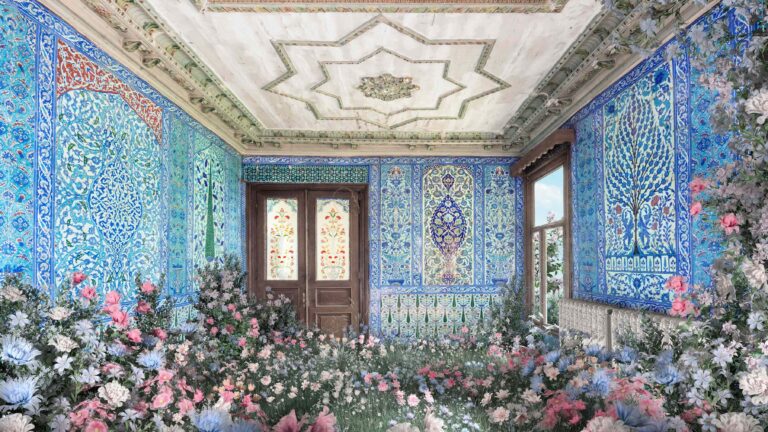
Ryan Koopmans and Alice Wexell have spent the better part of a decade turning abandoned buildings into something else entirely. Their project, The Wild Within, started in Tskaltubo, Georgia, in the ruins of former Soviet sanatoriums, and has since taken the duo through Armenia, Lebanon, Italy, Poland, Mexico and beyond. Each piece starts as a documentary photograph of a real, decaying space, then is rebuilt in the studio with digitally sculpted vegetation, light and motion, part archive, part invention. Ahead of their solo show at Leila Heller Gallery in New York this September, Koopmans talks about ruins, revival, and the blurry line between what’s real and what isn’t.
NM: What do you look for in a building?
RK: It doesn’t need to be old, but it needs deterioration, moss, water damage, some marking of time and human presence, even just where pipes have been ripped out. In Georgia, the Soviet-era buildings aren’t even that old, built in the ’40s, ’50s, ’60s; we’re not looking for ancient ruins.
We look for buildings that are unique and strange, geometric, symmetrical, a good, balanced, straight-on composition, and ideally with openings between interior and exterior that let us emphasise that boundary. And we look for places that haven’t been overly photographed already.
NM: Has a building ever surprised you, looked right on paper, then turned out not to be, once you got there?
RK: All the time, every trip. Often you find images online and by the time you arrive, the building’s gone, or fully renovated, or partially torn down, or the roof’s collapsed. Sometimes one usable location is enough to justify the whole trip. Other times, you travel for one specific building, don’t end up using it, and instead stumble onto something completely different. Every country, every trip, has some huge challenges and some amazing unexpected discovery.
NM: Do you usually shoot the interiors, rather than the exteriors?
RK: Yes, usually inside, that’s the core of it. We have shot facades and exteriors before, but mostly we’re looking for interior spaces with doorways or windows, which we later remove to create depth between interior and exterior. We shoot the inside and often use photogrammetry to scan it; instead of a single picture, we shoot 360 degrees of a space, then combine it in software into a three-dimensional, navigable model. You can walk under a balcony because you’ve shot from so many angles.
Back at our studio in Stockholm, we reconstruct those photographs into a 3D space using software like Cinema 4D. Then we build and model the overgrowth, the floor, the plants, the flowers, the light, and add motion. The final piece is a single-point-perspective video work, though it exists in two forms: video and large-format prints.
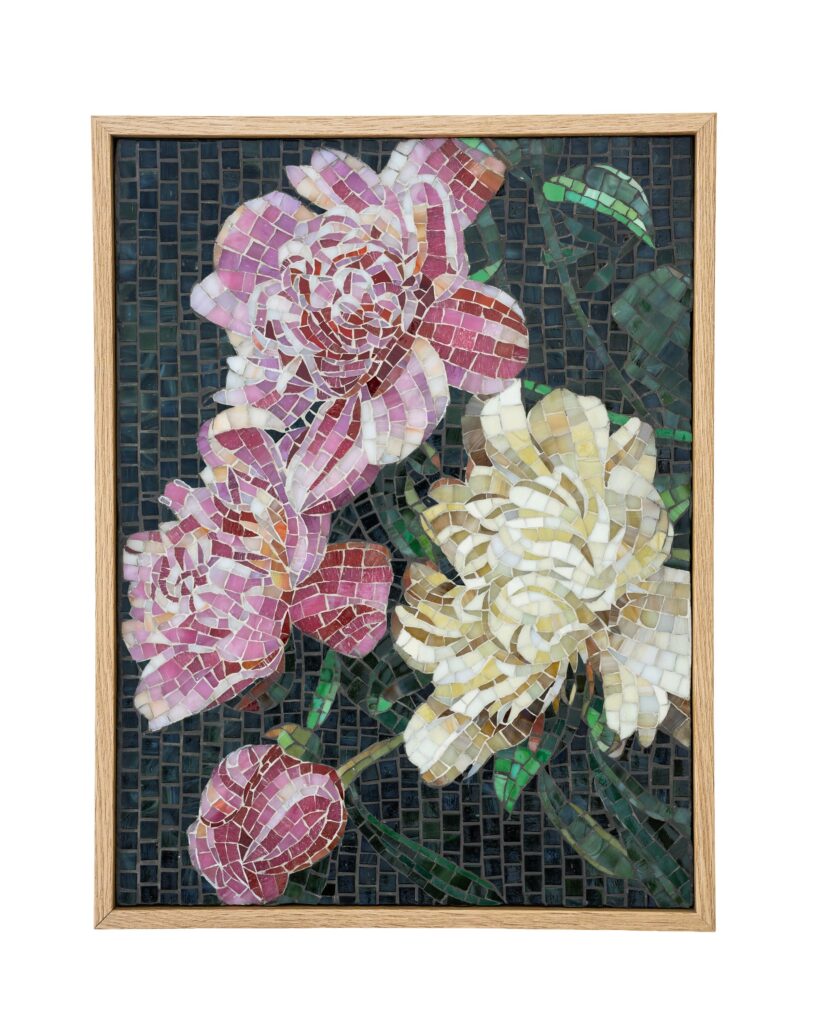
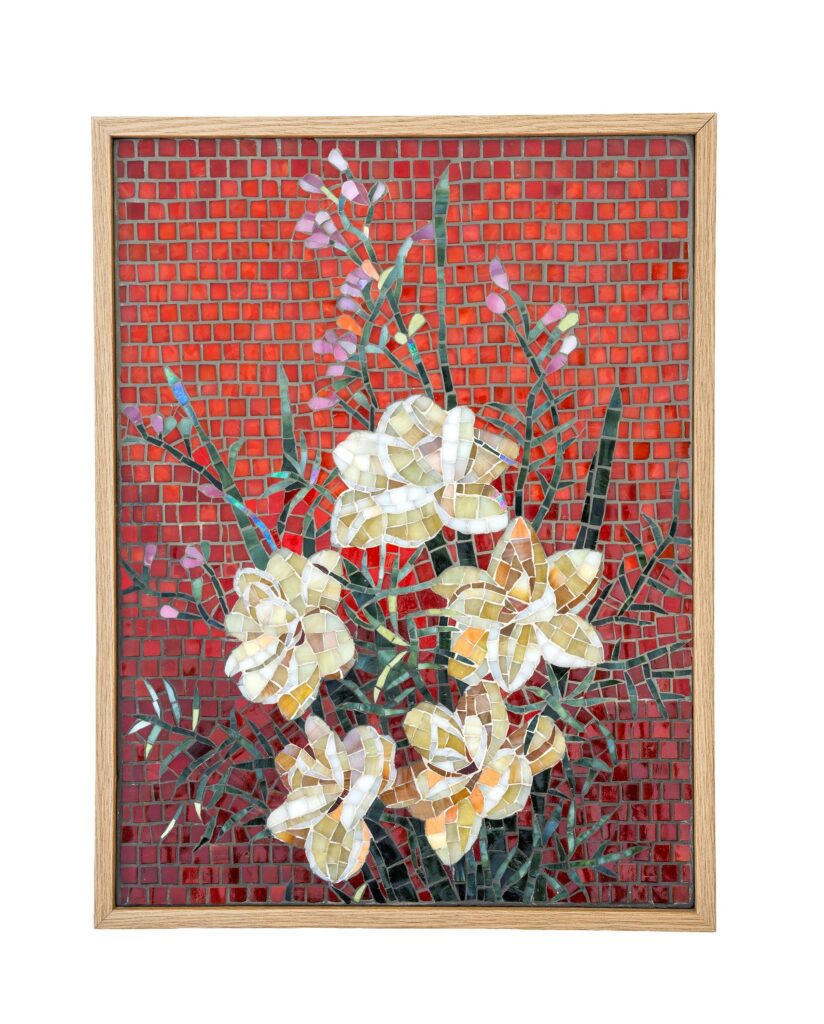
More recently, we’ve added a third layer, physical mosaics of these scenes. It came full circle, in a way: in Georgia, there were mosaics on the walls of these buildings, and an old post office full of postcards people had sent from the sanatorium town. Seeing those floral postcards scattered on the ground was actually one of the early sparks for thinking about colour and flowers inside these decrepit spaces. Now we’re making hand-cut glass mosaics; some recreate the postcards directly, others are our typical architecture-and-nature pieces rendered physically. They take months to make.
NM: How do you choose the plants and flowers you add?
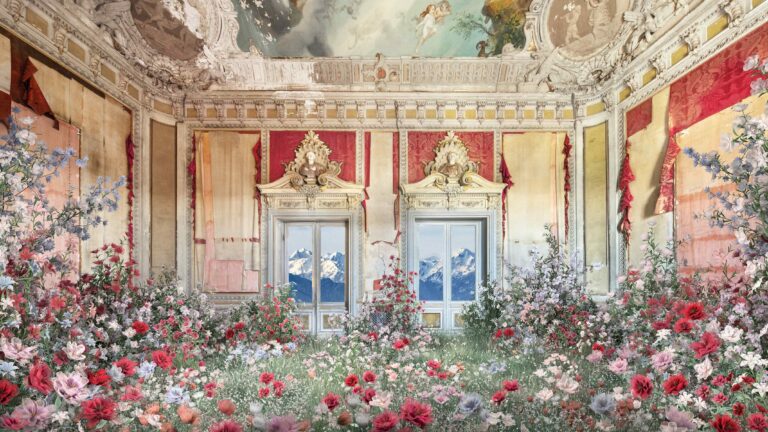
RK: It depends on the piece. Sometimes it’s purely aesthetic: colour, shape, scale, composed around the architecture. Most of the plants originate from photographs of real flowers that we bring into 3D and manipulate, and over time we re-adapt them until they become almost a fantastical, non-existent species. That points to a relationship we like exploring: what’s real and what isn’t. People often assume the architecture is the fake part and nature is real, when actually it’s the reverse: the architecture is human-made and real, and nature is the artificial layer.
Other times the plants are more literal: the national flower of a country, or for a piece from an old psychiatric facility in Italy, every plant was medicinal, used for treatment in some way. But composition, scale, and colour are always a big part of the decision, alongside whichever concept we’re working with, including researching and rebuilding species that are genuinely endemic to a place, like a recent piece in Cyprus using five or six native species.
NM: You started in Georgia, then moved through Armenia, Lebanon, Italy, Poland, and now this new chapter spans Italy, Poland, Lebanon, Mexico, Azerbaijan, Turkey, and India. What connects all these places?
RK: After Georgia, we realised this phenomenon exists in so many places. Armenia came next, then Lebanon, then Western Europe, Italy in particular, which has an enormous history of interesting architecture and sociocultural reasons for abandonment, and southern Poland. For a while our interest shifted to the Levant and the Gulf. India is fascinating too, though we’ve only spent a bit of time around Mumbai, but there’s so much to explore that it’s actually been daunting. And we recently shot in Mexico, which has a completely different history and lineage behind its abandonment.
The locations end up scattered because it really comes from personal interest, real life bringing up an interest in a place.
NM: Is there a deeper thread connecting them, beyond the buildings themselves?
RK: It’s abandoned buildings that are actively decaying, not being protected or preserved, almost a race against time. A lot of these countries are also going through exponential transformation and redevelopment, so there’s a high concentration of change happening as a country modernises, and that’s often what pulls our interest to a place. It’s not an infinite resource, either; it’s more like an existing stock that slowly disappears. You can’t manufacture a new abandoned building.
NM: Was there a site that changed how you think about the project, or was harder to document than most?
RK: Tskaltubo was the most impactful. I had never seen buildings designed quite like that before, with huge circular openings in the ceiling and so on. More recently, in Italy, the level of detail in the frescoes and interior paintings shifted how we approach pieces. We’re now incorporating that existing artwork into the work itself, rather than avoiding it, which is what we would have done before; we would have focused on structure and treated another era’s painting as something to work around.
What changed is realising those frescoes are more an architectural feature, tied to the place and time it was made, than a separate artist’s artwork sitting on top of the building.
NM: You’ve described the series as drawing on the capriccio tradition. Can you explain that?
RK: Capriccio is an Italian painting tradition where artists would travel to ruins, sketch them on site, then return to the studio and reinterpret that documentation into romantic, overgrown, fantastical scenes, a rough sketch of a Roman column might end up in the final painting covered in ivy, under dramatic light. The parallel to our process is quite direct: we shoot something documentary, then reinterpret it imaginatively back in the studio.
It’s also about looking at past civilisations, which is part of what’s so interesting about the former Soviet Union, a country that doesn’t exist anymore, and not even that long ago. An entire empire disappeared and fragmented into its own segments. The capriccio painters were doing something similar with ancient civilisations, drawing on that relationship to nature imaginatively, rather than documentarily, even though the mediums and the eras are obviously very different.
NM: The work is very much a fusion of you and Alice. How does that show up?
RK: There’s an influence of a masculine and a feminine in it, whether you want to phrase it that way or not, the architecture is stark and structural, and the nature is more traditionally ephemeral and lighter, and the two come together. There’s probably also a Swedish influence through Alice, midsummer, the seasons, the floral aspect of that, which is where you might see that fairytale, fantastical quality and the colour.
NM: You’ve worked together a long time. What happens when you disagree?
RK: We tend to have the same instinct about the final answer, what makes something good or interesting, even if getting there involves seeing each other’s perspectives and working through it like any dialogue. That’s not really an area where we have disagreements, which has been the reason it’s worked for so long.
NM: How would you describe the work? It’s photography, but also 3D, and now sculpture.
RK: I’ve always made work that crosses categories; even “documentary photography” feels too narrow, because it’s never purely architecture photography or purely documentary; there are always multiple things converging. It fits even less into a single category now that we’re working in physical wall sculpture through the mosaics.
The way I phrase it is lens-based art; the lens is involved from the very beginning, covering photography, video, and however it’s ultimately shown, whether projection or screen. It’s not purely digital either, so at the end of the day it’s multimedia, lens-based art that also moves into physical sculpture.
NM: You mentioned AI. Does it play a role in the work?
RK: I think AI is a wonderful tool, and we use it for research, planning, organisation, and communication, but we don’t use it in the actual image-making. It’s not that I have anything against it; it just doesn’t conceptually fit what we’re doing, because the work is still based on a real place you have to physically go to and experience. The plants and foliage are still hand-arranged to a degree that AI can’t replicate yet, and we still like doing that process physically, even if the result is digital.
People sometimes assume digital processes are instant, but a single piece is a ridiculously demanding amount of time, many months of full-time work, start to finish.
NM: Do you ever get halfway through a piece and realise it’s not working?
RK: All the time. We’re always making pieces, and sometimes finishing them, that never end up going out into the world, because something about it doesn’t feel right or isn’t up to the quality we want, and you can get quite far into a piece before realising that. There’s a stage we call the print test: are you willing to put the resources behind printing this and actually live with it on the wall? You get your answer pretty fast. Sometimes things surprise you, but ninety-nine per cent of the time, you intuitively know.
NM: Tell me about the exhibition in September.
RK: Our main gallery is Leila Heller Gallery. Leila’s been a gallerist in New York for over forty-five years, and she also runs the largest art gallery in the Middle East, in Dubai, where we had a big solo show that ran from last November through the end of January. This next show is at their New York location, in a converted Upper East Side townhouse, a much more intimate, human-scaled space than the airplane-hangar white cube of Dubai, so the pieces are slightly smaller on average than the three-metre-plus works we showed there.
It will include new work from Italy and Mexico, a couple of pieces from India and Poland, and it’s the first time we’ll be showing the mosaic works publicly. In total, there are twenty-five individual pieces. The largest is a screen work at three by two-and-a-half metres; the big prints run about two-and-a-half metres on their longer side; the largest mosaic is 2.7 metres, with some smaller ones alongside it. So the scale runs smaller to large, compared to our last show, where everything was at least a metre and a half.
It runs for a month and a half, through September and October, one of the best art months in New York, with the Armoury Show and fashion week happening at the same time.
NM: What do you hope people take away from it?
RK: What we find interesting is when people really have to look, there’s a curiosity, and often people touch the work because they’re not sure if it’s painted, printed or has some tactility to it. That questioning of what you’re looking at is always something we’re aiming for. A lot of people end up with a peaceful, meditative response to it, but that’s more a byproduct than a goal; we are not trying to engineer that reaction. What we really want is that curiosity: is this a real place? What’s real, what’s not? An engagement, visually and intellectually.
NM: What’s next for you, beyond the show?
RK: Before and after it, we’ve got a lot of art fairs, Frieze Abu Dhabi for the first time, Art Basel Miami in the works, and group shows in Spain, Italy, and Paris. In terms of geography, India is still going to be a big part of what’s next; we’ve only touched Mumbai, and there’s so much to explore that it’s actually part of why it’s taken this long; it’s such a huge place, and properly covering it takes a lot of resources and energy.
We also keep informal files of research on places we know about but haven’t properly explored; Portugal is one. But recently we’ve spent a lot of time through the Gulf and the Caucasus, Azerbaijan, Turkey, so I’d guess the next real pull is further east rather than those regions again.
NM: Is there anything you would want people to understand about how the work is made?
RK: That it takes a long time. Because some of the technique is digital, there’s a perception that things can be made quickly, but the opposite is true. It’s based on a real place you have to physically travel to and experience, and the plants are still hand-arranged to a degree no automated process can replicate. It’s a demanding amount of time for every single piece, but a very enjoyable process.