As She Conquers the Art World, Curator Carolina Edman Remains in Pursuit of Its Infinite Layers
text Anna Mikaela Ekstrand
In this conversation, Swedish curator Carolina Edman reflects on her own practice and others that are defined by curiosity, rigour, and a refusal of easy solutions. Working between New York, Paris, and Stockholm, she is always looking to the future, but learning from the past.
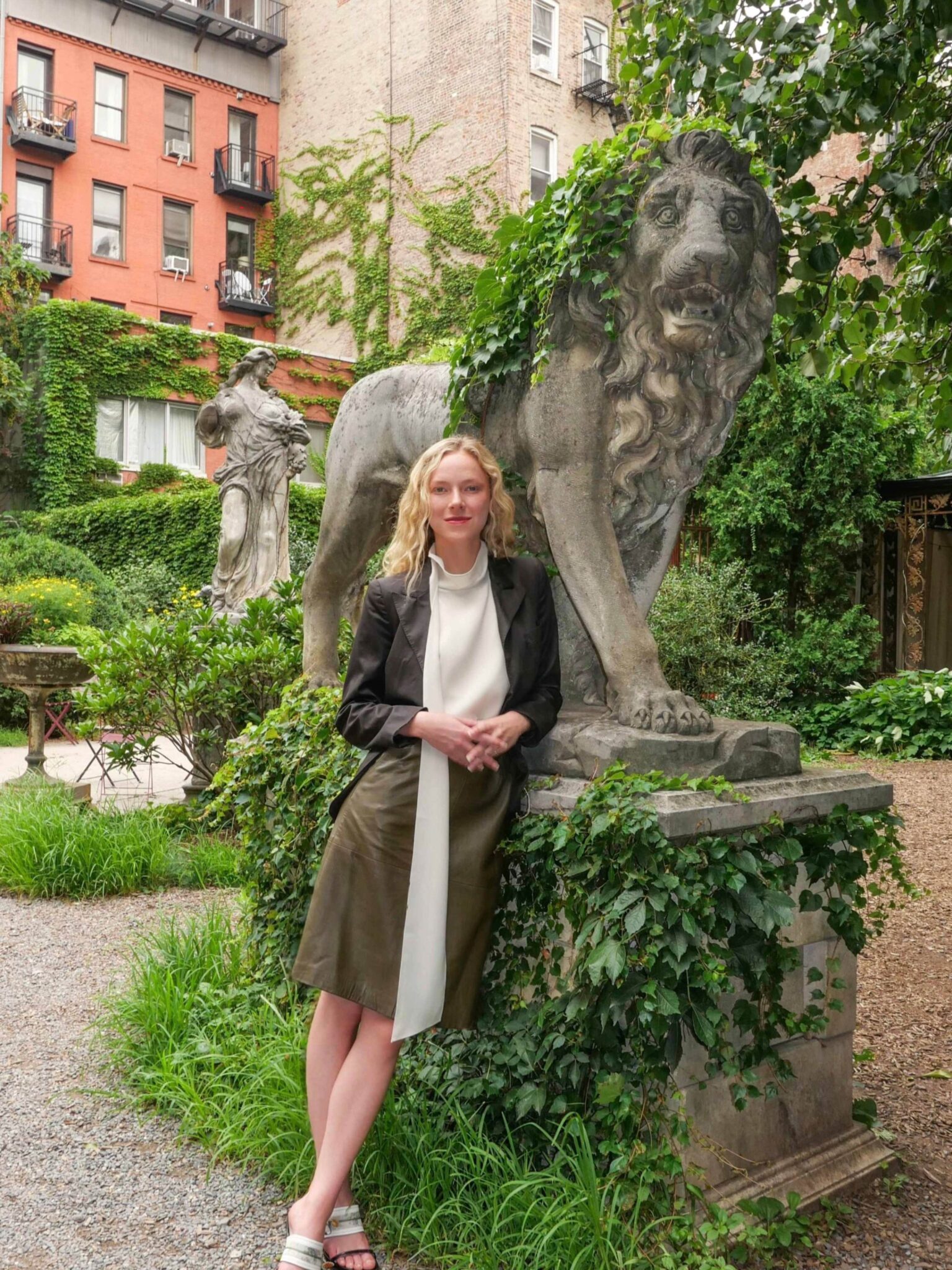
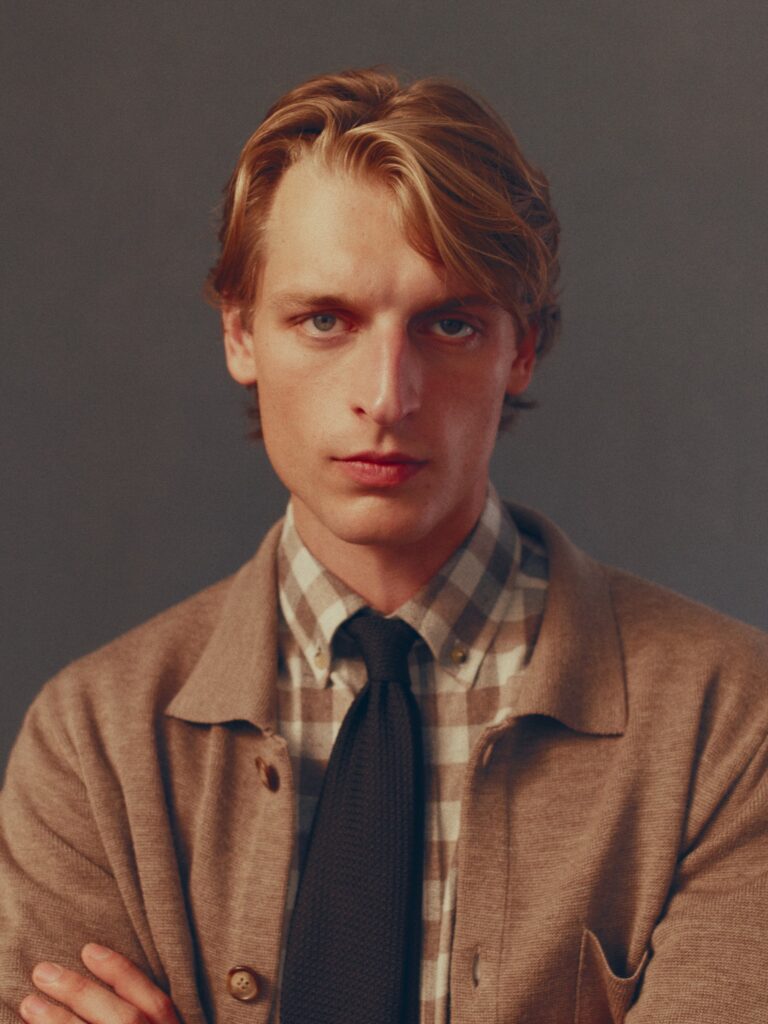
Anna Mikaela Ekstrand: You are pictured at Elizabeth Street Garden and the Temple of Dendur. Why are these places important to you and your curatorial praxis?
Carolina Edman: Elisabeth Street Garden is a place of wonder and tranquillity apart from the intensity of New York. To me, it transcends a mere green space; something living, something real is taking place in everything. The garden has a series of stone sculptures, including the Goddess of the Harvest, Hermes the Messenger, Sphinxes, and a reclining Lion. Medusa in a corner stands as a symbol of survival. These elements are of historical and artistic significance. The seasonal changes interact with the sculptures; the flowers in the summer and the glossy green ivy leaves turn brilliant shades of orange, red, and crimson in the fall, becoming part of the composition.
I believe that we can never be separated from nature and that humans and our culture are always interlinked with the site around us. The garden’s elements are interrelated, creating an environment, a holistic sculpture, if you will. But I am interested in the garden not as a kind of Eden, or the idea of equilibrium in Western mythology. There is never a clear division between us and the interface with our surroundings, and it is about the dynamic interplay. The fundamental part is the resilience of the constantly self-changing system that is evolution, and I believe there are many parallels here to artists. I am proud to have been part of the community that saved the garden from being demolished.
photography Danilo Laura
fashion Nicole Yang
‘Edman played a critical role by contributing her expertise in the history of art and its legal aspects to lay out the ideas to protect the garden. It is an irreplaceable physical and social sculpture, which she helped our community articulate and express’ – Joseph Reiver
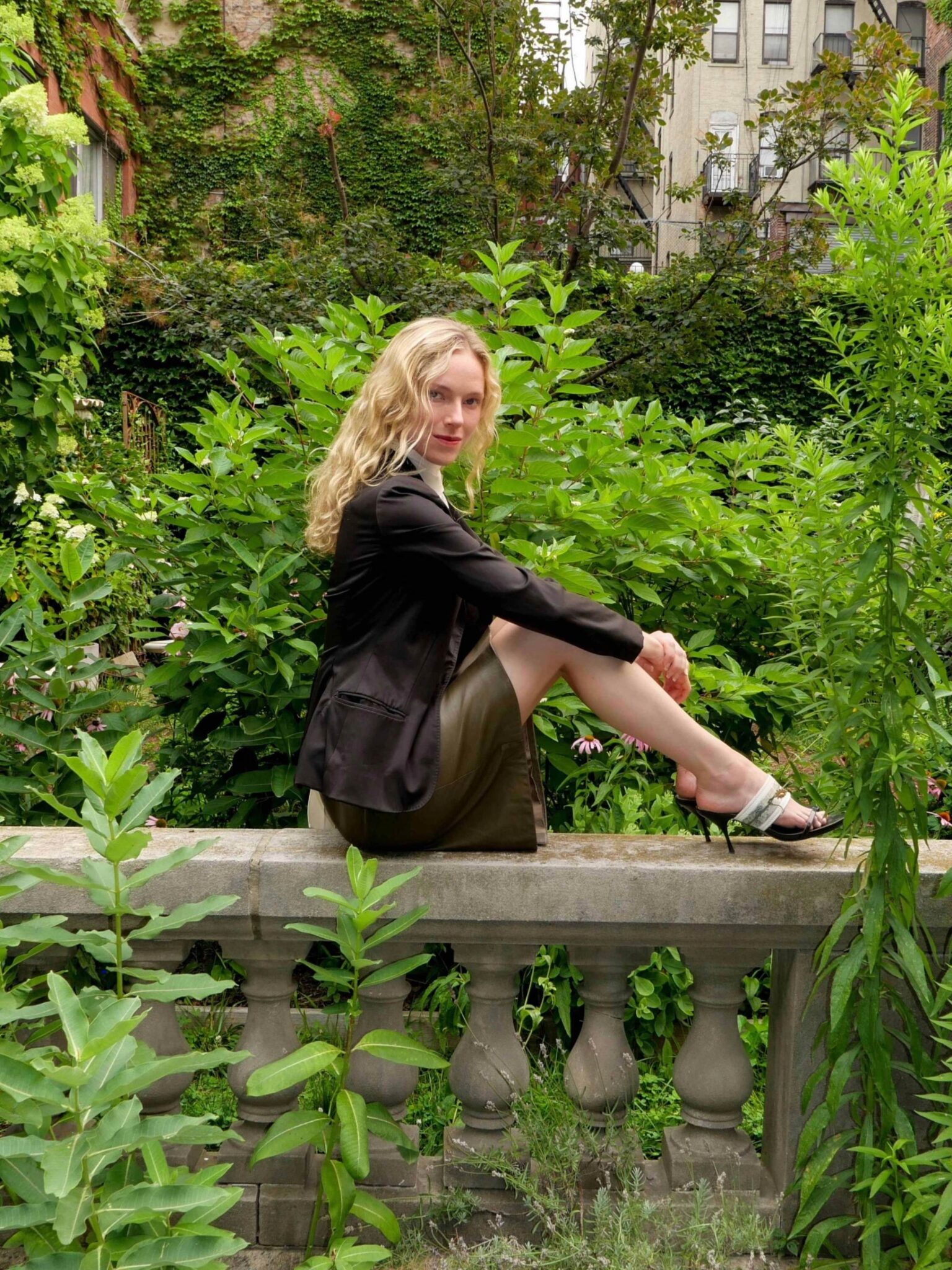
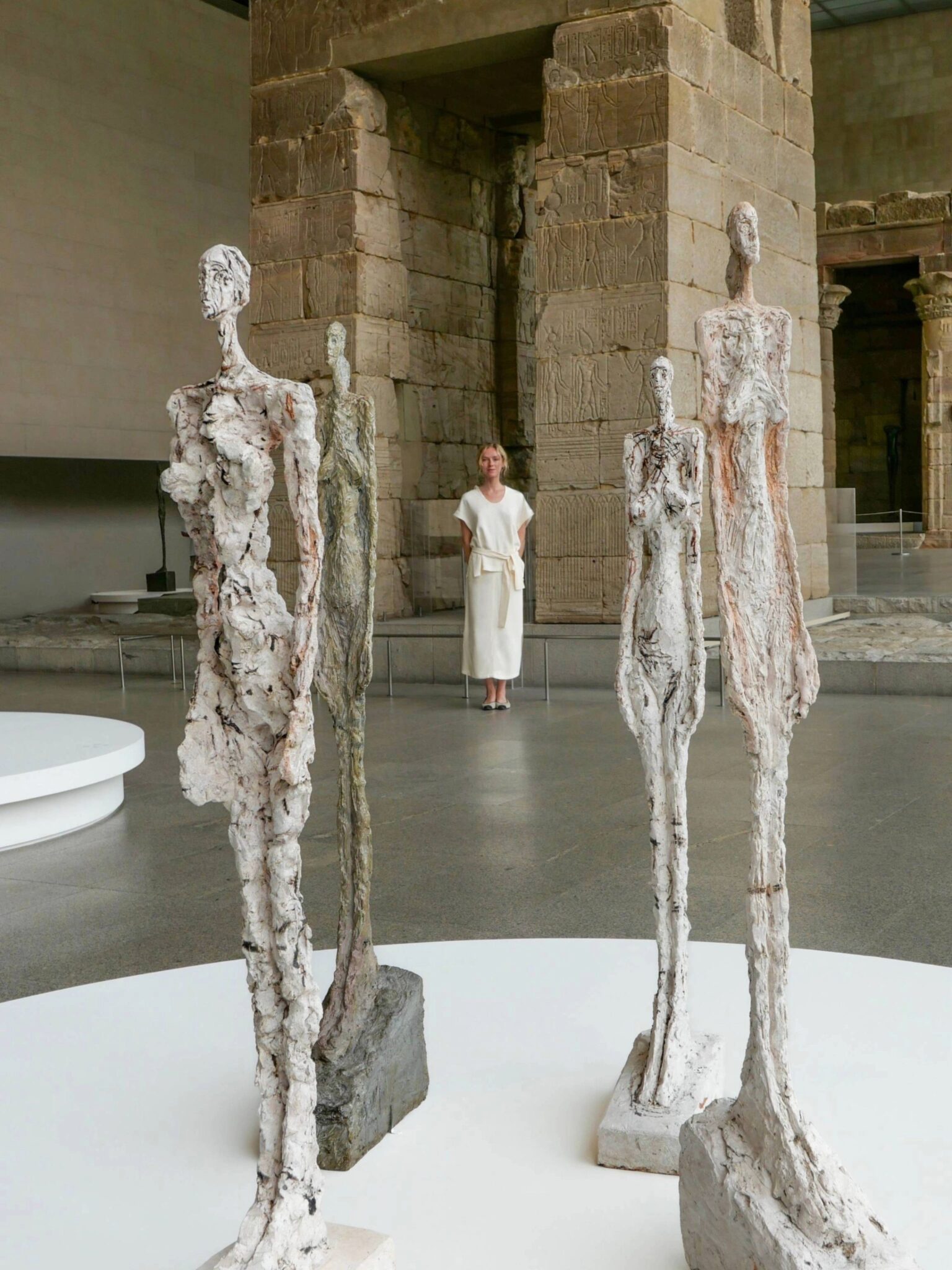
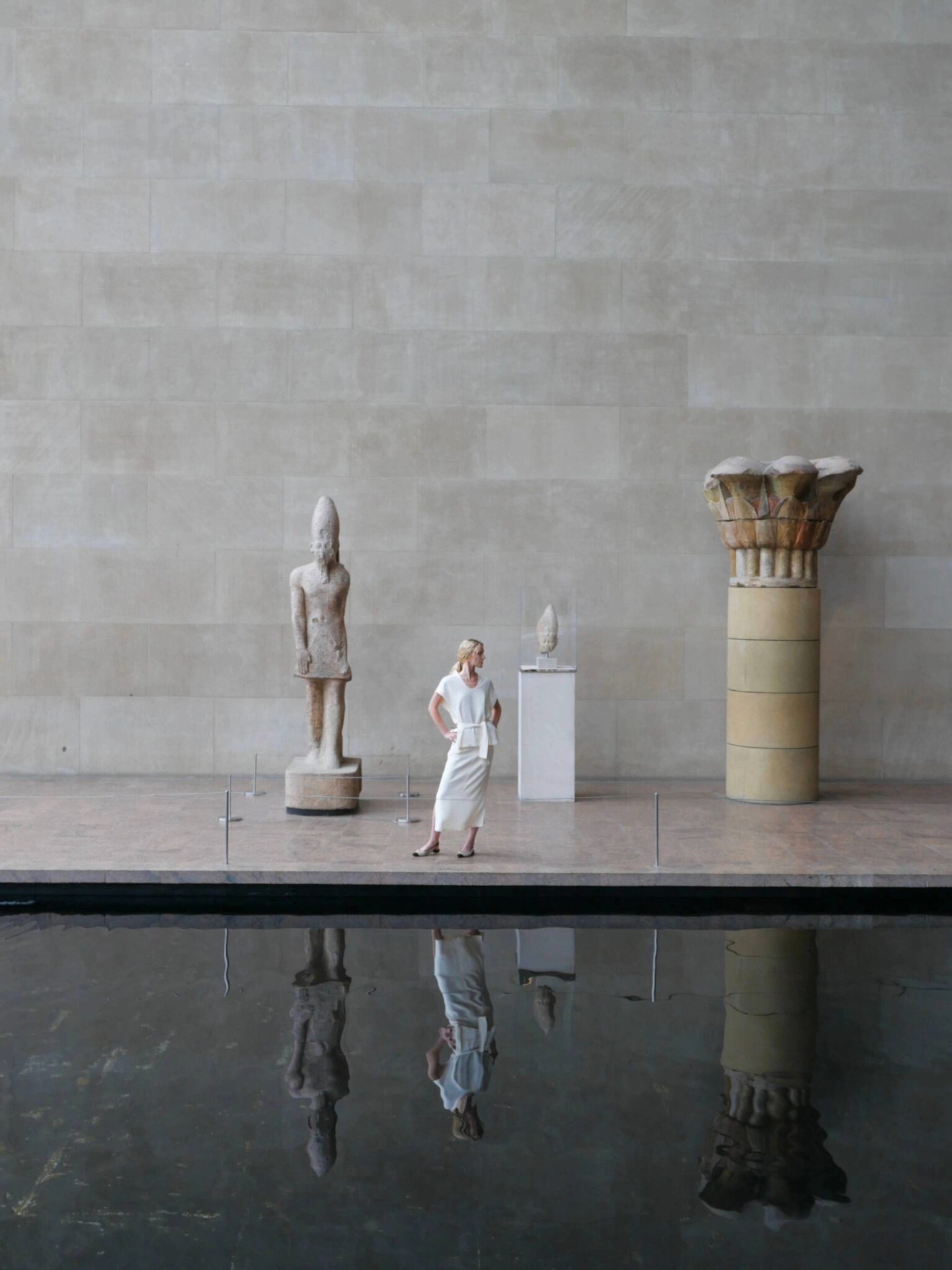
During the past years of calling New York home, the Metropolitan Museum of Art has been another core pillar of my life in the city. I often come to seek a specific object, or to simply meander. For good and for worse, this huge accumulation of objects stands out from any other museum in the world. Being able to sit in their presence is unique. Walking through the galleries creates temporal axes across millennia and ancient civilisations. It is precisely these bold curatorial dialogues that fascinate me. It is an approach to art that is at once generous, rigorous, and entirely thought-provoking. I am looking forward to how this will be developed by Frida Escobedo’s vision for the Tang Wing.
The current exhibition of Giacometti at the Temple of Dendur is a case in point. It succeeds in an ahistorical homage to human artistic expression through history, an unforgettable curatorial juxtaposition, only possible at the Met. It demands a new way of looking at Giacometti. Of course, pairing more recent art with ancient artefacts is not a novel curatorial move. One of my favourite exhibitions is Harald Szeemann’s A-Historische Klanken [Ahistorical Sounds] at the Museum Boymans-van Beuningen in 1988. It visualised the form of jolting dialogues made possible by placing objects from across time in proximity. I believe today, with the broader flattening of time, these exhibitions are more relevant than ever.
AME: Your writing and curatorial ideas centre around what you have called the ‘nonfinite’. Tell me more.
CE: I am interested in the ‘nonfinite’ as a distinct aesthetic mode. This is not about interruption or artwork which is unfinished. It is about artwork that is not retained only in the brain, but is, somehow, an energy. It is art that incorporates and invites the observer in its creation; it has the capacity to elicit imagination, or a form of alterity within, and sustain a continuous, mediumistic openness.
Since our minds cannot properly conceive the infinite, and indeed recoil from the very thought, we settle for the nonfinite. The world we inhabit extends beyond what can be seen; we live in a palimpsest of ‘structures of feeling’, in rooms framed by the longing of the soul. This largely invisible architecture creates a vessel for the world to arrive into. We always have the ability to access the plane where possibility takes shape, where contradictions are unified, and it is possible to reconfigure and reframe that which shapes our thoughts and actions. That plane is radical because it assumes there is always a way beyond.
At this moment, my confidence in the purpose of aesthetics, and that there are things only art can give us, by means specific to it, rests in the knowledge of its unendedness. The nonfinite evokes the sense of ordinary, or elemental, magic of life. It borders on the impossible, often eccentric, pursuit of beauty across art, science, architecture, politics, agriculture, theology, and fashion. So, I am looking for something beyond the mask of contemporary society. Something otherworldly. How do we access that? How do we ask better questions? Or, ‘How do we flood the gate?’ as Arthur Jafa has put it.
AME: What is participatory imagination?
CE: Consider seeing Turner’s painting with the mythological scene of Ulysses. In reality, it is merely a conglomeration of pigments and compositional parts, but we complete it in our minds; we wonder where on the journey the scene takes place; we experience an entire world in the eye of our mind.
Participatory imagination describes how meaning emerges through our encounters. We make art come into existence through observation, based on personal experience and collective consciousness. This does not mean that it is all constructed, but simply that the essential character, or aura, of a place or thing is activated by being seen or interacted with. Similarly, our sense of placement in life comes from sensing that we are seen by the world, or by others.
AME: You organised the U.S. launch of Pontus Hultén: The Commander of Modern Art. A biography of Centre Pompidou’s first director and the long-time director of the Modern Museum in Sweden, where he developed the collection and brought the institution to the international stage. He was really a behemoth. What does his work mean to your curatorial practice, and which of his projects are amongst your favourites?
CE: I believe Pontus Hultén had a singular impact on the development of modern art and how we understand curating today. He initiated some of the first exhibitions that truly aimed at giving form to life. It was always about ‘movement’ in art. My favourite exhibition with him is The Machine as Seen at the End of the Mechanical Age, curated for the Museum of Modern Art in New York, 1968. As with his practice at large, it complicated the ideas of the original and reproduction. This exhibition completely preceded what is possibly the most compelling global narrative of our current moment, namely the social, cultural, and economic synergy between the physical and the virtual, as the synthetic realm becomes increasingly more tangible.
The title of this exhibition obviously comes from Walter Benjamin, who captured the way visual space was starting to become more crowded. With camera technology, symbols and meaning could be reproduced and disseminated faster than ever before. It is in this context that Benjamin considers the decay of aura, which has been overwhelmingly read as a negative: seen as a form of historical pessimism or interpreted as a sense of failure of the Enlightenment. But I believe Benjamin should be appreciated not for predicting decay, but for describing a fundamental shift in how images are experienced, driven by techniques that could produce entirely new visual and mental objects. This is still as relevant today. In the process of reproducing artful objects, they also become more accessible, which has a democratising force to it. Here, Hultén’s Machine exhibition and his slightly anarchic approach to the borders of the work of art mark his importance in the history of art administration, and perhaps as an artist in his own right.
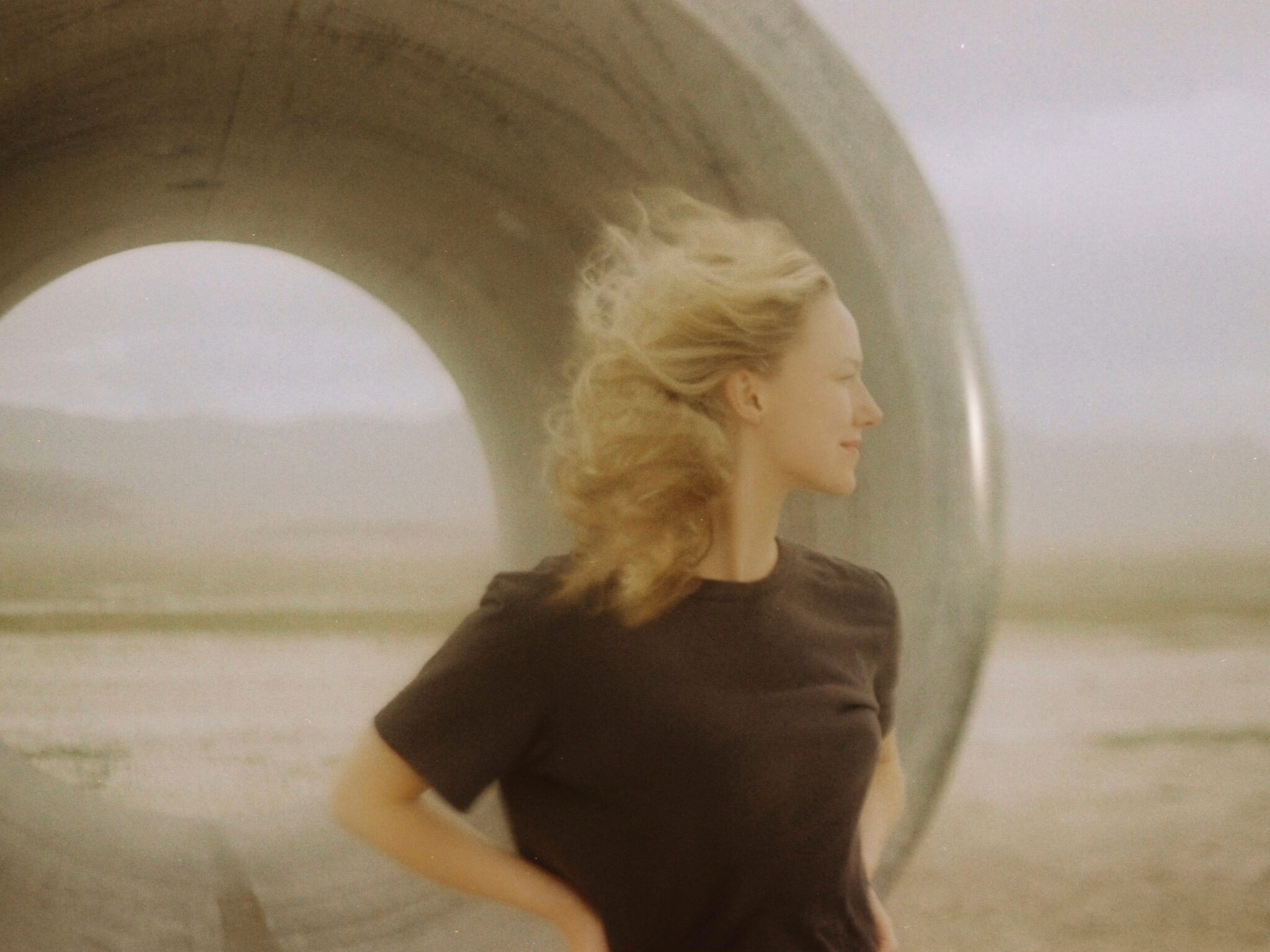
image courtesy Carolina Edman
AME: What exhibition did you like the most over the past five years, and why?
CE: The most striking artwork I have seen in the past five years is by far Nancy Holt’s Sun Tunnels (1973-76), nestled in a basin of Utah’s Great Salt Lake Desert. It is all about framing and bringing the ‘art’ or ‘elements’ to a human scale. Holt, from a ‘nonfinite’ perspective, refers to her revolutionary approach of presenting objects with simultaneous, conflicting qualities. Like flatness vs volume, representation vs abstraction, and static form vs dynamic movement, achieved through planes and shifting perspectives, creating a nonfinite, layered reality rather than a single viewpoint. Holt captures the experience of seeing and balancing opposing forces to reveal nature’s underlying structure and vitality.
Importantly, Holt is very different from her contemporaries, considering how canonised Land Art often perpetuates the logic of conquering the environment. Unlike interventionist approaches that impose extractive alterations, Sun Tunnels alters only your sense of being. The work is monumental without being hierarchical. Holt does not aim to master the sublime but invites us to recalibrate with it. In her own words, in the essay ‘Ecological Aspects of my Work’ in the exhibition catalogue for Creative Solutions to Ecological Issues presented at the Dallas Museum of Natural History, 1993: ‘The channelling of the energy and elements of the earth can be done intelligently with the long-term benefit of the planet in mind. In doing so we become nature’s agents, rather than aggressors against nature’. This is how they speak most to our moment.
AME: Tell me more about the unended in art, and what is engaging about the concept.
CE: We can either look at a glass, or through it. There is always another fold to discover. Who are we, who is each one of us, if not a combination of experiences, information, books we have read, things imagined? Perhaps it is the freedom to go beyond the rigidity of the self, and become the bird, the stone, then go on to the speech that has no language, the kite, the cement, the sea, and somewhere in the special aspect of life at all: the nonfinite self-changing energy. The sea, mountains, stars, and stones embody a deep time that, when stared into, reflects our questions; not as a mirror that encloses us, but as one we can see through, reminding us of sight itself.
AME: To end at the beginning, what project led you to these ideas?
CE: When I started exploring the nonfinite, I began noticing it everywhere. In New York, I live across from 11 Madison Avenue, an unfinished building. It was supposed to become a mega architectural feat, reaching 100 floors, but the Great Depression halted construction in the 30’s. Today it looks like an awkward stump, and it always makes me smile as I pass, walking down 5th Ave. It also happens to host my favourite bar, Clemente Bar.
I believe it all began with me visiting Michelangelo’s Slaves (1520–23) in Florence. Those figures arch and heave as they strive to escape the marble that enfolds them, as though the artist merely stripped away the excess to reveal their essence. Their struggle captures the human longing to shed physical limits, flesh, burden, or judgment. By deliberately leaving the sculptures incomplete, or rejecting finish, Michelangelo allows their characters to hover indefinitely in that state of becoming. With polished flesh juxtaposed against unrefined rock, he demonstrates that by inviting the viewer to complete the artwork, it becomes an even more absolute or authentic composition. By withholding finality, the work humbly admits it belongs to a larger continuum.