Agda Studios - the Scandi brand rethinking swimwear
Text by Natalia Muntean
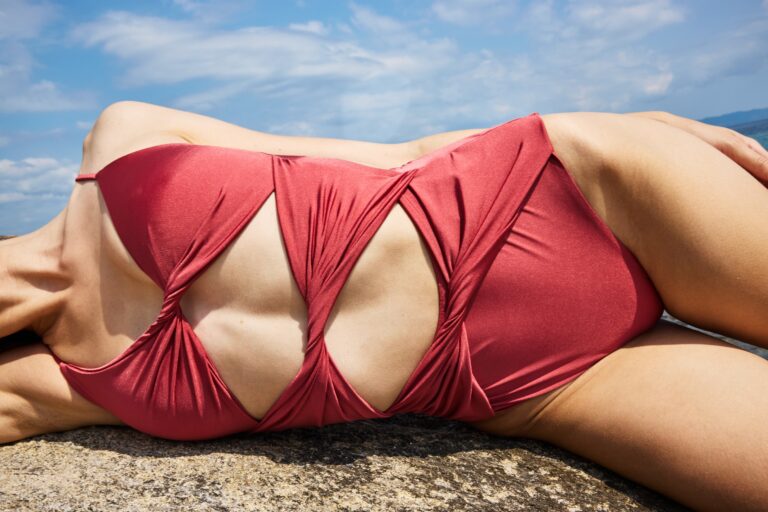
“I just want to make the best garments, because that’s what I’m best at: something that makes you feel good and sits well, with my own aesthetic,” says Caroline Beckman, founder of Agda Studios. Launched in 2023, the Swedish brand offers swimwear designed to move beyond the beach, occupying the space between swimwear and evening wear – versatile, timeless pieces made to last. Produced in small batches in a factory in Portugal, the collection spans bandeau, wrap, cheeky Brazilian, and ’90s high-leg styles, crafted from premium recycled fabrics such as ECONYL® (made from ocean waste like fishing nets) and SEAQUAL®. Beckman’s philosophy is that good garments require time and attention to detail. “I don’t push things out before they’re at 100%,” she says.
Natalia Muntean: Was there a moment when you felt like the industry was missing something, and that Agda Studios would fill that gap?
Caroline Beckman: I worked as a designer for many years, as a lingerie designer and a swimwear designer, and swimwear was by far the most fun and inspiring category for me. They’re small garments, but there’s a lot of expression in them. Then, when I became a mother, I started to shift how I thought about my time and energy, what I wanted to do with my life. That was definitely what made me take the step to start my own business, to create something of my own after gaining all that knowledge from years of working for other brands.
NM: What is the difference between designing swimwear and other types of garments?
CB: There’s a lot of expression in this small garment: colour, quality, detail, it all has to fit in. It’s also such a special garment because you’re basically naked, with this tiny piece of fabric, and you’re supposed to feel natural. You go from being fully dressed to almost naked, so it’s so important how the garment makes you feel. There are so many different styles for women to choose from, but for me it was important to design something that made women feel they could be themselves. I also think something is missing in the market: swimwear can be more than a small, colourful bikini that just speaks “resort.” It can be elegant, almost ready-to-wear. It can blend into daytime, even if that’s a bit of a design challenge.
NM: Tell me about the name – does it mean anything to you or is there a message behind it?
CB: It’s very personal – it was a nickname of mine from when I was a swimwear designer, and that’s also when the idea was born that if I ever started my own brand, it would be swimwear. I didn’t want to put my own name on the brand, and I didn’t want something typically “resort” or strongly tied to swimwear, because I want to keep the brand open. I can see it growing into a little universe, maybe ready-to-wear eventually, or staying with summer pieces. I just wanted to keep it open, like a creative space.
NM: You have quite a variety of designs and silhouettes – is it different women you’re designing for, or one woman across different moments?
CB: Definitely a mix of both, different women, and different moments, but all within the same aesthetic universe. Silhouette is the number one thing I work with, and I think it’s the most important thing in swimwear, because it’s what sits next to your body. It can look beautiful on a hanger, but if it doesn’t feel right on the body, you’re not going to wear it, no matter how good it looks in a photo. So I think it’s important to offer different silhouettes, because we’re all so different.
NM: When you imagine that one woman, who is she?
CB: I would say a strong, independent woman who follows her own path. Not necessarily super trend-driven, but she loves style and wants to feel good in what she’s wearing. She likes quality and understated luxury.
NM: Where’s the line between swimwear and pieces you could wear to lunch or dinner?
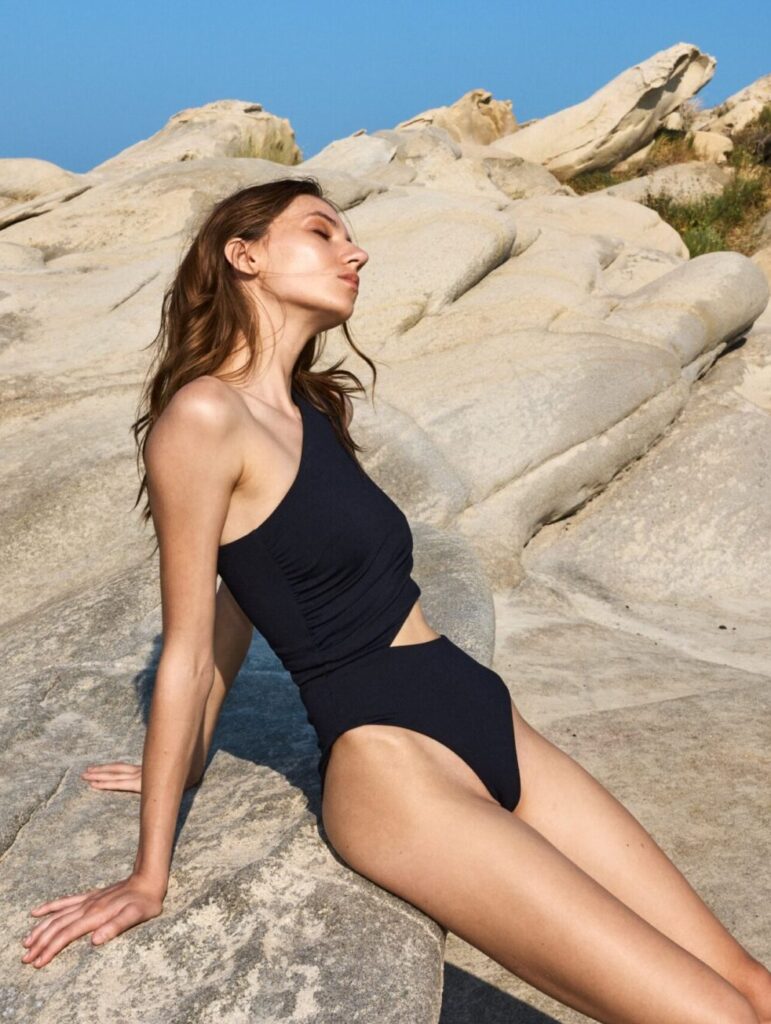
CB: The only thing that really separates swimwear from ready-to-wear is that it has to be technical – it has to function in water and sit properly on the body. Otherwise, I think a swimsuit can work just as well as a bodysuit, or a bikini top can work as a top under a shirt. I lean in that direction, but I never want anything to feel generic. I like pieces that feel special, that are versatile. A garment you can wear for more than one occasion is a bonus.
NM: Scandinavian minimalism is such a recognisable design language. How do you maintain that identity in a world of fast fashion and micro-trends, while still running a business that needs to turn a profit?
CB: I think it comes down to the fact that I’m Swedish, and I have a certain way of designing. It’s about making sure there’s quality, proportion, and fit in place, that’s where the design lives, and it doesn’t change depending on colours or fabrics. It’s not about trend for me, it’s a focus on function, on silhouette, on a clean aesthetic, but also a lot of warm, Mediterranean feeling. Almost like Swedish meets a Mediterranean soul. So it’s more aesthetic than trend-driven.
NM: How do you find the balance between wanting to turn a profit without falling into the trend cycle?
CB: It comes down to believing in a slow way of creating – developing garments properly takes a long time. When I started, my vision was: begin with a few silhouettes, and if they’re received well, build them out: more colours, more qualities, rather than moving on just because a new season has arrived. Of course, I want to expand the collection over time, but every piece should be considered and have a place that’s worth it.
NM: What is Agda Studios’ most successful piece?
CB: I would say the wrap top. You can’t really find that exact piece anywhere else. It’s a more dressed-up piece; a bikini top that doesn’t necessarily feel like a bikini, it can also be a top. I think it caters to women who want to feel a bit more dressed.
NM: Where does sustainability stand in your business, and how do you source your fabrics?
CB: That’s a tricky question, but I go to fabric fairs, and I also collaborate with the factory, who show me fabrics with a certain aesthetic I’m looking for; the only requirement I have is that it carries a sustainable certification. I know using sustainable fabrics isn’t everything. You’re never fully sustainable if you’re producing at all, the only way to be sustainable is to not produce anything. But I try to make the best choices I can along the way, starting with the fabric. It also means creating garments that last, that you don’t throw away after a season a design that feels timeless, that you don’t get tired of, that still fits well and holds its shape. There are many ways to work with sustainability, but it’s not easy; it’s a real challenge.
NM: What do you think is the most important thing when designing swimwear?
CB: The silhouette and, within that, the fit. That’s what I bring from my years as a lingerie and swimwear designer; I learned a lot about working with fit. Without that experience, I don’t think I’d be able to do this all on my own.
NM: Luxury swimwear is a competitive space. Where do you see Agda Studios sitting within it?
CB: I would call it more understated luxury. It’s not something that screams luxury, it’s more that when you feel the garment, hold it, wear it, you can sense the work that’s gone into it: the quality, the fit. That’s the luxury. Producing in Portugal is part of that too. Having a small, European-made production is its own kind of luxury.
NM: What would success look like for Agda Studios in the next five years?
CB: First, that we keep having customers come back, women who trust how it fits, who feel good in our garments. That would be the biggest success. And then, of course, it would be fun to see Agda Studios in a few selected places around the world, where our customers are.