Design

Design

Barber Osgerby and Kasthall: Letting the Loom Lead

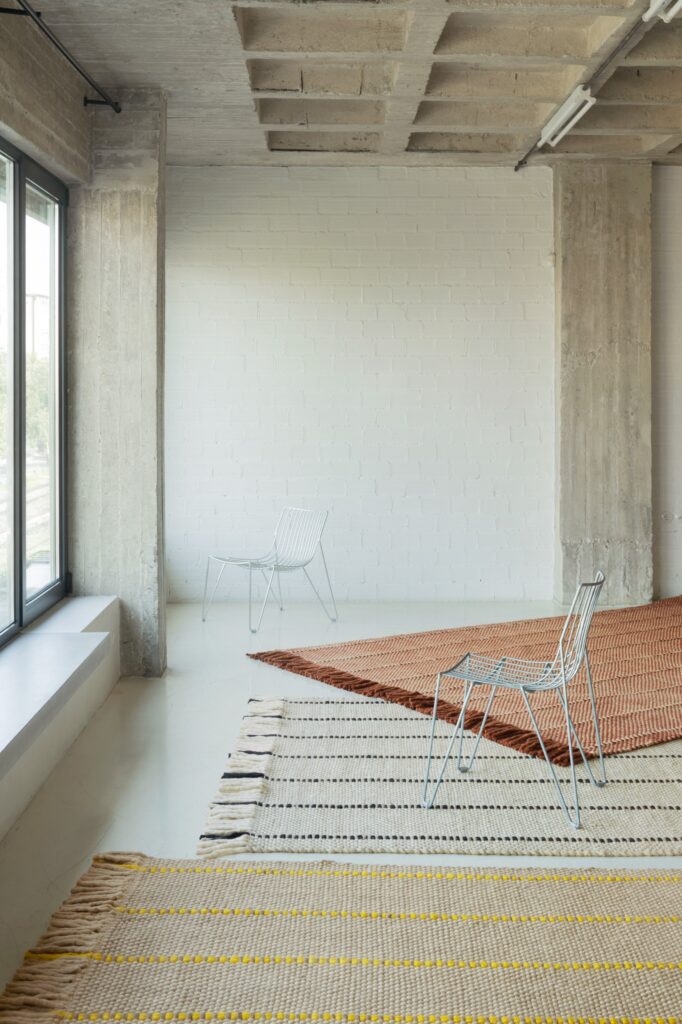
Barber Osgerby and Kasthall: Letting the Loom Lead Text by Natalia Muntean Atlas and Bon Bon, the first collaboration between London-based Barber & Osgerby and Swedish carpet manufacturer Kasthall, were born directly from the conditions of the industrial loom. Working closely with Kasthall’s team in Kinna, Edward Barber and Jay Osgerby spent time on the factory floor, immersing themselves in the rhythm and constraints of the mill before a single design decision was made. Rather than imposing a fixed aesthetic, they allowed the tools, techniques and archive of a 135-year-old company to shape the direction of their work, arriving, through experimentation and some sixty prototypes, at two collections that are as different from each other as they are from anything Kasthall has produced before. Natalia Muntean spoke with Edward Barber. Natalia Muntean: A lot of the collaboration with Kasthall was about listening and understanding their process. Was there something that surprised you, or maybe a limitation that inspired you when you were working with their industrial loom, something that changed the process, or made you rethink certain things?Edward Barber: I’d never done woven carpets before, so it was a completely new experience for me. And with every project I do, before designing anything, I always like to go and see where the objects are made and how they’re made, and talk to the people who make them, especially if it’s a craft project. And in a way, whilst this is industrial, for me this is also very much a craft project.So I spent a few days at the factory in Kinna to understand the process. They explained how the loom works. The basics are incredibly simple: you have the warp, and then you weave in between it, but when it comes to creating different patterns and techniques, it suddenly becomes much more complicated. They also have an extensive archive, so I spent some time going through it, mainly to see the range of colours they offer. A lot of it is very decorative and floral, which wasn’t what we were doing. The thing about archives is that they’re useful to a certain extent, but if you get too deep into them, you get lost, and they influence you too much. It’s good to get an idea and then close the door. After that, we started putting some experiments together. It was a back-and-forth process of them making samples, sending them to me, me changing the size of the weave or the colours, or asking more questions. When you come to something completely new, you have no preconceived ideas about what’s possible and what isn’t, so you ask what might seem like stupid questions. And sometimes they say, that’s interesting, we hadn’t thought of doing that before. They’re so nice to work with, such amazing people. We had a great dialogue, and it was really just a question of samples, changing them, more samples, until eventually we got to three different designs, three different patterns. They’re very simple, just straightforward woven carpets, but they’re really beautiful. I’m very, very pleased with them.NM: When you decided to work together, you didn’t have a preconceived plan as such; you went to Kinna, got to know their process, and that’s how the ideas started?EB: I’d seen Kasthall carpets over the years. I was aware of the company, and I’d seen various designs, but I didn’t think, this is what we need to do. It was really looking at some of the techniques they’d used in the past and saying, well, what about if we do this, but change this aspect of it? Can we make this bigger or smaller? What if we add two different coloured threads instead of using a single colour? Things like that, just asking questions, really. NM: Tell me about the two collections, Atlas and Bon Bon. How did you come up with the names, and what distinguishes one from the other?EB: Bon Bon is much stronger, more graphic in terms of its colourways. We use colour a lot in the studio, in a way that’s quite experimental, quite strong. With Bon Bon, we really went for it and tried to mix three colours on each carpet to create one finished colour. So the pattern is quite small, from a distance it might look like the carpet is one colour, but as you get closer, you can clearly see three different colours working together. It felt like a jar of sweets. And the names all reflect edible things. You’ve got Liquorice, Lemon, Toffee, Berry, Rhubarb, and Damson. They’re more playful, possibly even for a younger market.  Atlas is a very chunky weave, so you get quite a thick carpet. And what we’ve done is mix two or three colours, on one we’ve got four, and it comes across quite randomly. So each carpet will look different because the threads moving across don’t go evenly every time. Sometimes you have a green thread on top and sometimes an orange thread, so you get this nice variation of tone and colour. I would call this a more organic, natural-looking carpet, and the colours reflect that. We called it Atlas because these colours, when woven, were quite reminiscent of older Moroccan carpets, with natural dyes for the threads. The Atlas Mountains are in Morocco, and when you look at the design, you see triangular shapes that resemble a mountain range. So we thought, Atlas. The two are completely different directions. NM: The intriguing thing about Atlas is that when you look closely, you can very clearly see the warp. Why was it important to leave it exposed, and how does it change how the rug feels?EB: Whenever we design anything, we always try to find a different way, or a new way to do something. With carpets, that’s pretty difficult – they’ve been around for thousands of years. But it’s a little unusual to be able to see the warp exposed the way it is. After some of the experiments, I was

Design

Norwegian Design Makes its Move on Sweden

Norwegian Design Makes its Move on Sweden On a recent evening at the Norwegian Embassy in Stockholm, six Norwegian design brands gathered for an intimate showcase hosted by Norsk Industri. The event was less a trade fair than a declaration that contemporary Norwegian design, rooted in landscape, material honesty, and a near-philosophical commitment to longevity, has something urgent to say to the Swedish market. The brands ranged from century-spanning furniture makers to a new generation rethinking acoustics, textiles, and stone. What united them was a resistance to trend cycles and a conviction that how something is made is inseparable from what it means. Flokk & Fjell works with waste wool that would otherwise be discarded, dyeing it with plant-based pigments from local raw materials to produce handmade acoustic panels that are also objects of beauty. Founder and architect Annemieke Koopmans unveiled a new collection, Winter Landscapes, exclusively at the Stockholm event, her ambition being to bring indoors the same stillness one finds out in nature.  Norsk Dun’s new collaboration with designer Gustav Ovland takes a similar approach to materiality. Recycled fibres, mineral-based pigments, pomegranate peel – the collection’s palette is drawn from what already exists and would otherwise be lost. The results are textiles with a warmth that synthetic processes rarely achieve. “Good design is about creating something people want to live with for a long time,” says Ovland.  LK Hjelle has been making furniture in Sykkylven since 1940. Every piece still leaves their own factory, still bears the Made in Norway mark, still built for repair and reupholstery rather than replacement. Their collaborators, Andreas Engesvik, Hallgeir Homstvedt, Jonas Stokke, are among Norway’s most respected designers, and the furniture has found its way into the Norwegian National Opera and embassies worldwide. CEO Jens Peter Brunstad’s vision is simple and unsparing: no one should ever need to throw away a piece of LK Hjelle furniture.  Ekornes brought two new Stressless® models, Adam, recently awarded the Red Dot Design Award, and Bay, that make ergonomic rigour feel like luxury rather than compromise. Both are built for durability, both designed to support the body in the way the body actually moves. Comfort, here, is not a selling point. It is the whole point. Fora Form’s BAST, designed by London-based Norwegian duo Hunting & Narud, is a modular low table system that thinks in the long term. Solid oak, floating aluminium, three sizes that can stand alone or compose into something larger. Every joint engineered for disassembly and repair, with longevity written into the object’s logic from the start. The most structurally ambitious proposition came from Lundhs Real Stone®. Their Larvikite and Anorthosite, formed hundreds of millions of years ago, entirely free of quartz, are no longer simply surface materials. A ten-storey building on Finchley Road in London now uses Larvikite as its load-bearing exoskeleton, replacing concrete and steel in what is believed to be a first of its kind. “Larvikite is more than a surface material,” says Business Developer Thomas Løvald. “It is architecture in its most fundamental form.” From Oslo’s Sommerro House to the University of Oslo, the stone keeps finding new ways to hold things up.

Design, Uncategorized

Nordic Nest Brings Design History and Future Visions to Stockholm Design Days

Nordic Nest Brings Design History and Future Visions to Stockholm Design Days As part of the new Stockholm Design Days initiative, Nordic Nest steps outside the boundaries of traditional retail to present two curated public showcases exploring Scandinavian design from legacy to next generation. The focal point is a tribute to Verner Panton, one of modern design’s most influential voices, honored on his 100th anniversary with an exhibition of licensed works still in production today. Founded in 2002, Nordic Nest has steadily grown into a global destination for Scandinavian interiors, now reaching customers in more than 70 countries. What feels different this year is the company’s clear shift toward storytelling. Design is not only displayed, but framed in a broader cultural context, while remaining immediately accessible to those who wish to bring these pieces into their own homes. Celebrating Verner Panton at 100 Walking through the Verner Panton 100 showcase at Gallery Existens, it becomes evident how radical Panton’s vision once was and how current it still feels. His fearless exploration of color, form and materials helped define a new visual language in 20th century design. Decades later, his work continues to feel alive rather than archival. The exhibition gathers licensed pieces still in production through brands such as Montana, Louis Poulsen and &Tradition. There is something powerful about seeing designs that have not only survived but remained relevant enough to stay in production. It quietly reinforces the idea that true icons do not belong to a single era. Visitors can also access these pieces directly through Nordic Nest’s platform, allowing admiration to turn into ownership without friction. Icons of Today and Tomorrow Running alongside the Panton tribute is Icons of Today and Tomorrow, a showcase that asks an interesting question: how does a future classic begin? Featuring Montana, Louis Poulsen, &Tradition, Ferm Living and Flos, the exhibition pairs 2026 novelties with established designs across lighting, furniture and objects. The curation avoids the language of trends and instead focuses on longevity, material exploration and cultural relevance. Previewing upcoming collections in the same space as enduring pieces invites reflection on what makes a design last. It is less about what is new and more about what will matter. A New Format for Experiencing Design Nordic Nest refers to these spaces as editorial environments rather than retail settings, and that description feels accurate. They encourage conversation and contemplation, not just consumption. This approach follows a year of notable steps for the company, including a design dinner at Stockholm’s Nationalmuseum and the opening of its first physical store in Hamburg. What emerges is a brand positioning itself somewhere between curator, retailer and cultural mediator. As the Verner Panton 100 celebration illustrates, looking back at design history can be just as forward-looking as launching something new. Scandinavian design, in this context, feels less like a style and more like an evolving dialogue between past and future. Image Courtesy of Grand Relations

Design, News

LAYERED Unveils the Lozza Rug Collection Designed by Erik Bratsberg

LAYERED Unveils the Lozza Rug Collection Designed by Erik Bratsberg LAYERED presents the Lozza rug collection, a hand tufted series designed in collaboration with artist and designer Erik Bratsberg. What began as a practical solution to wine stains in a restaurant project evolved into a broader exploration of form, colour, and function, resulting in a collection defined by sculptural expression and thoughtful design. Crafted in wool and shaped by soft, organic silhouettes, Lozza draws inspiration from Bratsberg’s sculptural wall works, where overlapping forms create a sense of harmony and movement. The rugs move beyond the traditional rectangular format, offering irregular shapes that bring flexibility, flow, and a subtle dynamism to interior spaces. Each rug is composed of three tonal fields, carefully balanced to create depth and contrast. A lighter outer edge lifts the room, while deeper tones toward the centre add visual weight, enhanced by subtle variations in pile height and tactile detailing. Available in two versatile colourways, the collection is designed to complement both warm and cool interiors, harmonising effortlessly with diverse materials and furnishings. The name Lozza stems from the Italian word tavolozza, meaning artist’s palette, reflecting the layered composition and Bratsberg’s enduring fascination with the interplay of colour, form, and materiality. Through this collaboration, LAYERED continues its mission to merge art, culture, and design, creating objects that transcend function to become expressive centrepieces. The Lozza collection launches today on layeredinterior.com. Image Courtesy LAYERED

Design

Hästens Dream Factory: Where Generations Shape the Future of Sleep

Hästens Dream Factory: Where Generations Shape the Future of Sleep There is something almost disarming about arriving at the Hästens factory in Köping.Not because it feels modern or clinical, but because it feels alive. There are no gloves, no masks, no distance between human hands and nature’s finest materials. You instantly understand that the work done here has very little to do with industrial manufacturing and everything to do with craftsmanship. Real craftsmanship. The kind you rarely see anymore. Hästens calls it a dream factory, and the name feels fitting. Since 1852, the company has held one intention: to make the best bed in the world. And not the best bed within a certain price range, but simply the best bed possible, without limits. It is a philosophy that has travelled through six generations, from saddles to mattresses, from horsehair padding to global sleep culture. The story begins with saddler Pehr Adolf Janson in 1852, whose mastery of horsetail hair   mattresses laid the foundation for everything that came after.His sons continued the craft, and decade by decade the family refined what sleep could be. In 1978, Jack Ryde introduced what would soon become a design icon: the blue check. A bold aesthetic choice that transformed the bed from an everyday object into a symbol of Swedish excellence, a pattern that still carries the weight of history and innovation today. Today, the company is led by Jan Ryde, the fifth generation, with the slow integration of a sixth. Jan’s background as an engineer is visible everywhere in the factory. Nothing is left to chance. Every decision is made with obsessive precision, from the way the pine trees are selected to how the horsehair is layered. What makes a Hästens bed so unique is not a secret recipe of materials. It is a secret recipe of craft. A philosophy that combines engineering, intuition, and an uncompromising respect for nature. The Three Layers of Perfection At Hästens, the bed is built in three intentional layers, each designed to answer one fundamental question: how can the body rest as naturally as possible? Natural materials like horsetail hair, cotton, wool, and linen create a bed that breathes, transports moisture, and regulates temperature. The horsehair, sourced as a by-product from partners around the world, is naturally springy and self-ventilating. It needs to be “massaged” regularly, which is why Hästens recommends rotating the bed. It helps the materials recover, just as the bed helps the body recover. In the factory, craftspeople separate horsehair into fine, airy layers by hand, massaging fibres into place with a rhythm that feels almost meditative. A process where multiple layers of horsehair, cotton, and wool are joined by hand to create the distinctive Hästens elasticity and breathability. The frames are built from slow-grown Swedish pine, selected tree by tree, ensuring stability, longevity, and a quiet, grounded energy that becomes part of the sleeper’s experience. And then there are the springs. Hästens speaks of its spring systems as a science in themselves. Multiple spring layers, each with its own height and wire thickness, respond individually to the body, creating weightless support that allows the spine to align naturally.It is this combination of softness and structure that produces the sensation of floating. Beds with Horsepower Hästens likes to joke that its beds have horsepower, and in a sense, they do. Horsetail hair is the brand’s beating heart. It is resilient, elastic, and naturally ventilated. It springs back instantly, just like a well-trained muscle. Anyone who has laid on a Hästens bed can feel this energy moving underneath. This is not luxury for the sake of luxury. It is quite a luxury. The type that invests in wellbeing with intention. The beds are made in one single factory, by a team whose collective knowledge spans centuries. And they are sold around the world because sleep is universal, even if the definition of comfort is personal. Five levels of firmness allow sleepers to tailor their bed to their body. Even the pillows can be custom-made to match the firmness of the bed. A Hästens bed is not a status symbol. It is a commitment. An investment for the restless sleeper. An upgrade for the person who refuses to compromise on the quality of their rest. And it is always evolving. As the Heritage Timeline notes, Hästens believes that 170 years of mastery is only the beginning. They are constantly testing new materials and refining techniques. In their words, the last bed is far from made. The Icons: Vividus, Grand Vividus and the Jack Ryde Edition Some beds have become legends in their own right. The Vividus, introduced in 2006, is widely regarded as the purest expression of Hästen’s philosophy. The Grand Vividus, designed by Ferris Rafauli, elevates the idea further through a couture approach to sleep, blending architecture, design, and craftsmanship into a sculptural object of rest. The new Jack Ryde Edition 2000T, launched as a tribute to the visionary who introduced the blue check in 1978, is one of the brand’s most exclusive models ever, limited to two thousand numbered pieces worldwide. The edition celebrates Jack and Solveig Ryde, the fourth generation, and includes deep craftwork, saddle leather corner details, bronze fittings, and a hand-embroidered signature plaque. It is a bed that honours the past but is designed for the future. Do not let the mastery of the design intimidate you. Hästens offers a range of beds at different price levels, from entry models to those reaching six figures. A Hästens bed is an investment, and the twenty-five-year warranty says a great deal about the confidence they have in their craftsmanship and the longevity of what they create. The Science of Better Sleep According to Dr Chad Eldridge, Hästens sleep and wellbeing expert, true quality sleep has nothing to do with falling asleep quickly and everything to do with staying in deep, restorative sleep cycles. He explains that good sleep supports the heart, immune system, metabolism, emotional processing, cognitive function, and even muscle

Design

Radisson Blu Plaza Helsinki

Radisson Blu Plaza Helsinki: Luxury and Comfort in the Heart of the City text Ulrika Lindqvist and Sandra Myhrberg In mid August, Editor in Chief Sandra Myhrberg and Fashion Editor Ulrika Lindqvist traveled to Helsinki to produce the cover story for Odalisque Issue 16, featuring actress Laura Birn. During the stay, they checked into Radisson Blu Plaza Helsinki, a hotel the editorial team is always happy to return to again for its understated luxury, impeccable service, and central location. LocationThe hotel is centrally located near Helsinki Central Station, The Finnish National Theatre, the Ateneum Art Museum, and many other key spots. This was ideal for us, as we spent our first day exploring beautiful Helsinki while scouting locations, and our second day on our feet shooting with Laura. The shoot unfolded across Helsinki’s architectural landmarks, with the city itself becoming part of the story. Radisson Blu Plaza offered excellent service, received several clothing deliveries ahead of our arrival, and even allowed us to photograph in their stunning interiors. The HotelHoused in a historic building dating back to 1917, the year Finland gained independence, Radisson Blu Plaza Helsinki carries a sense of heritage that feels deeply rooted in the city. The hotel has occupied the building since 1999, blending classic architecture with contemporary comfort. Ulrika even had time to try the well-equipped gym, although we did not manage a sauna visit this time. We look forward to returning to enjoy both wonderful Helsinki and a relaxing sauna session. About the Hotel• 302 beautifully designed rooms• Prime central location in Helsinki, Finland• Room categories include Executive Suite, Plaza Suite, Junior Suite, Executive Business Class, Business Class and Standard• Five meeting rooms• A restaurant, bar and lounge that quickly became favorite spots for us to unwind All images Courtesy of Radisson Blu Plaza Helsinki 

Design

Dusty Deco x Matthew Williamson: A Bold New Home Collection

Dusty Deco x Matthew Williamson: A Bold New Home Collection images courtesy of Dusty Deco             In a vibrant collaboration between Swedish and British design, Dusty Deco unveils its new collection with Matthew Williamson. The series unites two design languages through a shared passion for color, pattern, and tactile expression, exploring maximalism while balancing energy and sophistication. The collection features expressive furniture and textiles, including four hand-tufted rugs, two throws, and updated upholstery for the Lola sofa and V-daybed. Each piece carries the collection’s distinctive patterns and palettes, designed to work both as cohesive ensembles and as standout individual objects.       Matthew Williamson’s signature kaleidoscopic colors, intricate patterns, and rich textures are translated into home design, creating a layered, energetic aesthetic that complements Dusty Deco’s contemporary material focus. Dusty Deco, founded by Edin and Lina Kjellvertz, has evolved from curated pop-up vintage stores into an international design studio with a full collection of furniture, rugs, lighting, and objects. The collaboration with Matthew Williamson introduces a more color-intensive language to the brand’s signature aesthetic and is now showcased at Dusty Deco’s flagship in Stockholm, emphasizing its commitment to innovative and expressive design.

Design

“A Collective Contribution”: Michael Anastassiades on His ‘After’ Series for Fritz Hansen

“A Collective Contribution”: Michael Anastassiades on His ‘After’ Series for Fritz Hansen text Natalia Muntean With a career spanning over two decades, Michael Anastassiades has cultivated a unique language of design, creating lights, furniture and objects characterised by a balance of improvisation with structure. Having collaborated with the world’s leading manufacturers, from Flos to B&B Italia, his work is part of permanent collections of institutions like the Museum of Modern Art and the V&A. Now, Michael Anastassiades brings his poetic, yet rigorous design language to his first large-scale furniture collaboration with Fritz Hansen.  Natalia Muntean: This is your first collaboration with Fritz Hansen. How was this experience different from your other partnerships?Michael Anastassiades: It’s different in the sense that it’s a Danish brand. So for me, although I’ve had quite a lot of experience in collaborations on a different level with Scandinavian brands, Fritz Hansen is probably the first one of that scale in terms of industrial production. I have worked in the past, starting with Iittala, Danish Modern, or Bang & Olufsen, but this really is the first furniture collaboration on that industrial kind of level. Every brand is different. The culture is very different when you do something in Scandinavia. The speed and the development process are very different and there seems to be a different attitude towards the sense of ownership of design. With Danish design, if you study historically, it feels like it’s a more collective contribution towards the evolution of icons. They were all modelled on different archetypes from history – a classical Greek chair, or traditional English furniture. Every time a certain typology of chair was approached by an architect, it was built on something that had happened before. This approach has been recurring for many years; everybody was adding something, building on what came before. For me, this was a particularly attractive point when working with Fritz Hansen, understanding that sense of collective contribution was a good starting point for the dialogue about this chair. NM: And how has this philosophy of collective contribution shaped your approach to the ‘After’ series? MA: It has shaped it in the sense of understanding and acknowledging it, this sense of ownership. So somehow it feels a little bit more democratic. This different mindset is very much aligned with everything else I have done, especially for my brand of lighting, which is also modelled on a sense of familiarity. There is already a starting point for a conversation; you’re not there to shock people with something completely different. That approach is very much aligned with my brand, so it does work very well with the project I’ve done for Fritz Hansen. NM: Your work often strikes a balance between simplicity and emotion. How did you find that balance in the ‘After’ chair and table? MA: I think it’s really obvious in that example because there are hardly any elements to it. Structurally, if you analyse the chair, there are four legs, an armrest which is combined with the backrest, one element that wraps around, and then there is the seat itself. Everything is so perfectly placed in its position and how they are constructed together. There’s not much you can actually remove from the design other than the essentials I have chosen to keep. That reduced approach is very much there in its simplicity. NM: What was the biggest challenge in achieving this pure form, without compromising comfort? MA: Well, the fact that you have to constantly revert to your original idea and vision. You have to pause now and then and look back. It’s interesting because even the very early prototypes look almost identical to what it ended up being. But the challenges have been: how do you introduce comfort? And what does comfort mean in your approach to a piece that is so strict and disciplined? The biggest challenges have been how to make these introductions in such a subtle way, not to compromise the strength of the chair in terms of its look. NM: You’ve worked closely with the craftspeople and the creative team in a very hands-on way. MA: The development has been over a series of workshops in Copenhagen with the design team. The conversations were very much about trying it out on the spot and making a collective decision that this makes sense. There was very much their feedback in the process and how it guided us to arrive at the final result. NM: Can you tell me about the material choices? There’s a contrast between the wood and the marble tops. MA: The starting point of the ‘After’ series is really the chair itself; that is the protagonist. I wanted it to be monolithic. I wanted it to be wood for its warmth, its lightness, for all the welcoming qualities. I like the challenge of using a soft material in a very strict language. The type of wood was very much a sustainability decision. You have to look at the cycle certain timbers have in the world in terms of their availability. We chose types that are readily available and not rare species, which also drives the cost. The choice of ash was that kind of decision. NM: Your process has been described as both analytical and intuitive. How did that unfold for the ‘After’ series? MA: I think you’ve got to really educate yourself. Informing yourself about the DNA of the company, their contribution to the Danish approach, and then historically looking at the history of design and the history of a chair. Understanding how anything new is positioned in this map – that takes many years of study, observation, and education. From that moment on, all that information is embedded in your process. You don’t have to constantly refer to it because you’re already informed. So when you start working, you follow a certain intuitive process, but that deep knowledge is already filtering whatever comes out. NM: The development took nearly three years. How did time influence the final

Design

ARKET x MASSPRODUCTIONS

ARKET x MASSPRODUCTIONS text Astrid Birnbaum  images courtesy of Arket As the new season begins, ARKET is launching a collaboration with Swedish design studio Massproductions — a partnership that brings together form, function, and colour. Designed by Chris Martin, co-founder of Massproductions, the collection introduces two standout pieces: the Buffer Bookend in a punchy neon orange and the Silo Wine Rack in a vivid electric blue. Both come in exclusive colours for ARKET — everyday objects turned into sharp, sculptural statements. The lineup also includes a few well-considered staples: a solid rubber Door Wedge, a jacquard-woven wool blanket made by Klippan, and a canvas tote created just for this collab. It’s a collection that balances precision with play — pure Scandinavian design thinking,where function meets quiet beauty. Objects made to live with, use, and enjoy. Available now, in stores and online.

Design

Nobia Park: A New Era for Scandinavian Kitchen Design

Nobia Park: A New Era for Scandinavian Kitchen Design from Marbodal text Natalia Muntean Imagine 17 full-size football fields or four Eiffel Towers laid on the ground. With a surface of 123,000 square metres, that’s the size of Nobia Park, the new production facility for Marbodal in Jönköping. A century after Marbodal’s first kitchen was built in Tidaholm, Nobia opens a factory designed for the next hundred years. Combining robotics, digital traceability, and Swedish design heritage, the BREEAM Excellent-certified site redefines what sustainable, high-tech production can look like and places the customer at the very heart of innovation. “What’s most impressive is the leap we’ve made with this factory – it’s full of potential,” says Herman Persson, Design Director. “Few companies manage to bring an idea all the way to execution within the same organisation.” “With our new painting technique, the colour is applied in one piece, creating a uniform, high-quality surface that is not only high-performing but also lovely to touch,” says Jenny Schild, Head of Product Category Frontals & Décors, describing the seamless quality of the fronts produced at Nobia Park. For Anna Hamnö Wickman, Group Director Sustainability, Nobia Park’s strength lies in how deeply sustainability was built into its foundation: “BREEAM isn’t just a certification you get at the end, it’s something you have to integrate from the very beginning. Over 600 materials have been checked, approved and logged; that’s how thorough the work has been.” Find out more about Nobia Park from our interview with EVP Supply Chain North at Nobia, Samuel Dalén. Nobia Park is described as Europe’s most modern kitchen factory. What does that mean in practical terms for your production and customers? Samuel Dalén: Our customers are the true beneficiaries of this investment. Nobia Park represents a completely new era in kitchen manufacturing. It’s a facility where advanced automation, inspired by the precision of the automotive industry, meets Scandinavian craftsmanship and design. The highly automated internal logistics and unique assembly processes make Nobia Park unlike any other production facility in our industry. The new technologies for surface treatment and edge banding allow us to deliver a level of quality and customisation that simply hasn’t been possible before. The result is greater flexibility, shorter lead times, and exceptional reliability in delivery. Customers can expect kitchens of superior quality, with an expanded palette of colours and finishes, produced with the highest sustainability standards, in a BREEAM Excellent certified building that already meets future Nordic Swan Ecolabel requirements. Digitalisation also ensures full traceability and an enhanced service experience. Altogether, it’s a transformation that places the customer at the very heart of our innovation. What were the biggest challenges during the five-year journey from idea to completion?SD: Embarking on something no one has ever done before requires courage. Creating Nobia Park meant not only building a factory but also reshaping our entire way of working: from product range and technology to systems and organisational roles. Bringing all these dimensions together into a seamless whole was, at times, a real challenge. Adding to that complexity, much of this journey took place during the pandemic, a period that tested our ability to collaborate closely with partners, suppliers, and teams across countries. Despite those obstacles, the shared ambition to redefine our industry kept everyone moving forward. How did your teams collaborate between engineers, designers, and craftsmen when developing new technologies like ToneTech™ and PrimeShell™?SD: The development of our trademarks ToneTech™ and PrimeShell™ was truly a multidisciplinary effort. Engineers, designers, product developers, and sustainability experts worked side by side, combining technical precision with aesthetic and environmental sensibility. The result is two innovations that embody both beauty and performance. Technologies that elevate the customer experience through exceptional durability, finish, and tactile quality. This transformation comes to life in the kitchens produced here, including Marbodal, where Scandinavian design tradition meets the precision and sustainability of next-generation manufacturing. Many manufacturers move production abroad. Why was it important for Nobia to keep this investment in Sweden?SD: For us, staying in Sweden was never just a logistical decision; it was about honouring our heritage and building on the craftsmanship and design tradition that has defined us for a century. In a time when much production is being relocated abroad, Nobia Park stands as proof that sustainable, high-tech manufacturing has a natural place here in Sweden. From Jönköping, we can efficiently serve the entire Nordic market while minimising transport distances and utilising renewable energy. Having full control from the very first shovel of soil has allowed us to design every aspect of the factory with sustainability and innovation in mind. It also ensures that the development of new technologies, like PrimeShell™ and ToneTech™, can continue to evolve right here, where design meets engineering excellence. Marbodal has a 100-year legacy in Swedish design. How does this new facility help you carry that heritage into the future?SD: Nobia Park allows us to bridge our heritage with the future. The craftsmanship and design expertise built over generations in Tidaholm now meet cutting-edge technology and modern, sustainable production in Jönköping. It’s the continuation of a proud tradition, but with the tools and vision to ensure it thrives for decades to come. Beyond securing long-term production capacity, Nobia Park gives us the space and flexibility to grow, innovate, and continuously push the boundaries of what a Scandinavian kitchen can be. Producing Marbodal kitchens here at Nobia Park allows us to stay true to our Swedish roots, close to our designers, craftsmen, and customers, while embracing the most advanced production technology in Europe. What would success look like for you in five years, both in terms of business growth and environmental performance?SD:  In five years, success will mean producing 1000 kitchens a day that exceed both our own and our customers’ highest expectations in quality, design, and sustainability. Environmentally, we aim to continue leading our industry in climate action. Thanks to Nobia Park’s resource efficiency and strategic location, we’re able to advance along our science-based climate pathway. We’ve already reduced our company-wide carbon footprint

Scroll to Top