Chuck Olson on Heritage, Ambiguity, and the Studio Beyond Time
Written by Jahwanna Berglund
images courtesy Ian Bald
On his first visit to Stockholm, American painter Chuck Olson speaks with Jahwanna Berglund about Swedish-American inheritance, the cultural pull of France and Italy, deliberate ambiguity, and the studio as a place outside time.
There were several firsts that evening. It was Chuck Olson’s first visit to Stockholm, and my first time passing through the gates of Villa Åkerlund, the official residence of the US Ambassador to Sweden.
Hidden behind walls and greenery in Stockholm’s diplomatic quarter, the residence had long stirred my curiosity. I had often wondered what lay beyond its gates and, perhaps even more, what hung on its walls.
Through the US State Department’s Art in Embassies programme, each ambassador helps select a collection of American art for the official residence during their posting. The result is something between a private home, a gallery, and a diplomatic stage, where the works become part of both everyday life and international exchange.
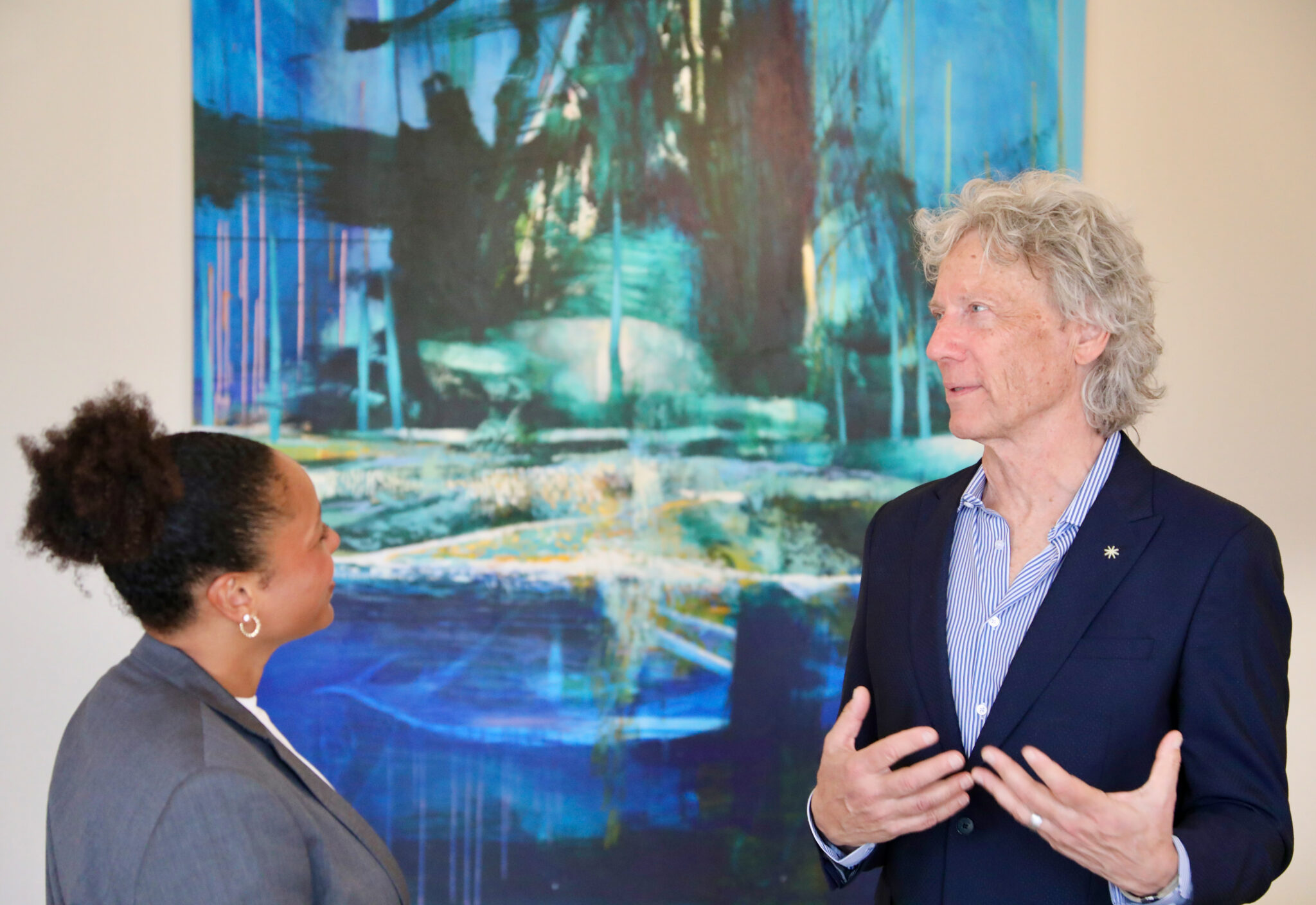
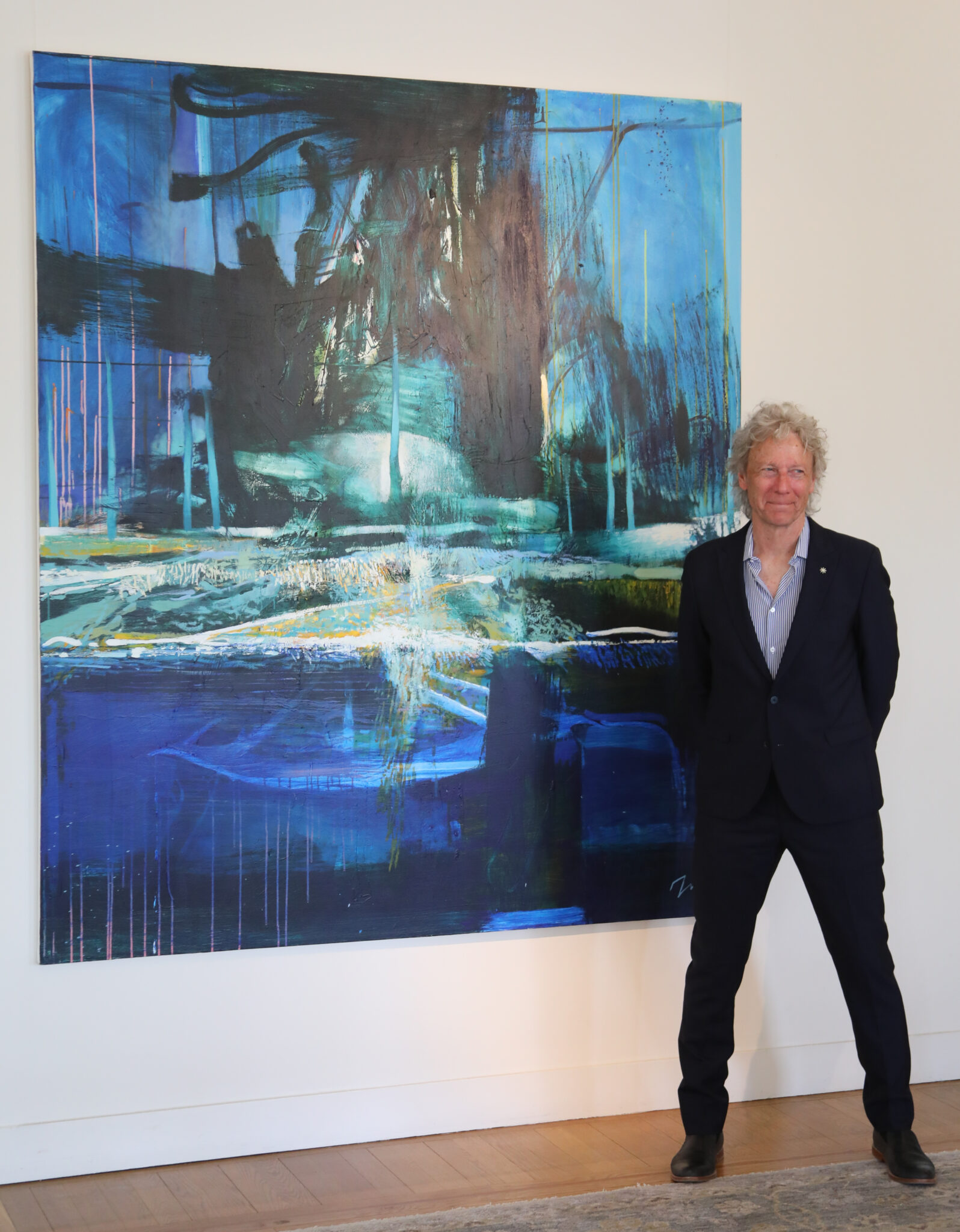
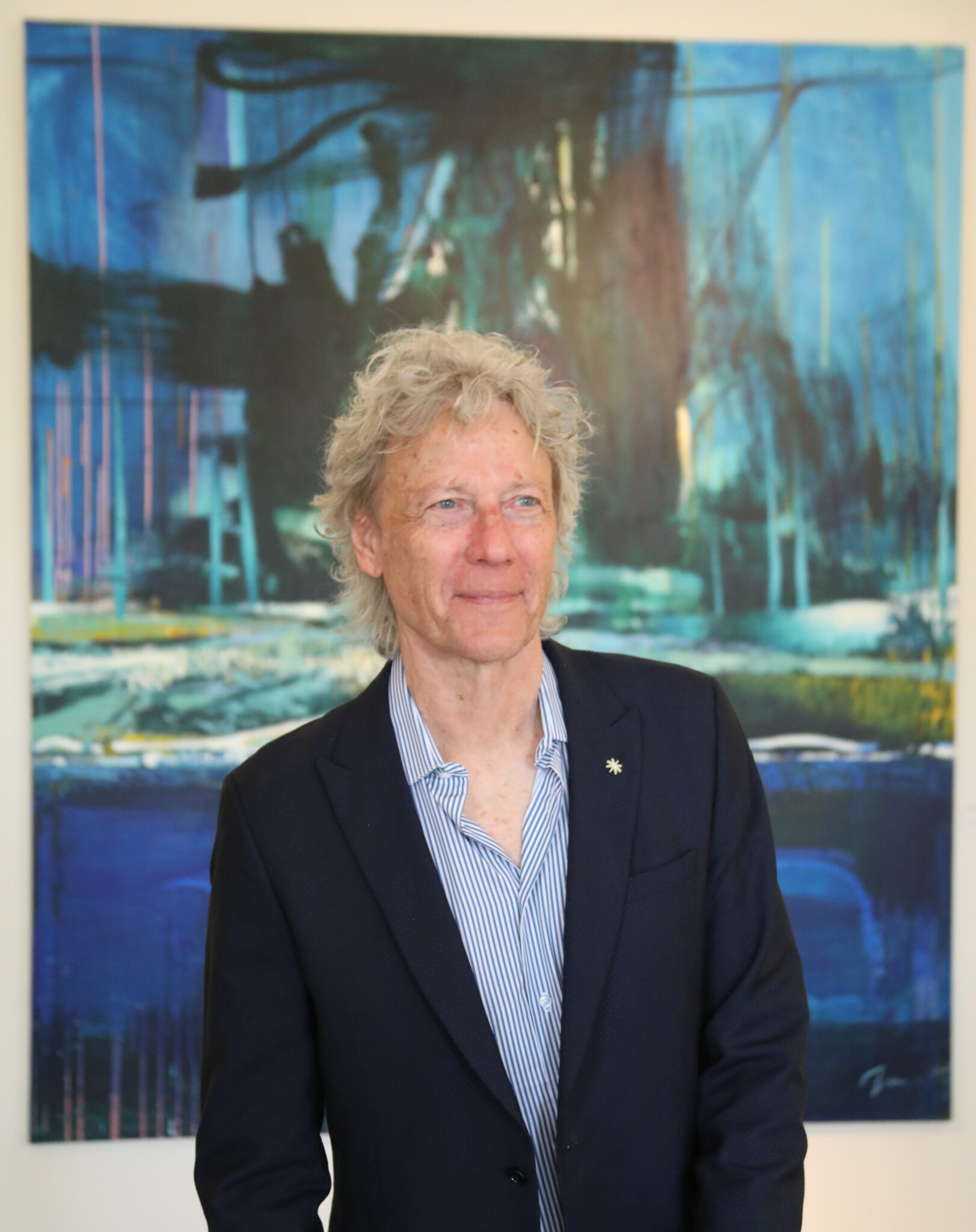
Inside, the residence staff welcomed me and surrounded me with paintings carrying their own histories. Yet one work immediately held my attention: a monumental field of cobalt blue, painted by the man I had come to meet.
Chuck Olson’s own connection to Sweden reaches back two generations. Swedish traditions remained present throughout his American childhood, woven into family rituals, faith and memory. After several days visiting art schools and cultural institutions across Stockholm, we sat down to speak about inheritance, cultural identity, and the quiet tensions that continue to shape his work.
Jahwanna Berglund: Your grandparents left Sweden, yet Swedish traditions remained in your family. Two generations later, what did you inherit?
Chuck Olson: When your grandparents move, the question becomes: what do you inherit of what mattered to them? We had Swedish Christmases. The 24th was Swedish, and the 25th was American. We went to a Swedish Lutheran church, and I was baptised there. That mixture of rituals becomes part of your cultural DNA.
JB: Your life has also been shaped by France and Italy. What has each culture brought to your painting: palette, structure or the way you resolve a canvas?
CO: I married a French woman, and we have built a life that moves between these cultures. The dinner table debates say a great deal. My Italian cousin once asked whose bread was better, and I said, ‘French’.
In northern Italy, around Parma, you do not have the same abundance of vegetables as you find in the south, while the French kitchen is perhaps more curious. Still, those little Italian wines are perfect with pasta. At home, I cook Italian and Marie cooks French.
In the studio, France sharpened my eye for structure and restraint, while Italy expanded my sense of light and my appetite for colour. I edit like a French painter and layer like an Italian cook: clarity overlaid with richness.
JB: How did you come to know Ambassador Christine J. Toretti, and how did your work become part of the collection at Villa Åkerlund?
CO: We are both from Indiana, Pennsylvania, which is also Jimmy Stewart’s hometown. With Christine, we met through education and the place of the arts in society. Politics aside, art is where we talk.
When she said, ‘I want one of your paintings in the residence’, I thought, ‘Sweden, here we go’.
JB: Your work is often described through a Franco-American duality. What happened when that sensibility encountered Sweden?
CO: Before this visit, I did not know Sweden’s contemporary art culture firsthand. After three remarkable days visiting institutions and art schools, I have a much better sense of it.
I am curious about how the Swedish eye reads restraint, silence and landscape, and how water, distance, and light operate here.
JB: What are you seeking within the paintings themselves?
CO: Often, it is a quiet confrontation. Not something angry, but the viewer alone.
With this work, I kept thinking: I am in a kayak, by myself. I turn, and there is something there, perhaps a ruin. I like deliberate ambiguity—forms that feel like trees, and then perhaps they are not. Something beneath the water that you can see but cannot name.
A British critic once wrote that my paintings are like a shell you pick up on the beach. It is too compelling to leave behind, so you put it in your pocket and take it home. You forget it on a shelf, and then one day you rediscover why you kept it.
I do not think artists know everything about their work. It grows like a flower, with roots. I aim for the intellectual curiosity of an adult and the sense of wonder of a child. We oscillate between the two.
JB: Where does that movement between play and responsibility enter the work?
CO: A Zippo is a toy when you flick it, but once there is a flame, it becomes a responsibility. A pocketknife spins in the hand, but once the blade is out, it becomes a responsibility too. That shift from play to consequence is a space I like to paint.
JB: What does the studio mean to you?
CO: It is where nothing really changes. The paintings evolve, but for fifty years I have walked into the studio and become the same age again, somewhere in my early thirties.
Your failures get better, but the work must remain restless enough to keep you honest. Doubt, excitement, the urge to leave and then return tomorrow: those are all signs that you are still alive in the work.
JB: The cobalt painting at Villa Åkerlund was created two years ago. How did it develop, and how does it relate to the rest of the series?
CO: I work on eight or nine paintings at once, in an easel room with built-in easels reaching three metres high. Some canvases are four metres wide, others three and a half or two and a half.
If one painting stalls, another may offer the solution. I develop them together. They are not bathroom projects. They need to share a cultural DNA.
At Villa Åkerlund, Olson’s cobalt canvas now belongs to another temporary constellation: an American painting shaped by several cultures, hanging on walls where art becomes a form of diplomacy. It is a fitting setting for an artist drawn to everything we carry with us but cannot always name.