Manon Steyaert Paints Her Childhood From Memory
Text by Natalia Muntean
As a child, Manon Steyaert threw fallen oranges at the bright pink wall beside her grandmother’s garden in France. Years later, those orange splotches return in Long Distance Romance with Memories, her second solo show at WAY gallery in Stockholm, on view until November 8, being painted entirely from memory.
Natalia Muntean: The title, Long Distance Romance with Memories, is quite evocative. Where did it come from?
Manon Steyart: I really wanted a longer title for this show and something emotive. I’ve always leaned towards shorter titles in the past, mostly a word or two, whereas this title is very much part of the works themselves, while also tying into the titles of the works. I was inspired by Cecily Brown and the way she talks on her art, especially in her latest show at the Serpentine in London. I have a very positive view of my childhood in France and wanted something that complemented this, almost romanticising it.
NM: The show draws on places from your childhood in France: gardens, woodland walks, the countryside. Do you work from photographs and sketches or purely from memories?
MS: For this new body of work, I didn’t use any personal photos to serve as reminders of the places; they were purely from memory. This was important to me as I didn’t want to alter my perception of these spaces. Instead, I leaned into the fragments of my memories when painting. I was also inspired by various paintings/artists that I would turn to for inspiration in gesture and mark-making, but the feeling of the memories was very much from recall. For example, the two pieces titled “The Pink Wall” are purely from recall. My grandmother’s garden had a building on the side of it that was multiple stories high and bright pink, both beautiful and overpowering to the serene garden she kept. As children, my cousins and I used to throw fallen oranges from her trees onto this wall, creating splotches of orange against the pink wall. I almost remember this action of throwing as painting.
NM: You’ve been turning back towards painting recently. What prompted that shift after working so much with silicone and sculptural elements?
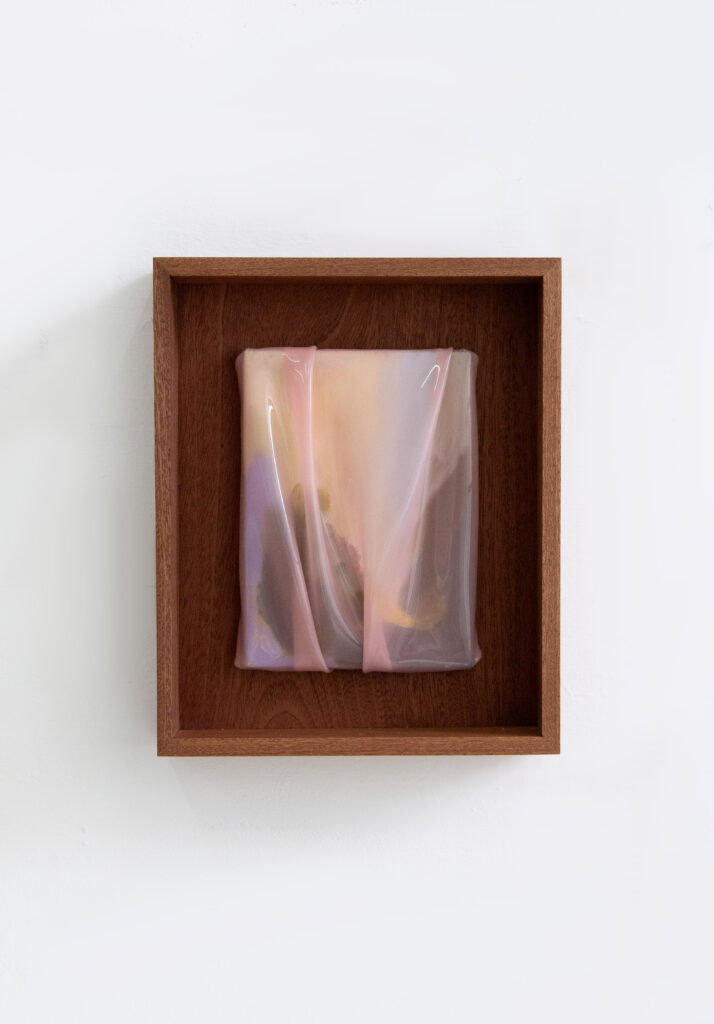
MS: I think as I’ve grown older, I have been wanting to tap into a slower side of everything. For me, that is painting. Sculpture has a more calculative tendency, and so I didn’t feel like I was tapping enough into a flow state while working, whereas with painting I love the feeling of the paint and the strokes, which become almost meditative. I have also been enjoying seeing the immediate effect of the gesture within painting, whereas silicone is slightly different, a more controlled way of working. I find painting more romantic, and that’s a stage that I am currently at with my practice.
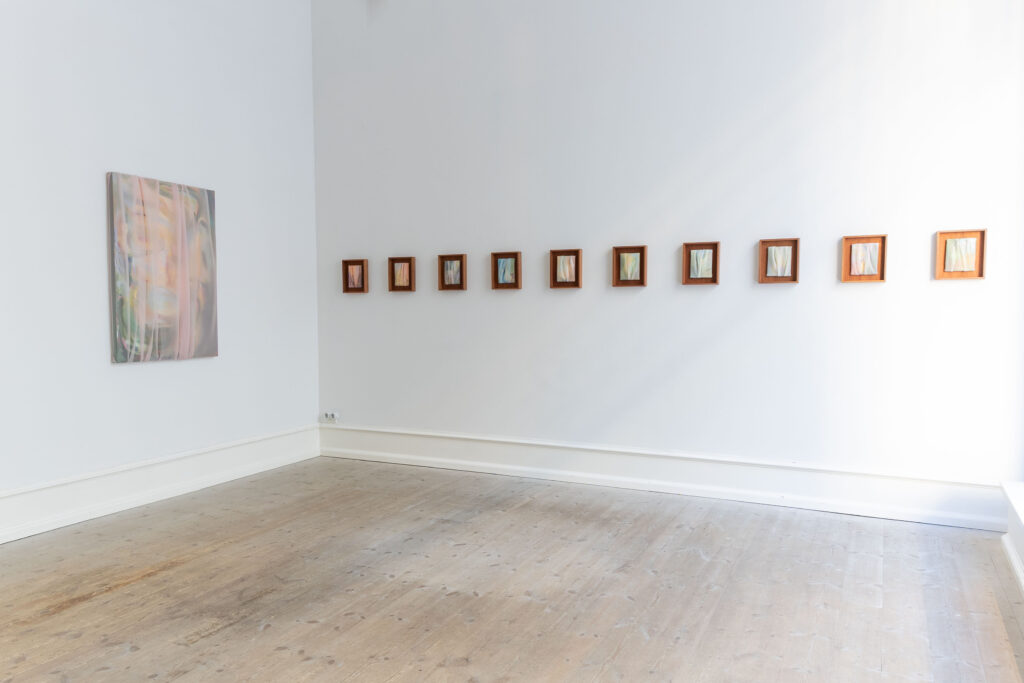
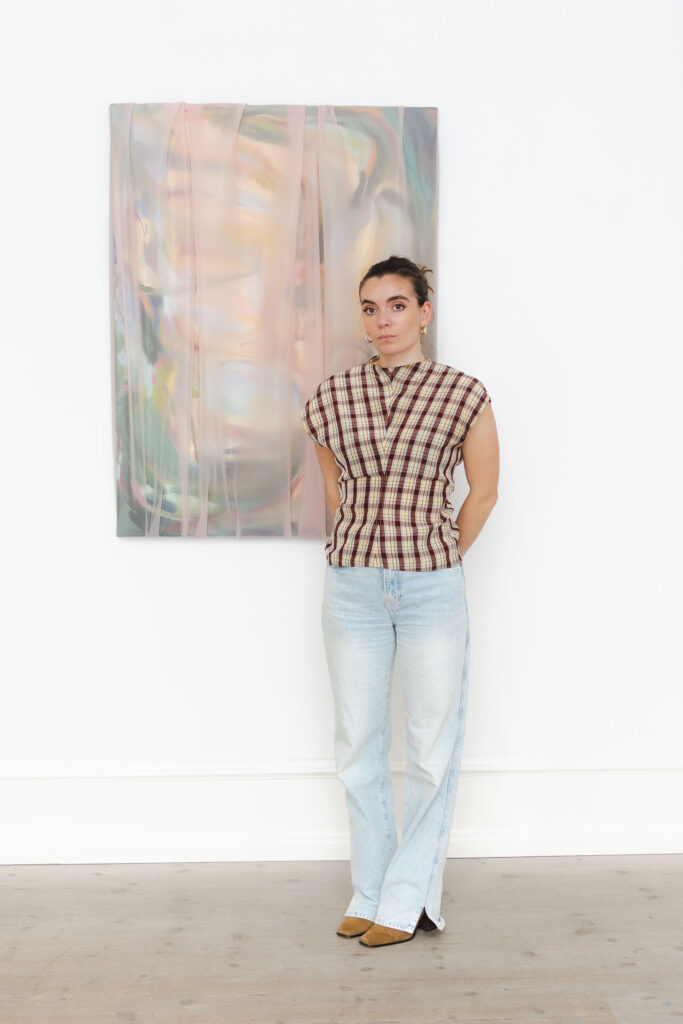
NM: Looking at the draped works, I thought of a seal, as if the silicone were keeping the memories safe. Is that close to how you think about it?
MS: I think there are many connotations with the draped silicone. In this instance, it serves as a layer of haziness. It can express the flawed aspect of memories and the act of remembering, especially the feeling we can have when thinking about the past. Obviously, everyone is different and has different capabilities of remembering their past, but for me, there can be clarity, but there can also be haziness over those memories. I guess that’s just part of life and getting older.
NM: The smaller works evoke postcard-sized printed photographs and the idea of false memories. Do you see the image of a place replacing the experience of having been there as a loss, or as something more playful?
MS: I probably see it as both. Some memories I desperately wish I could remember more clearly, but I know my mind references the photo, not the feeling. I wouldn’t say it’s a loss per se, as each place in my mind has at least one memory attached to it, but I do think these photos bring playful fragments of the memory forward, almost an introduction to the thought.
NM: Born in Belgium, French-British, based in London, and now showing in Stockholm. Does being between places shape how you think about memory and belonging?
MS: It definitely played a big part in the sense of belonging when growing up and where this may be, especially between countries. It definitely made me yearn for these spaces, even more so now as I get older and I create my own. The essence of moving on can be quite daunting, as I am a nostalgic person, but I think for now I will just live in these spaces in my mind and try to communicate them in my work. I think belonging is a continuous topic that is reflected in my work and is something I want to continue diving into.