Breaking It Up
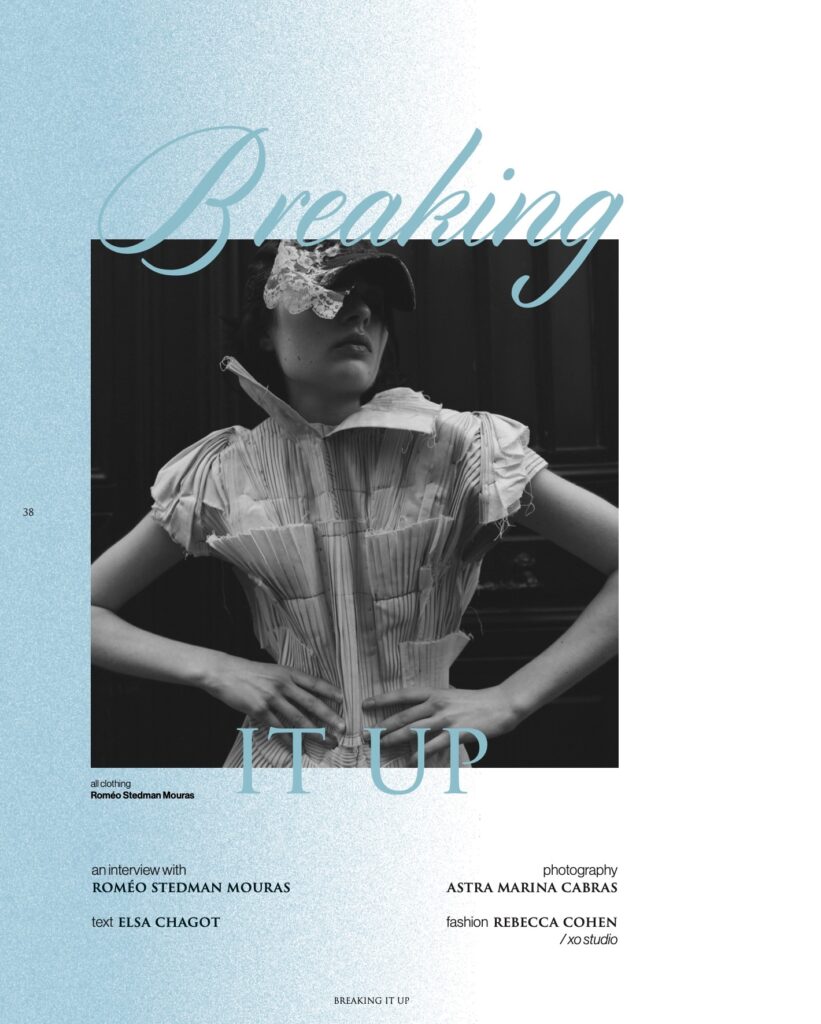
Raised in the southwest of France, the French-American designer Roméo Stedman Mouras learned early that nothing is ever truly fixed. Transformation — of land, of identity, of material — became both a philosophy and a practice. Working exclusively with discarded textiles and deadstock, his designs move beyond sustainability as a trend, positioning upcycling as a political, emotional, and almost spiritual act of reclamation.
Elsa Chagot: To begin, could you tell us a bit about your background and how your relationship with fashion first developed?
Roméo Stedman Mouras: I’m French-American. I grew up in the southwest of France, on a farm, raised by my mother, an American artist, feminist, and someone who never really fit into systems comfortably. I was surrounded by animals, by land, by things that were constantly changing. You see birth, decay, repair, seasons shifting. Nothing is fixed. I think that understanding of transformation came very early for me.
Fashion wasn’t something I decided on. It happened naturally. I used to cut into existing clothes, mostly my mother’s, which she didn’t always appreciate. I wasn’t trying to destroy them. I just didn’t see them as finished. I wanted to move things, reshape them, make them feel like mine. Before I knew what design was, I understood alteration. I understood that nothing is sacred in its original form.
EC: Having been raised in a creative and politically aware environment, in what ways has your upbringing shaped the way you view clothing, expression, and the role of a designer?
RSM: Growing up in a creative and politically aware environment made it impossible for me to see clothing as neutral or purely a product.
Environmental protection is fundamental to the way I work. I was raised in a place that felt protected, full of life — animals, land, ecosystems that felt almost sacred. Being surrounded by that kind of abundance creates a sense of responsibility. Using upcycled materials and deadstock isn’t a trend for me; it’s simply the only way that makes sense. It’s my way of giving something back through the act of creating.
At the same time, I grew up aware of inequalities and social imbalances. When you witness injustice early on, it shapes you permanently. It creates a desire for protection, for community, for freedom of expression. As a designer, I don’t see my role as just producing garments. I see it as creating space — space for individuality, and space for those who exist and resist outside-imposed norms.
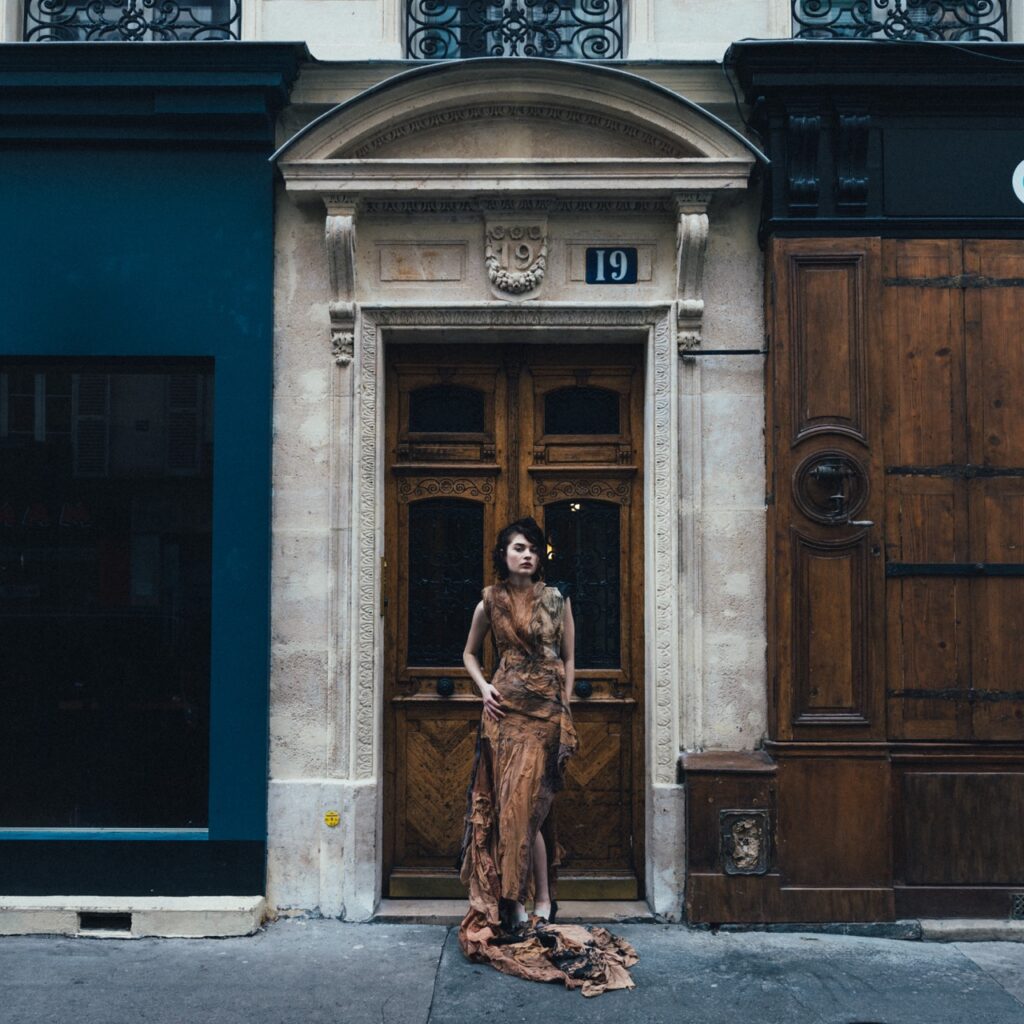
EC: Can you walk us through your creative process, from the first encounter with a material to the moment a piece is complete? How does work typically begin for you?
RSM: I usually begin with research, both conceptual and historical, to build a framework around the narrative of the collection. Once that direction feels clear, I move into sourcing materials. I collect extensively, and the origin of each textile influences how I approach it.
If it’s a deadstock roll, I might begin more structurally, working with pattern cutting first. If it’s a found or donated textile, I often respond more intuitively, letting its existing condition guide the process.
Technically, I tend to start with a base pattern, a foundation, and then build onto it through draping and stitching. I work a lot through layering, surface manipulation, and what could be described as a habillage technique, sculpting directly on a body.
EC: When you start a new piece, what usually comes first, the material, an emotion, a memory, or a concept — and how do these elements interfere throughout your process?
RSM: It’s all quite spiritual, and I intentionally allow it to remain that way. The only fixed element at the beginning is the narrative — the story I write before starting a collection. That story becomes the spine. From there, I start breaking it down piece by piece, and that’s when memories, historical references, and personal associations begin to surface.
The fabric doesn’t usually change the original concept, but it extends it. It adds nuance, texture, sometimes tension. It can deepen the emotional tone of a piece without redirecting it entirely.
All of these elements coexist in a kind of melting pot. They don’t operate in isolation — and neither do I. My work is deeply shaped by the people around me, my community, my family. Creation, for me, is never solitary. We are constantly influencing one another. My role is to let that chaos exist, but to anchor it visually, so the garment feels intentional rather than abstract. I try not to control it completely; I try to translate it.
EC: “A THEFT OF ESSENCE” could be described as being built from an act of emotional archaeology. What does that phrase mean to you personally?
RSM: Indeed, that collection is about what happens when something intrinsic to you is slowly taken, not violently all at once, but through expectation, conformity and normalisation. It wasn’t about inventing something new; it’s about excavating what was always there, but buried under social structures, control, and inherited silence.
The characters in the manifesto embody that tension — the stillness of submission, the suffocation of imposed identity, and the moment when something inside begins to resist. Archaeology requires care, patience, and confrontation. You uncover fragments, damaged pieces, scars. You don’t restore them to perfection — you preserve their history.
In the collection, repair is not hidden. I wanted it to be ceremonial, visible, almost ritualistic, becoming proof of survival rather than an attempt to erase damage.
To me, it is about the process of reclaiming one’s essence through community, art, and expressionism — not by denying what has hurt you, but by transforming it into something visible, something defiant, something shared.


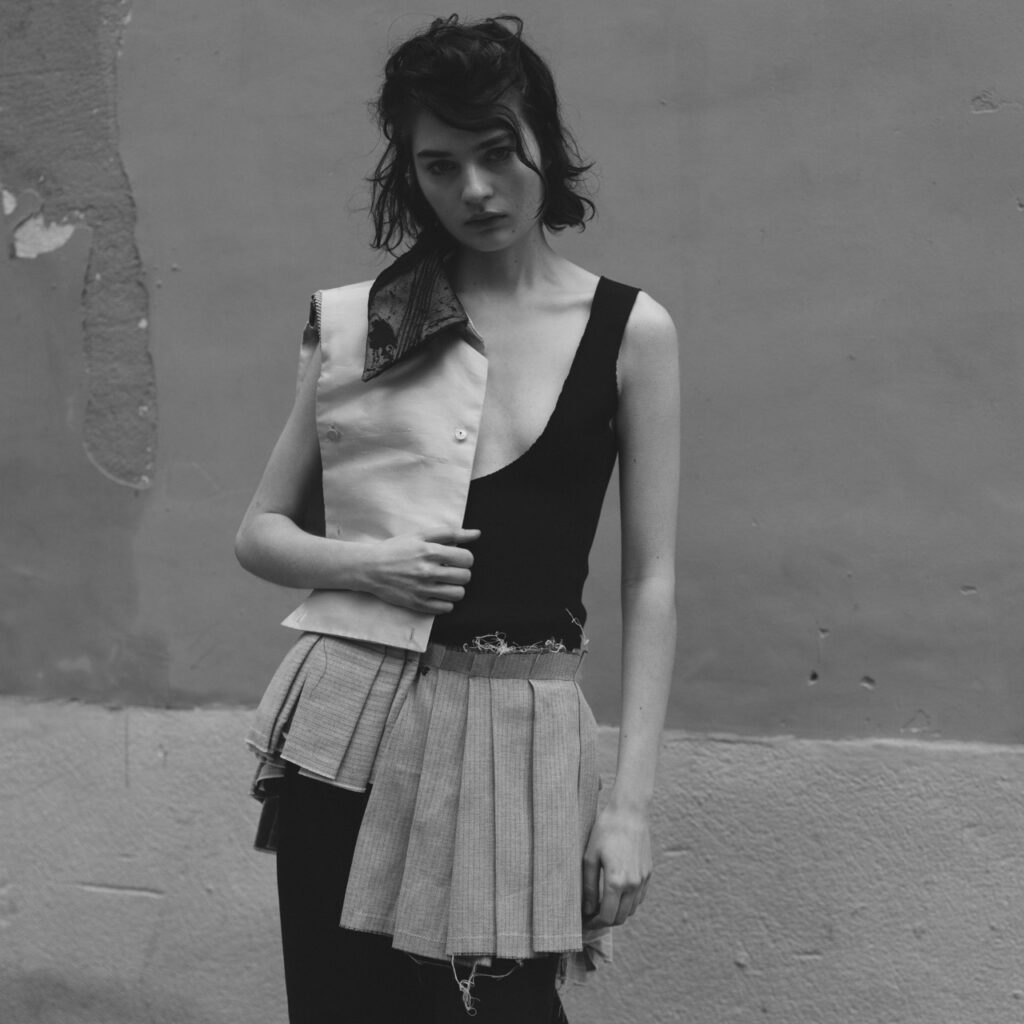


EC: The pieces were created in collaboration with your grandmother. How did this intergenerational exchange influence the work, both aesthetically and emotionally?
RSM: The intergenerational exchange was both aesthetic and deeply emotional. The work itself is very political, and I found myself in awe of my grandmother — not only of her technical precision, but of her willingness to involve herself so fully in something so charged. It broadened my perspective and challenged the way I see transmission, resistance, and legacy.
She is extremely meticulous in the way she sews. Every hem is finished by hand. She pays close attention to symmetry, to balance, to structure. There is a discipline in her approach that contrasts with the rawness and chaos of my designs.
That contrast created a powerful paradox. And yet, rather than clash, it strengthened the work. It grounded it. It taught me that rebellion can coexist with care, and that resistance can be constructed with tenderness. I thrive in that tension, I think we both do.
EC: You work exclusively with materials that already carry histories: donated, recovered, thrifted, discarded. What draws you to textiles with a past, and how does the decision to work sustainably influence the way you translate their former lives into new narratives?
RSM: Beyond the environmental aspect, I think I’m fundamentally against the idea of perfection — especially within the stories I want to tell and the systems I want to critique. Used fabrics embody that rejection. They’ve already lived. They’ve travelled, been worn, ripped, and stained. In many ways, they’ve experienced more than I have. And then, almost by chance, they arrive on my desk. There’s something almost magical about that encounter. I feel a responsibility to preserve traces of their previous lives. I don’t want to erase their history; I want to let it coexist with the new narrative. Reusing and reshaping them becomes a way of allowing them to exist in another form rather than disappear.
There’s also the question of constraint. My work, especially in A Theft of Essence, critiques social conformity and imposed structures. So I impose limitations on myself. I work with what is available — a certain surface, a specific stiffness, a restricted colour palette — and I adapt to it. I don’t dominate the material; I negotiate with it. That constraint becomes conceptual. It mirrors the themes of restriction and resistance within the collection.
EC: Is there a particular thrifted or found textile you’ve worked with that holds special significance for you? What was its story, and how did it shape the piece it became?
RSM: One piece that holds particular significance for me is a dress I made entirely from shawls. A dear friend once gifted me a large box filled with lace, delicate fabric fragments, and two antique piano shawls. The silk, the weight of the fringes, the depth of the colours — they moved me immediately. I can’t fully explain why, but I felt something visceral when I touched them.
That encounter stayed with me. It became almost an obsession. I decided to go on a three-week road trip to Northern Italy, actively searching through markets, antique stores, and church sales for more shawls. I came back with nine of them — some over a hundred years old.
Each shawl carried its own history: ceremonies, performances, inherited wardrobes, forgotten trunks. Instead of isolating them, I brought them together. I constructed an entire dress from these fragments of past lives. This example is one of many, but it reflects the way I work.
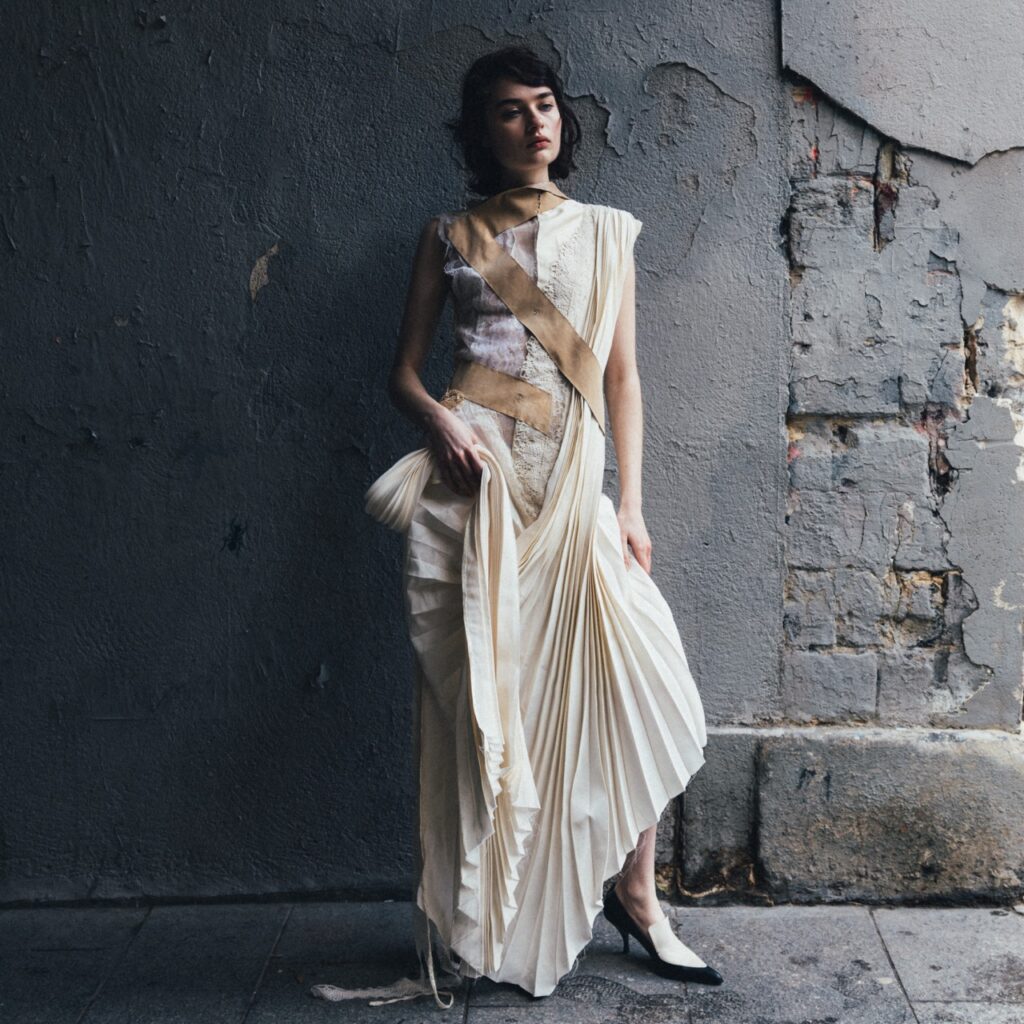
EC: Your construction methods are entirely manual and deeply tactile — pleating, fraying, dyeing, sculpting by hand. What does this human physical labour mean to you within the context of fashion creation today?
RSM: I’ve learned the hard way that my process is counter-current. Many of the pieces are, in essence, unreproducible. They can’t simply be replicated, and that’s intentional. For me, that’s how singularity is expressed — not as ego, not as the designer positioning themselves at the centre, but as a reflection of everything I believe in and of the people who shaped the collection. Each piece carries specific gestures, specific hands, specific moments. They can’t be industrialised without losing that imprint.
I’m deeply attracted to complexity — almost in a mathematical way. There’s a structural rigour in the way the garments are built, even if the narrative behind them is spiritual and fluid. With these methods, I can’t achieve the kind of visual perfection the industry often imposes. But I’m more than comfortable with that. In fact, I resist it. The slight irregularities, the said visible labour, the asymmetries — they make the garment human. In a context where speed and replication dominate, working manually becomes a form of devotion. It slows the process down. It forces presence. I want it to leave evidence.

EC: Upcycling is often discussed in strictly practical or ecological terms. In your work, it seems to function on a symbolic, even emotional level. How do sustainability, ethics, and the idea of reclaiming lost or discarded histories shape the narratives you build through clothing?
RSM: In today’s climate, I believe that reusing is already a political act. Choosing not to produce something new, choosing to work with what already exists, is a refusal of excess and a refusal of erasure.
But beyond that, there is the idea of reclaiming. And reclaiming is central to everything I try to communicate in my collections. Reclaiming materials mirrors reclaiming identity, voice, and essence. What has been discarded, silenced, or overlooked still holds value. It simply needs to be seen differently.
Using these fabrics gives my narratives an anchor point. They make the concepts tangible — visually and texturally. Its irregularities, its previous life — they embody the themes I explore. They are fully part of the story from the beginning.
EC: What do you hope viewers feel, confront, or recognise when encountering these pieces for the first time?
RSM: I hope the work offers a shift in perspective. For minorities and communities navigating today’s political and social climate, I want the pieces to feel like acknowledgement. I want them to feel heard, seen, and written into history rather than erased from it. There is a political depth to this journey, and I hope that depth is felt — not just understood intellectually, but sensed emotionally.
For society and for the industry, the message is different. We cannot return to old systems. It is no longer a time for passive questioning; it is a time for action. My work is not about attacking individuals — it is about challenging institutions, structures, and inherited norms. Above all, I want people to feel protected in their truth. I want them to feel that complexity, vulnerability, and resistance can coexist.
EC: As you look towards the future, what directions, emotionally, materially, or conceptually, are you most interested in pursuing next?
RSM: Looking ahead, I’m searching for a deeper sense of community. Building this brand has taught me that none of this exists in isolation — even though we often forget that. The work is shaped by conversations, by shared experiences, by collective resistance. I want to expand that. I’m interested in working on a more social level through the brand — collaborating with cultural thinkers, artists, and intellectuals who are actively questioning the systems we live within. I want to continue uncovering societal mechanisms that systematically keep certain communities in the margins. Materially and conceptually, I want to push further into experimentation. To work across mediums. To allow performance, installation, and dialogue to enter the space alongside garment-making. More than anything, I want to keep learning — to remain in motion.
photography astra marina cabras
fashion rebecca cohen / xo studio
makeup Thomas Lorenz using Dr. Barbara Sturm
hair Andre Cueto using Oribe HairCare
model livia b/ Stockholmsgruppen
photography assistant charleen billot
all clothing roméo stedman mouras