Inside Trove: Cathy Nordström’s Unexpected Source of Inspiration
Text by Natalia Muntean
An online auction, a mystery box of books and centuries of decorative arts became the surprising starting point for Trove, Cathy Nordström’s latest collection of textiles and wallpapers. What arrived at her studio was far from a carefully curated archive, rather it was a personal library documenting embroidery, ceramics, rugs and ornamental crafts from across Europe, Asia and the Middle East.
Instead of reproducing historical motifs, the Swedish pattern designer transformed these references into five original, hand-painted patterns that reflect her use of colour and love of craftsmanship.
Six years after launching her brand, Nordström reflects on its beginnings after years of designing for others, the emotional thrill of discovering the archive and why the hardest part of creating Trove was knowing when to stop.
Natalia Muntean: You have described yourself as a “passionate textile nerd” in one of your other interviews – was there a moment you can point to when patterns and textiles became a serious interest?
Cathy Nordström: I can’t think of a specific moment. Looking back, I can see that it’s always been a part of me. As a child, I loved decorating my room, and there were always patterns and colors involved. I repainted, wallpapered, and played around with cushions and textiles. Since then, it has gradually grown to become more of an obsession than even a passion. There are a few things that make me more excited and more filled up emotionally than old textiles and craftsmanship.
NM: You worked for years licensing patterns to other brands before founding Cathy Nordström in 2019. What made you want to go out on your own?
CN: Somebody asked me at one point, “Do you have a lot of your patterns at home?” and I remember answering, “No, definitely not.” Then I started thinking maybe I should actually start designing patterns that I am proud of and that I truly, truly love. I grew more and more tired of just sending away a digital file. When you freelance and license patterns to other brands, very often the customer dictates the outcome, to some extent.
I was licensing my patterns to a lot of different kind of brand, from IKEA and UNIQLO, to smaller baby brand in the UK and quilting fabric companies in the US. It was fun, but I didn’t love these patterns. I wanted to design prints that I wanted myself and I knew it was always interiors and homeware that was my passion. I wanted to be part of the whole process: I didn’t just want to send a digital file to someone, and then it was out of my hands. I wanted to be part of everything, from the first idea and moodboarding to the sketching, drawing, creating the screens for the screen printing, being on the factory floor when we print it, and just following through until the finished product. And I wanted it to be made in Sweden, so that was the starting point of everything. I didn’t know what I was throwing myself into, I just went for it.
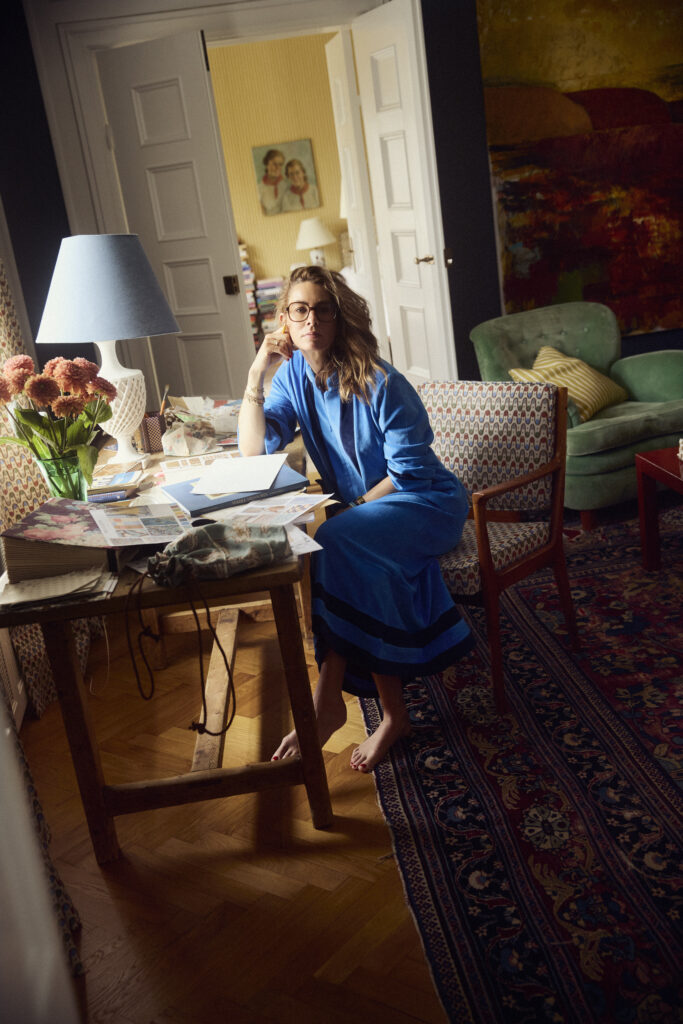
NM: How would you describe your own design language now, six years into running the brand?
CN: Some of the very first patterns I launched in 2020, had already been in my pattern library for some time. They were the prints that I had designed during my freelancing career, but never licensed because I must have known subconsciously that, at some point, these were prints that I wanted to own myself. Two of our best sellers, actually, I made before I started this brand six years ago.
I don’t know how to describe my design language, these things are always better described ny someone on the outside. I think the color scheme and limited use of colors in each pattern is what ties it together. Color is massively important to me. I guess my designs could be described as modern and simplistic, with a rich color story. I just design what I do. I’ve never designed with a specific style in mind, it’s just what comes out.
I do admire these more richly ornamented fabrics,I love French, Indian and British fabrics that have more details and colors. At some point, you feel like, “Oh God, I wish I could design patterns like that,” but it’s just not me. I try not to think too much about what my style is. I just let my hand dictate what comes out.
NM: The Trove Collection began with a friend’s tip about an online auction. What was going through your mind once the box arrived and you started looking through it?
CN: So many feelings and butterflies in my stomach. I knew I had stumbled upon an amazing treasure. Flicking through those pages, especially from the thickest book, which is like a documentation of craftsmanship, textiles, and ceramics from all over the world, dating thousands of years back, I knew I had something golden in front of me. And also, how many other books are out there for everyone to enjoy?
NM: Can you describe what was actually in the archive: the books, objects, documented crafts, and the regions and centuries they came from?
CN: Books and pamphlets about decorative arts, rugs from the Middle East, books about Swedish traditional sewing & embroidery, about folk costumes, about Swedish textile design in the 50s, books about how to knit and embroider, about curtains, about woven materials, about Asian art and Japanese patterns.
NM: Was there one object, book, or region in the archive that surprised you most, or that you keep coming back to?
CN: Yes, a really thick, large brick book called Decorative Art from Foreign People and Cultures. This one is the one I keep coming back to because it’s catalogued. Someone has catalogued so many different pieces from cultures all around the world, and it’s divided into countries and regions. It’s everything from textiles to ceramics to everyday objects, and it is the most amazing piece of work I’ve seen.
NM: You’ve said the challenge was never finding inspiration in this archive, but limiting yourself. How did you narrow an archive that size down to five patterns?
CN: It was truly a challenge, but when putting together a collection, I’m always looking to create different types of patterns. I don’t want two patterns within the same collection to look too similar to each other. I really was looking for five very distinctively different patterns, and that was the starting point when excluding and narrowing down the selection. I have many more designs that I made when I was sketching and designing, but I felt like some of them were too close to each other, so I’m saving them maybe for the future, or maybe I will end up never using them. I find it quite uninteresting when a collection is filled with designs that are too similar. I prefer them to be very different and to have their own personality.
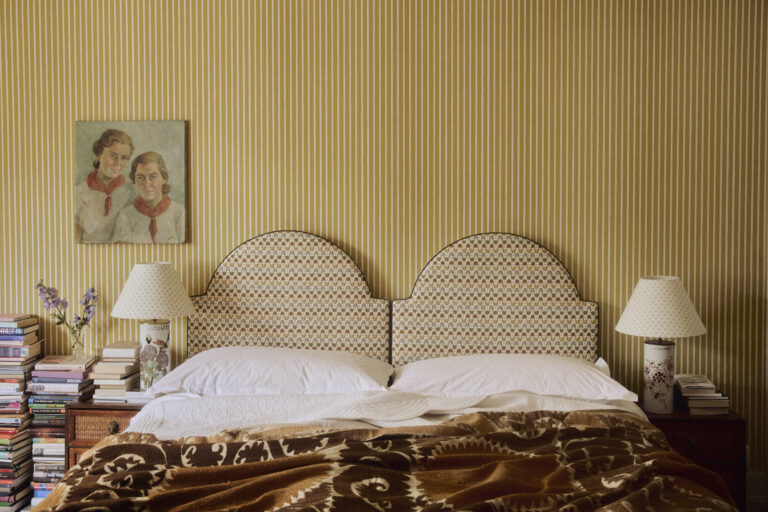
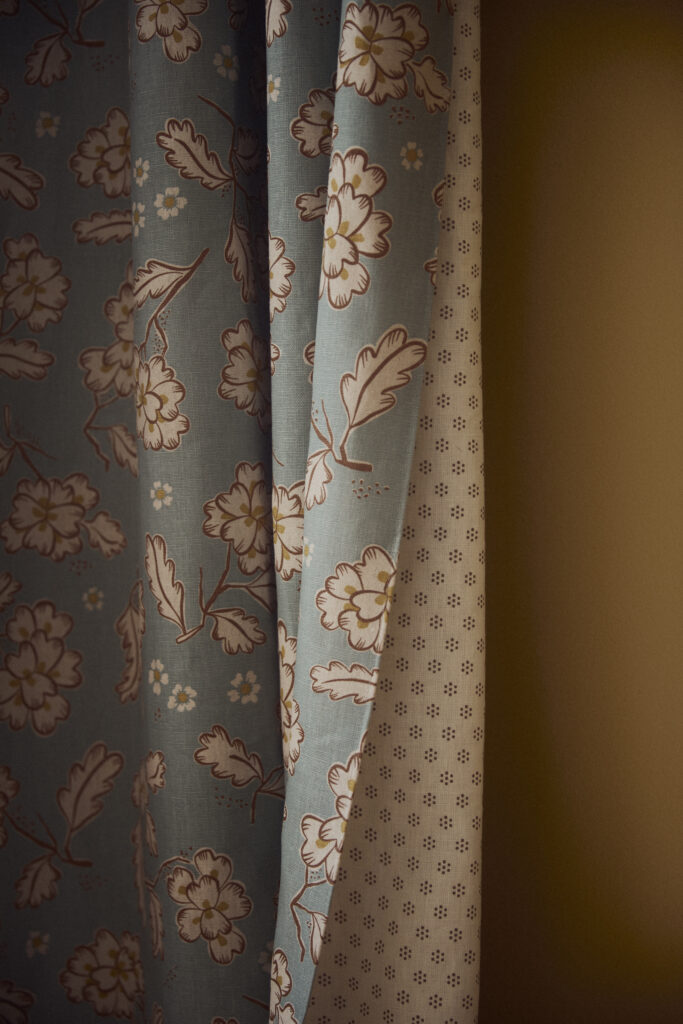
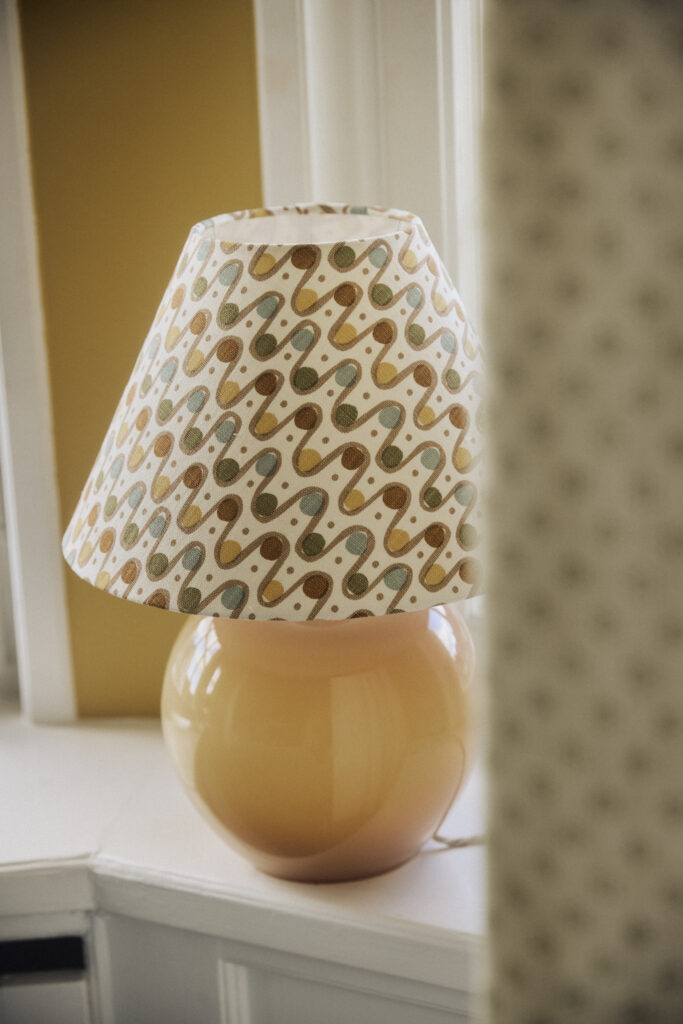
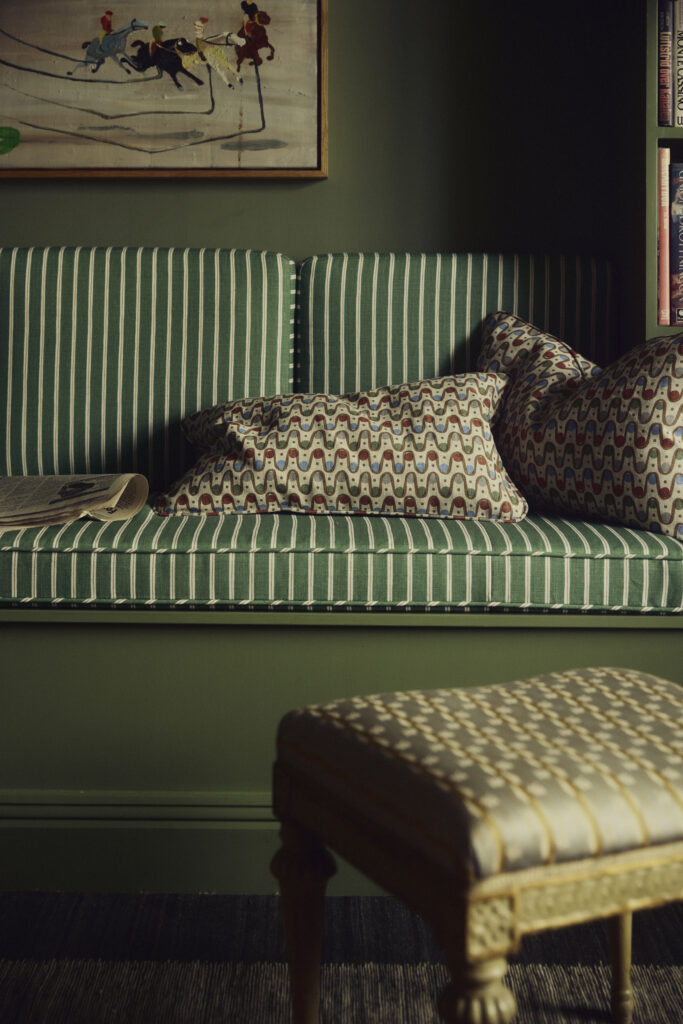
NM: Each pattern draws on a distinct reference: Ingrid Günther’s embroidery templates, an Egyptian archaeological fragment, Delft tile motifs, antique ceramics and indigo textiles, and a 1950s floral. Which pattern came together quickly, and which one fought you the most?
CN: Several were quite tricky. The easiest one was, naturally, the simplest one, Dutch Dot. I knew I wanted a very simple pattern with one object repeating itself across the pattern tile. This one was more about just painting these little rectangular shapes and dots and putting them together in different constellations. I ended up with this one, which has seven little dots creating almost a stylistic flower. I had a few versions of this, but design-wise and in making the pattern, this is very straightforward. The one that was really complicated to make was the diagonal stripe, because it’s printed on a rotary machine, with the pattern engraved on 53 cm wide cylinder. Designing a diagonal stripe on a cylinder, which is 53 cm wide, was mathematically really challenging and not to be honest, not so much fun.
NM: The collection splits differently across textile and wallpaper; some patterns are only in one, while Dutch Dot is in both. What determined that?
CN: It’s a combination of what we can afford within our budget, technical limitations and what I think works best for fabric and wallpaper. Because not all designs work for both. When you screen print as we do, you have to produce the screens before you can even start test printing. Quite nerve-wrecking! Every color is one screen, and then there is a minimum amount of meters for each colorway, so it’s very, very costly to produce a collection like this. There are also technical limitations. As I described, the wallpapers are printed on 53 cm-wide cylinders, and some of the fabrics are screen printed on flat-beds, whereas some of the fabrics are printed on engraved cylinders, and they all have their specific widths and dimensions. Sometimes you simply cannot translate one pattern onto both fabric and wallpaper due to technical limitations.
NM: How did working from someone else’s historical archive compare to designing from your own travel memories or family history, as you have in past collections?
CN: Designing from someone else’s historical archive was super exciting. It was like diving into their personal taste, and I found myself wondering why they had chosen to save these specific books, because I imagined they had so many more saved. It turns out that the couple who had these books were living in southern Sweden, and they were the ones who started a magazine called Antik & Auktion. They were definitely fellow antique, textile and craftsmanship nerds and it felt like this auction really ended up with the right person. I feel honored and proud to have been able to channel some of the historical objects in these books by making this new collection for the modern consumer. I hope these designs will live on for a long, long time.
NM: Is there anything from the Trove archive you deliberately held back that might resurface in a future collection?
CN: Yes, there are a few more floral patterns that I have chosen to keep. The Ingrid floral was inspired by an embroidery manual by Ingrid Günther. In this auction find, there were four beautifully printed pamphlets, all containing some of Ingrid’s original floral designs for embroidery. I designed two floral patterns – one made its way into this collection and I’m saving the other one.