Marcella Mravec: “Writing is my home”
Text by Natalia Muntean
“Power, revenge, beauty and art,” says Marcella Mravec about the ingredients of her third novel, Hennes ögon. Mravec came to fiction by an unconventional route. The Swedish author started as a fashion blogger, moved into journalism and later into the corporate world, working for a fashion brand. At 40, she decided to leave it behind and write her debut novel, Rebound, published in 2024. Nouveau Riche followed a year later.
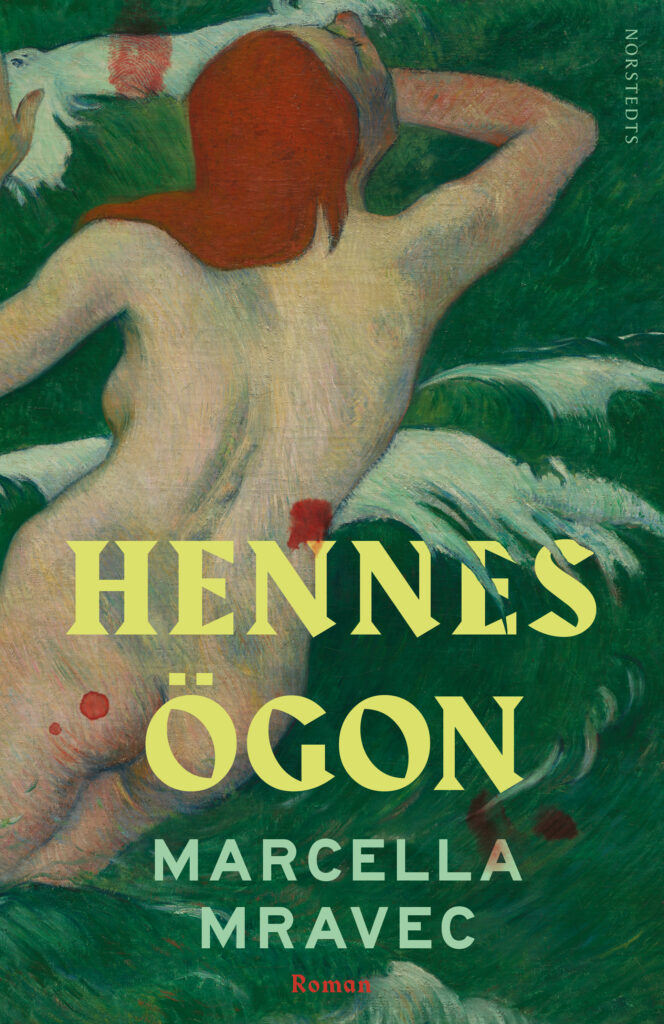
Set to be released in Sweden on 12 November, Hennes ögon is a darker departure from her previous books, taking place at an art school on a remote island. The title translates as “Her Eyes”, which she says suits the story: “The entire story is about being seen by others and being born, almost, in someone else’s eyes.” With publishing rights sold in 12 countries, it will reach English readers as The Muses, her first book to be translated. “I’ve never been translated before, so it feels like a huge honour,” she says.
Natalia Muntean: Congrats on your new book. Three books in three years. Do you have a lot of stories stored up, or are you very disciplined?
Marcella Mravec: Maybe both, but mostly disciplined. I’ve had the time to write full-time with these three first novels and the story needs to come to me, but it’s a mix of those two things.
NM: Do you have a routine for how you work?
MM: You know, when I first started, I actually googled how to do it. I googled, like, what do you do when you want to write a novel? And I stumbled upon this Stephen King quote. He wrote a book about writing, and he said to write 2,000 words every day. That’s quite a lot, actually. But I just followed that for my first novels.
NM: Only related to the novel, or do you also journal?
MM: No. Just for the novel. And then I try not to care too much if it’s good or bad. You just need to pump through it. Then I start each morning by going through what I wrote yesterday. So I do a very light edit every day. That’s how I like to start the day.
NM: That’s a good start to the day, actually. You said novels have to come to you. For the last one, Hennes ögon, you were walking on an island when a scene came to you. Do you usually start with a scene, or do you have the plot already?
MM: So far it’s always started with a little seed that comes from somewhere. It might be something I overhear in a conversation. For this book, I was walking around an island on the west coast of Sweden. The weather was autumnal, quite windy. And I didn’t meet that many people on my walk. So I started interviewing myself: if this was an interrogation, what would I remember from this walk? That’s how the first scene in the book came about. I started writing this interrogation scene with the main character. This was way back in 2023 and I was working on my first two novels. I just wrote that first scene and put it in a drawer for almost a year and a half. And then I continued from where I left off. I didn’t really know where it was going. But then the story quickly came to me.
NM: How would you describe your books to someone who can’t read Swedish?
MM: Oh, they’re so different, I think. But this new novel is very atmospheric. I would call it a literary thriller. So it’s this mix between a more literary novel and a suspense novel. It’s suspenseful, but not a conventional crime story, more like a psychological drama. And nature was a big inspiration. This island that I created is totally fictional, but it’s almost like a character in itself.
NM: What was the first thing you wrote that you took seriously?
MM: I have always taken writing seriously. I wrote a lot when I was a kid. I wrote short stories, I wrote poems, and I always wrote almost like short novels as a child. And I took those very seriously. And then after high school, in university, I studied literature, and then journalism. And then I became a journalist, and then writing was more for work. So I stopped writing fiction and just wrote articles for work for a long time. And then I went into marketing and worked as a creative with other things. So I didn’t write any fiction or any creative stuff for a long, long time. And then I was kind of sick of my corporate gig as a middle manager, and wanted to do something creative for myself. I had this idea that would become my debut novel, an edgy rom-com. But writing a novel as an adult always seemed so hard. It almost seemed like an impossible task. So I didn’t really have too high expectations of myself when I started. And then I wrote a few chapters, and fairly quickly I realised, “Oh, this is actually not that hard. And it could actually turn into something pretty good.” I always feel it in my bones whether it’s good or not. I trust myself. And I believe that imposter syndrome is a very human feeling that you will always have. I know best-selling international writers who still suffer from it. I try not to be too hung up on that feeling, because I know you will always have it, no matter how successful you are. But I’ve also always felt very at ease, and very much like writing is my home. Sometimes I write stuff that I feel is not good enough, and writing novels is super hard, but I also very much trust my craft. That it’s something I know how to do. Which is a good feeling.
NM: So writing the novels felt more like a return to your core than a change?
MM: Yes, definitely. Exactly. It made me feel more like myself.
NM: Your debut was described as romance and chick lit. How do you feel about that label of chick lit, and books about women?
MM: I didn’t really mind that label, because I wanted to sort of reclaim the chick-lit category and label, maybe. When you write chick lit or rom-coms or romance, there is a formula to it, and I sort of enjoyed working with that formula: someone was clumsy, someone sprained their ankle, someone made a big romantic gesture. I enjoyed writing and playing with all those tropes that come within chick lit and romance. So for me it was more like enjoying that, but still thinking, “Okay, so how can I make it more relevant? How can I make it edgier? How can I make it more contemporary?”
NM: Do you draw from personal stories as well, yours or your friends’?
MM: I’m truly a fiction writer, and I like to invent things, but then, I also draw from real experience. Every character is a side of myself, all the people I’ve met in my life. As a writer, it’s very difficult to separate your writing from your experiences in life. With that said, the stories that I tell are very fictional, so it’s more like details or bits and pieces. A creative weave of things, you know. But with my new novel, I wanted readers to feel as though they had entered a fairytale. Even though the story’s not fairytale-esque, I wanted them to feel that it was a very fictional world I created. I had some artist friends who offered to read it and make sure everything was accurate about art school, and I actually declined, because I wanted it to have this almost saga-like, very fictional feel to it. And then, of course, I did research, but I made sure not to do too much research on Swedish art schools, because I didn’t want it to resemble a real-life art school too much.
NM: Your first two novels are related to each other, and then the third one is completely separate.
MM: Yes. So it’s both a new genre and a completely separate universe.
NM: Why the shift? Did something happen that caused it, or did you have the idea from before?
MM: Not really. This book is closer to me, both as a writer and as a reader. I have always enjoyed rom-coms and chick lit and everything, but it was also something I felt I could do. It was my debut novel, and I asked myself, “Okay, what could I write?” And I had this idea for it. So it happened quite naturally, but, without sounding too crass, I also identified a bit of a gap in the Swedish market for that sort of edgy chick lit. But I would say this book is truer to myself as a reader and as a writer. It just came from passion. It was a very passion-driven project. It was just really what I wanted to do, and I didn’t think too much about how it would turn out or who the reader was. I just wanted to write something for myself, I think.
NM: Alma, the main character in The Muses, is maybe not a conventional heroine, because she’s scheming; she’s vengeful in a way. Did you set out from the beginning to write this kind of anti-heroine?
MM: I did. I love stories with unreliable narrators, so I knew she would be one. And I wanted to write her as a classic underdog, but also someone who is not the nicest person. She’s scheming; she has a lot of not-so-nice thoughts about people. So I didn’t want her to be too kind-hearted. I did want to write her as a classic antihero. I wanted the readers to root for her, but also to be a bit appalled by her at times.
NM: Do you think these kinds of female characters are judged more harshly or differently than male characters who are a little bit scheming and mischievous?
MM: Yes, I think historically they have been. But now we have seen a lot of these characters over the last few years, so it’s sort of changing now. Female characters get to be more multifaceted, which is nice.
NM: I agree. Were there any particular books or writers that influenced you when writing Alma’s story?
MM: I don’t think one person has read it yet without mentioning The Secret History by Donna Tartt, so it would be silly of me not to mention it, and not to say it was heavily influenced by that book.
It’s such a classic, and I love it so much. So that was a big influence on this book. But as I said, I also wanted nature to be a big character in it, and that gives it a very filmic, scenic kind of atmosphere. I’m very visual as a writer. I always use mood boards, and when I write, I almost see it like a film.
NM: How would you describe the mood board for Hennes ögon?
MM: It’s both dark and beautiful. We also worked a lot on the cover. We went through so many ideas and sketches, and our main idea was to combine something very beautiful, almost this ethereal beauty, which is the novel’s atmosphere, with something disturbing. We had lots of different ideas about how to create those disturbing elements, that’s also very present in the mood boards.
NM: The book shifts the question of who’s the victim and who’s the perpetrator. Was that something you had in mind from the beginning?
MM: What I do is that I write maybe four or five chapters and just let my mind go free and see where the story takes me. And then I write a synopsis, and I outline each chapter roughly. So I knew where the story was going, and I knew that I wanted to have this shift and kind of fluidity between who’s the perpetrator and who’s the victim. But it also shifted for me throughout the book, actually. What’s so interesting about writing, and something I didn’t really know until I started writing novels, is that the characters come alive during the process and they make their own decisions. I know this sounds trippy, but sometimes it’s like, “Oh, I didn’t know she would do that,” or, “I didn’t know he would go there.” But when you write, it feels very natural that the characters would make those decisions. I had most of it outlined, and I had the twist outlined. But in the end, some things weren’t set in stone. So it shifted more than I imagined from the start: who was the victim and who was the perpetrator.
NM: How do you resist forcing your ideas, versus just letting the writing flow?
MM: That’s one of the main challenges when writing a novel: you need to be disciplined, and you need to have a structure, but you also need to be open to letting the story sort of write itself sometimes. I don’t have a great answer to that, because there is a balance, and it’s hard to find it. But then you have a team of editors. You draft your novel, and then your senior editor comes in, and then your copy editor comes in. So they also guide you and make sure you stay on track.
NM: How open are you to feedback?
MM: I think I am. I can’t speak for my editors, but I do think my team thinks that I’m fairly easy to work with. Writers probably work differently, but for me, I draft my novel, then bring it to my editor, and we meet. After that meeting, she gives me her feedback. And that first big feedback feels like climbing a mountain. When you go back to your desk, even if you know it’s a first draft and you know how much it will change, you still feel kind of done when you finish the first draft. You’re like, “Okay, this is my story. I wrote the entire story. Yay, it feels good.” And then you go to your editor and they’re like, “Okay, and now for the changes.” The first feedback round is always kind of hard, but I do enjoy it. Once I’m in the process of editing, I really enjoy it. I love the back and forth, and it’s such a luxury to have people being so invested in your writing and in your story.
NM: Now that you’ve explored the romance genre and the more psychological thrillers, are you thinking of staying with that one?
MM: Yes, I’m going to stay with that for a while. The industry and publishing houses don’t like authors who jump from genre to genre. So I’m a bit problematic in that sense.
NM: But you’re also maybe discovering yourself as a writer?
MM: Yes, when I quit corporate, I promised myself this would be a passion-driven thing for me. When it comes to discipline, I very much treat it like a job. But when it comes to deciding what I want to write or what kind of writer I want to be, I promised myself to be very free in it.
NM: What kind of writer do you want to be?
MM: I want to be a writer who entertains but also writes things that stay with you for longer. I love immersive novels and creating worlds that you can escape into or just want to stay in. Even though the world I created for The Muses is very dark and sort of scary, it also gives you this feeling of transporting yourself and the reader there.
NM: Is there a writer you always return to, or a comfort book that you reread?
MM: I reread books all the time. Sometimes I also just read a small passage from a book. And when I have writer’s block, sometimes this helps, just reading a bit from a favourite book. It might be something silly, it might be a classic, and it might be something else. It really differs. A book I’ve returned to a lot is The Lover by Marguerite Duras. That’s a book I’ve always returned to. Also, a lot of Bret Easton Ellis books. Not American Psycho so much, but he wrote a collection of short stories called The Informers. That’s one of my favourite books, and one I return to a lot.
NM: What books are on your nightstand now?
MM: I just finished James by Percival Everett, which was shortlisted for the Booker Prize, and I really enjoyed it. I was actually surprised. It had a lot of mystery, but also this feel-good quality I didn’t really expect, which was funny and nice. And before that, I read The Guest by Emma Cline. She is probably my favourite contemporary writer.
NM: In a recent interview, when asked about love, you wrote about a friend, Lisa. And then in Hennes ögon, Alma creates a sort of alliance with Sara. Is female friendship the central love story in your work, in a way?
MM: Yes, definitely. And also in my first two novels, they’re both romance novels, and they’re both about a girl meeting a guy, but the central love story in those two books is the trio of friends. And also, with this new novel, the love story isn’t really about Sara and Alma. It’s more about Alma meeting three girls at the school who she becomes obsessed with. I really wanted to write about how, in your twenties, you meet people and make friends who almost become like lovers to you. Those friendships can resemble a love story. I wanted to write about becoming so obsessed with someone that you want them, but you also want to become them. That’s very much what Alma wants in this book. It’s not just desire for them. It’s not sexual desire, but it’s not only intellectual either. It’s still a physical desire, without it being sexual.
She wants to be close to them, and she wants to almost become them. So it’s more like a love story about love and obsession than friendship, in a way. It’s twisted, in a way. And it’s a twisty novel, which was something I wanted to try from a technical perspective, almost. Like, can I do this as a writer? I think I pulled it off.
NM: Do you read reviews?
MM: No. Definitely not. I wouldn’t be able to shake the criticism and it would stay with me forever, for sure. I don’t even really read good reviews. I just skim through them because I don’t want them to get into my head. It’s a weird feeling because I very much think that once you publish a book, it’s not really mine anymore. It’s the readers’, and they can interpret it as they want. They can think what they want about it. But I just don’t want to know about it.
NM: Because it’s such a personal text?
MM: Even though it’s highly fictional and I write stories rather than real life, a novel is still very personal work. I want it to be personal to the readers as well. I want them to attach whatever experiences, ideas, or feelings they have to it. That’s how I read books. I want them to feel that it’s their experience of reading that book.
NM: Writing can be an intimate ritual: the way you write, the words you use. Do you feel that when people criticise it, it’s like criticising yourself or your persona?
MM: Maybe. And maybe that’s why I don’t want to read it. The good thing about writing your debut novel at 40 is that I’ve already lived a life. I’ve had a career, so I don’t think I’m as vulnerable. Maybe if I were younger, it would be harder. I have kids and things to keep me grounded. I’m pretty good at separating my work from myself as a person. But I still don’t want to read bad reviews. That’s more for my ego, I think. I decided early on that I would be very open to feedback from my team of editors and my agents. But other than that, I want to have a clean, free mind. If I read too many reviews, that might influence my writing too much.
NM: What’s next for you?
MM: I have been writing three novels in a very short time, and I’m a bit tired. But I am working on something new and I’m not yet sure where it will take me. I’m also outlining a story about one of the characters from this novel, a sort of spin-off, set in the same universe. So we’ll see what happens. But I’m very excited that this novel will be out in so many languages and countries.