
Linnea Axelsson on Language, Literature and the Meaning of Home
What does it mean to feel at home, in a language, a place or a work of literature? Linnea Axelsson reflects on this question and others in a conversation about writing, motherhood, collecting and the quiet moments in which ideas begin to take shape.
Ulrika Lindqvist: Have you always wanted to write? What inspired you to start writing your first book?
Linnea Axelsson: Yes, I think I have always wanted to write. I also think that, for most people, writing has one foot in reading. You are a reader first. That was certainly the case for me. I was a reader.
UL: As you write both novels and poetry, do you experience a difference in how you approach them?
LA: The work itself is essentially the same, regardless of the genre. But I consider myself a poet at heart because of my relationship with language and because I think in images. For me, everything begins with images. At the same time, I really enjoy the resistance that a particular genre offers, and the process of discovering what form a piece of writing should take. Should it be a poem, an epic poem like Aednan, or a novel? I like the frameworks that each genre provides. In a way, genres offer their own particular differences, but the work itself is very similar.
UL: I was thinking about this when I read Sjaunja, where you discuss what feels almost like linguistics within the poems. Where does your interest in language come from, and how would you say it manifests itself in your writing?
LA: I think there are several aspects to my interest in language. On the one hand, as is often the case with poets, I tend to get caught up in language. I listen very closely to words, and I find the sound of something incredibly fascinating. I have always been very preoccupied with that. I listen very carefully, and I also enjoy the visual aspect of a title or a word. My mother also played with language a great deal, in all kinds of ways, such as saying words backwards or making up her own words. There is a playfulness to language that I really grew up with. That is one side of it. Another side, which I think some writers will recognise, is that I actually find language quite difficult. In a way, I do not consider myself a natural writer. Even today, my relationship with language involves a great deal of doubt. I can get stuck. You may feel a need to express something but be unable to find the expression, unable to find a language that feels true, and so on. I think I struggle with language quite a lot, and I believe that this is part of what leads some people towards an artistic language that feels true, or whatever you might call it.
UL: Are there any particular novels or authors that have deeply influenced your writing?
LA: The list could be incredibly long. I know a few writers who do not read, but most writers do. Literature is built so much on other literature, and all art is, in a sense, repetitive. That said, things change so much over the years. I feel that I move on from authors quite a lot. With Sjaunja, for example, I am in dialogue to a considerable extent with Elizabeth Bishop, an American poet whom I love and have read for a long time, particularly around six or seven years ago. She is a poet whose work I actively engage with in my own writing.
UL: Could you tell us about your creative process? When do you do your best writing, and do you have any particular rituals?
LA: The truth is rather boring. The honest answer is simply that you sit at your desk and persevere in some way. I think people often write best in the morning, for example. That is quite common. But I feel that this has changed a little over the years. These days, I can often still write even after a full day filled with all kinds of impressions. I try to write every day, and I prefer writing in the morning. I do not think I have any particular rituals, but I want it to be quiet. I do not want to have music on, and I need to be alone. That has really changed. I used to be able to sit in libraries or cafés, but I cannot do that anymore. I need to be alone.

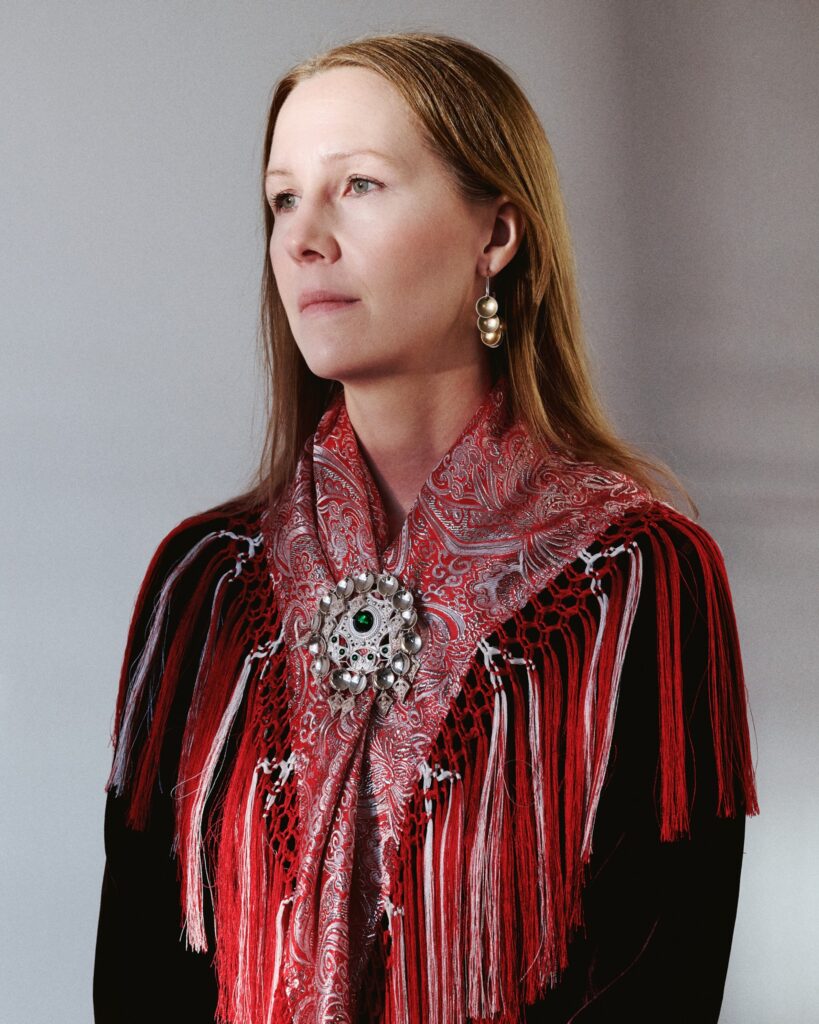
photography Josefine Laul
UL: I sometimes feel that, as you get older, you develop a greater need for silence.
LA: Yes, absolutely. About ten years ago, I often walked around with headphones on, but I have completely stopped doing that. I never listen to anything when I go for a walk anymore. I just go outside, walk and think. I love going for walks and swimming, and all those things. They are a very important part of my writing process, especially walking. A really good day is one where I work in the morning and then go for a walk. That is almost the most important part of the day because so many things fall into place. Afterwards, I can return to my desk and use what I have thought of while walking.
UL: Aednan was translated and published in English and Northern Sámi in 2024? How did it feel to have your work translated and reach a new readership six years after its original publication?
LA: It is simply wonderful. I am really happy about it. One part of your question concerns translation, and I think translation is already present in the act of writing itself, in a way. I feel that the book already exists in some form, and when someone begins to enter that world, it is my work, while the translator reflects it to some extent and brings it into their own language. In a similar way, the reader reflects it through the process of reading. Reading is an active process.
Finding words is such a natural part of writing, so it is incredibly lovely to see the book take on a new form in another language and another context. As for the question of time, I do not really think about literature in those terms. If books were animals, I think they would live down in the mud. They could rise to the surface and then sink back down again. They exist in a different kind of time, and they do not really age in the same way as other things. In that sense, the book feels somehow outside of time to me now. Of course, I may look at my own work with a critical eye. I think I have written better things since that book. But that is my perspective, and I would never want to stand between a reader who is discovering it now and the book itself. A publisher is encountering it now, too. In a way, that is not for me to interfere with.
UL: I think it can be good to gain some distance, but six years can also be a good amount of time. I think we are often at our most self critical during the first year, and that, with time, we become kinder to ourselves.
LA: I agree that you gain some distance. If I had started working on a translation around 2019, I was quite tired of the book at that point. Now, it feels different. Publishing a book is also about letting it go. It is no longer mine. It belongs to the readers, and the more time passes, the easier it becomes to respect that knowledge. It is not my book. It is the readers’ book.
UL: Were you involved in choosing Saskia Vogel and Kari Makreda Utsi as the translators? If so, what made you choose them?
LA: I should mention that the book was translated into Finnish a few years ago. Saskia contacted me fairly soon after it was published and wanted to translate it. Kari Utsi came into the translation process a little later, when the book was being translated into Northern Sámi, and she has done a wonderful job. I am very happy that she translated it. But I was not personally responsible for finding the translators or initiating the process. I have been involved from the sidelines throughout, and I have been able to answer questions when someone has asked me something, but I have not been the one finding people or taking the initiative.
UL: The question of what a home is and what it means feels central to Sjaunja. What does home mean to you?
LA: That is a difficult question, I think.
UL: Yes, it is very difficult.
LA: Yes, but it is a good question. A very good question. I think there is a strong idea of what a home is supposed to be. Something connected to your origins, something relatively stable and secure. But I think relatively few people actually experience home in that way. Perhaps some do. I mean, considering what the world is like today, and what it has always been like. For me, a sense of home is something that requires quite an active and critical process, in a way. That feeling of home, that sense of security and belonging, is something I experience in certain places. I experience it with certain people. And I experience it to some extent in literature, too.
There is a cliché that language is a home for a writer, or even for a reader. But I do not know whether language is a home for me. Language is closer to a living creature in my mind. But it is certainly a kind of place that I keep returning to, through reading and writing. So in some way, it is part of the phenomenon of home. At the same time, I think home is also closely connected to the idea we carry in our imagination. Perhaps it is particularly tied to our origins. My own sense of home is connected to places where I no longer spend very much time. Then, of course, there is the concrete home of everyday life, my apartment with my family and everything that happens there. That is a place where I feel at home. But it is not the home I came from, in a way. I have brought things from my background into the home I have now. So I think it is very much a process.

UL: I also think the children have a fairly central place in the book. I understand that you may not want to talk too much about your own children, but would you say that they have affected your writing? And if so, how?
LA: I think I can talk about my children. I believe that writers use everything. They have their lives, their experiences and, of course, their imaginations. The imagination is also very personal. So I think living with children and having given birth has genuinely enriched my work, just like all relationships do. All the knowledge you acquire enriches your work. In Sjaunja, I feel quite comfortable with the central lyrical self, this first person voice. I can use the real names of people in my family in a poem, but I also know that it is fiction. It is not them, in a literal sense. I do not find it uncomfortable that these children are present in the work. But today, because of the autobiographical turn in literature, which has been so dominant for such a long time, there is already a certain dialogue with the reader. Is this autobiographical? Is this her? Are these her children? But I do not question it in that way, either as a reader or as a writer. I know that I do not write autofiction, although I certainly could. I simply have not done so. I also know that all the memories, anecdotes and similar things that appear in my work have been transformed by the act of writing and fictionalised to such an extent.
UL: A line from Sjaunja reads, “Mother gave birth in two languages.” Which languages do you feel connected to, and do you use different languages in different situations?
LA: Swedish is very much my mother tongue. It is the language I write and read in, so it is fundamental to me. Absolutely. But Northern Sámi is also present in my family. One of the poems describes how it comes and goes between generations. It is a language that I truly love, too. I find it difficult to explain exactly how I feel about it. I feel a deep sense of belonging, but there is also a particular rhythm to it, in a way. I do use Northern Sámi to communicate sometimes, but I think it has become something of an artistic language for me. Perhaps it is more like a book than a language. I also spent a long period studying French and German, and I am learning Greek. At the moment, I read quite a lot in English. So I have a number of different languages that I know to varying degrees. I think that is incredibly enriching. It gives me a great deal of inspiration, particularly on an intellectual level.
There is such a large discourse around lost mother tongues and colonialism, and how colonialism has taken so many languages away from us. I think the desire behind that discussion comes partly from a genuine sense of loss, from missing something deeply and feeling the pain of having lost a language. But there is also a kind of will involved. Sometimes I get a little tired of the idea that the mother tongue has to be something so extraordinary. It can become almost exaggerated. I also think that every language has its own qualities. Northern Sámi is not an idealised language for me.
Of course, with languages such as Sámi, Meänkieli, Finnish and Romani, there is the history of suppression. People were told that these languages were ugly, that they were worth nothing, and that they should not pass them on to their children. They were told that the languages were simply bad. That is why it is important for children today to feel proud of Sámi, to see it as a beautiful language and to value it. But in this case, I was thinking about it more in a poetic context. I enjoyed exploring the question of what a mother tongue actually is, and complicating that idea in some way.
UL: In Näver, the narrator says that they are the third generation of collectors, and that the two generations before them only owned what they could carry. What do you collect, and why?
LA: I collect a great many things. I collect fabric for sewing, for example. I really identify with that idea of being a collector of my generation, or of collecting fabric. I also collect Sámi objects and art. I collect art because I find that objects can give me so much. Works of art are enriching. There is something about having art in your home that I find deeply meaningful. I need it. Encounters with art are a very important part of my life. Collecting objects, such as traditional craft objects and textiles, is also connected to my enormous desire to work with my hands. That is something I feel very strongly, and my mother was always making things, too. It is one of my strongest desires. I think, “Oh, I have to learn how to weave a shawl like this. I have to learn how to sew this kind of hat.” So there are two sides to it. There are works of art that I observe and experience, and then there are craft materials that allow me to make things myself. It is about learning how to make them.
UL: I think so, too. Or at least, I feel that there is a growing need for it in society. As we were saying about silence, people want to work with their hands.
LA: Absolutely. To stop scrolling. And it is both about working with your hands and about how beautiful the things you make can become. Seeing people use them is wonderful, too. I think it is meaningful on so many levels.
UL: Can you tell us a bit about your new novel Saivo? What was the inspiration behind it and what did your writing process look like?
LA: Saivo is an epic, I am very interested in the epic as a genre and how it differs from the novel and lyric poetry. I have sought to tap into the epic’s narrative foundation, writing about a few different people over the course of a few days in 1987—the year after the Chernobyl meltdown—and exploring their conflicts and needs during that time. Something I am always looking for in the epic isdifference in scale, between small details and largeness, that everything is alive and meaningful, from plant to human being, that the past is never over and delt with, and the loss and desire of a people – the Sámi people being the hero here. The story is inspired by a line from a poem by Paulus Utsi—”Their needs have no limit”—and by the boundless nature of wind.
UL: What are you reading right now?
LA: I am reading Independent people by Halldór Laxness.
UL: What is next for you as a writer? Are there any new projects or ideas you are excited to explore?
LA: I have just published a book, an epic, so there is a kind of silence following that. But I have two different things that I am working on at the moment, and have been working on for quite some time.
