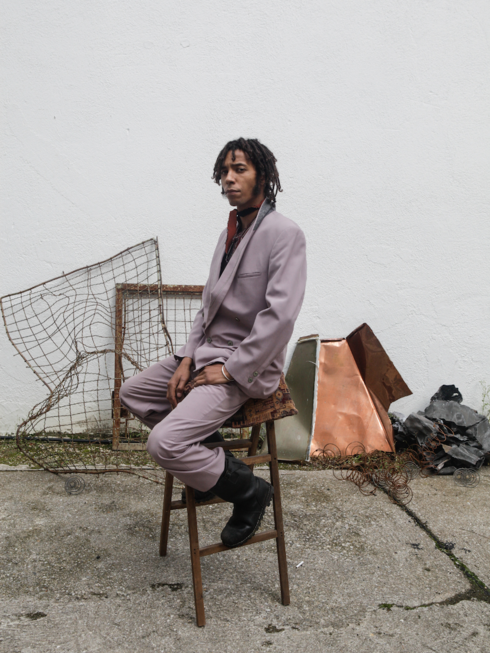
Alexandre Diop About Truth, Keith Haring and His Creative Process text Natalia Muntean In Puer Veritas creates the space for a dialogue between Keith Haring’s legendary Subway Drawings and Alexandre Diop’s assemblages on salvaged doors. Though separated by generations, both artists share a kinship: creating with found materials, in public spaces, for a world they refuse to accept as it is. On display at CFHILL Gallery, Stockholm between May 14 and August 8, 2025, the exhibition frames their shared urgency – Haring’s chalked figures dancing across subway ads, Diop’s nail-pierced doors bearing witness to forgotten histories. The French-Senegalese artist discusses why “good enough” never is, his creative process and the creative dialogue with Keith Haring. Natalia Muntean: In Puer Veritas suggests an unfiltered honesty, which is often found in children. How do you think this idea manifests in your work?Alexandre Diop: I think it’s not just about unfiltered truth; it’s also about a genuine point of view. In French, we say that “the truth comes out of the child’s mouth.” This reflects the conviction that, as a child, you still have positive, pure intentions, while the adult world is often corrupted by many things. I see this in my work. I always strive to have fun and to please myself above anyone else because I believe in my aesthetics and what’s important for me to create as an object. NM: Were you always confident in your work?AD: Not at all. Even today, I still have moments of struggle and doubt. I think it’s part of the practice to experience doubt. It’s like a child’s doubt, perhaps. NM: How do you overcome those moments of doubt?AD: By distancing myself from it and trying to understand where it’s coming from. Doubt is just that – doubt; it’s not a concrete reality. It feels similar to anxiety or fear about how others will react to your work. I remind myself that I don’t create art for others. As Sartre said, “Hell is other people.” His idea suggests that many of our problems arise from how we perceive the opinions of others. Of course, art prompts discussion, so you can’t create an artwork without considering the audience, but I always create for myself. My journey began because I was truly inspired by many artists, musicians, poets, philosophers and filmmakers. I loved their work so much that I wanted to try creating my own. When you’re passionately interested in something, you naturally want to explore it yourself. Each piece helps expand my archives and process, and eventually, I will consider sharing it with others. NM: Keith Haring worked quickly with chalk, and your art looks like you work in layers; it seems more intensive. How do you balance spontaneity with craftsmanship and deliberate actions?AD: It often starts with a spontaneous and fast sketch. Everything comes from a sketch, a drawing, or a painting I’ll do directly on the surface. It’s about playing with the contrast of how the drawing becomes sculpture and how the combination of the initial drawing with applied material creates a visual effect. There’s a lot of rushed action because it’s physically demanding. If you start overthinking how to place each object, it takes too much time. After years of working with these techniques, it’s become practical for me. Most pieces take one to four days; some even one night, especially with pre-cut materials. There’s also destruction – sometimes I apply something and destroy it. Most of my work, even when physically demanding, is made extremely fast. If I spend too much time on the sketch, I’ll never see what it could become. Sometimes, the sketch is so strong that it carries the message itself. For faces, hands, or symbolic parts, I take more time to choose elements that match the composition and visibility. NM: So you kind of start with a plan, but then you let your intuition guide you?AD: Yeah, sometimes I do. For example, I have an idea, I start working on it, and then it becomes something totally different because I realise it’s not good, or I find something much more interesting in the composition. This happens often. The work becomes complex, with many layers, and it can take weeks or months. Sometimes I can’t even work on the piece – I have to hide it. But when I start working, I’m completely immersed and it affects me, in good and bad ways. NM: Do you work on several works at the same time, or do you dedicate yourself to one?AD: I like to work on different things, but when I start something, I want to finish it because I’m already dreaming of the idea. I think it would be nice to see this come to life soon. I also do it for myself because I want to see this beautiful object on my wall.When I was younger, I started drawing because I lived in a white apartment in Berlin and thought it was so sad. I didn’t want to put up football posters, so I drew. Now, I work on many things at once because some pieces need to dry, or some aren’t working well. It’s easier for me to work in a series – it keeps me from being too fixated on one piece. NM: You’ve said these doors lived lives before you. Can you share a story behind one in this exhibition?AD: I started working with doors thanks to one of my oldest friends from Berlin. He knows how I work, how I collect materials. Back then, he helped me carry wood when I started painting on doors. Later, in Vienna, I grew bored with pre-made wood panels. I asked him to help me find old doors, raw wood, because I want to return to my initial practice. Early on in my career, I only did black work, hard, big pieces. In Vienna, entering the art world pulled me out of my darkness, my anger. When I was young, I thought I’d never paint in colour. NM: Why were you angry?AD: I’m still angry because there