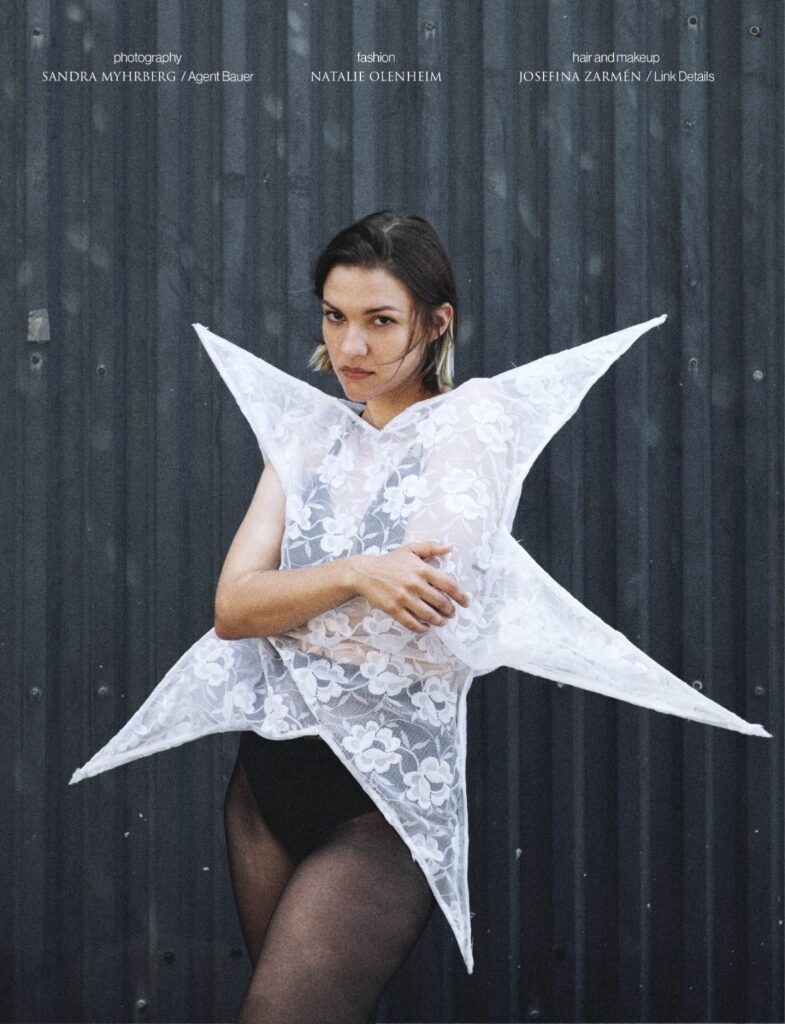

jacket and trousers STAND STUDIOS
bikini top SKIMS
boots COS
“Music is like a highway straight into people’s feelings,” says Tove Styrke. She is sitting in front of me wearing jeans, a white T-shirt, and a baseball cap, her face completely bare of any makeup. We met several months before the release of her latest album, “I thought this story wasn’t about me”
The idea for the album was born with a movie in Styrke’s head: a person alone in a small apartment, isolated even when surrounded by people. “A person can be in the middle of other people, at a party, and still be going through the most difficult things,” she says. “It’s all about the inner versus the outer, and how they relate to each other.” The original image she had was always of a person alone in one room, very similar to the first apartment she lived in when she moved to Stockholm. Someone can be one metre away from you, separated by a wall, and you can still feel completely alone.
Initially, the album was meant to be called The Afterparty, but as she continued working on the songs, Styrke realised the title had to change. “The music came into being through pure intuition. I haven’t used my brain or logical thinking at all in the creative process, only in the editing. I just followed my body and the universe. It sounds like a cliché, and everyone says this, but it really feels like these songs, this story, were already there. I just picked them up. And I think that’s part of why I naturally interpreted it as a story about somebody else I was observing, because I felt like I found it.” The moment of recognition, when it became undeniable, arrived in a sentence. “I just found myself saying it: I thought this story wasn’t about me”. The title becomes a work in progress, as this story and myself,” she says.
Styrke has been making music since she placed third on Swedish Idol in 2009. Fifteen years and four albums later, this feels like a different kind of release. This time, the campaign to promote the album is a sort of reckoning. A document of a person who can no longer hide. “The whole process has been the hardest thing I’ve been through in my life,” Styrke admits. “It’s a personal challenge to show myself as vulnerable. It’s scary.”
Compared to previous bodies of work, this album was an intimate experience, produced by a group of four people. “I was really cautious about each person I brought in,” she says. “First, it was just me, writing lyrics and themes. Then Magnus, developing the sound. Then Joel Kiviaho, for a slightly different perspective. And Linnéa Martinsson. We’d been working on the album for months, and I just felt there was an energy we needed. I barely knew her. I called her up, explained this very complex thing we were working on. She got it immediately. When she came to the studio, we started working straight away. She became an extension of myself.”
There is not a single sample on the album. Every sound is played on one of three analogue synths, live on a drum kit, or on a single acoustic guitar. “In a lot of electronic music, each sound has its own journey, changing over time,” Styrke explains. “We created a little world of sounds and let them go on a journey: expanding, growing, slowing down again, moving seamlessly into the next song. The transitions are as important as the songs themselves.”
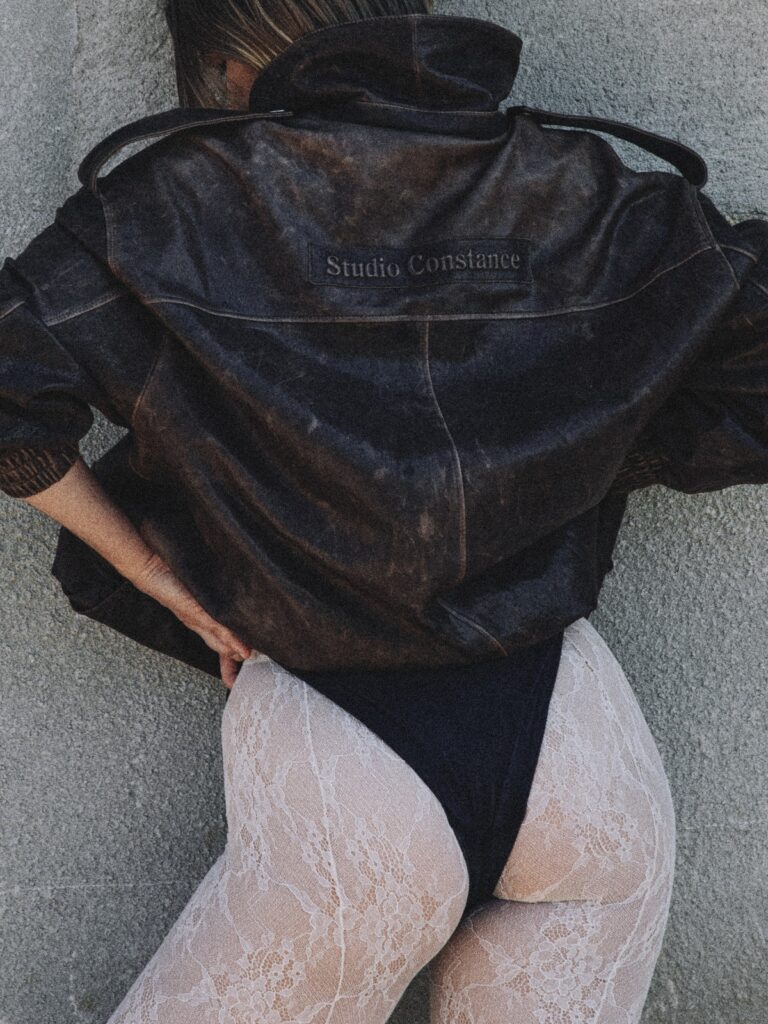
jacket Studio Constance
briefs FALKE
stockings Swedish Stockings
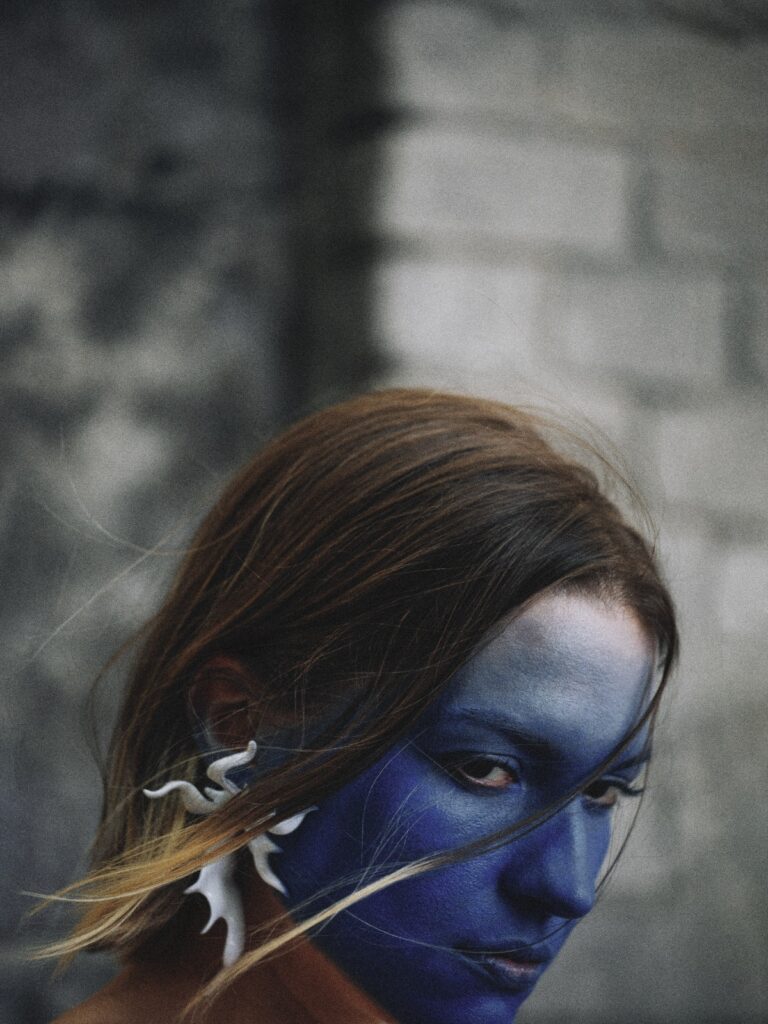
earring WHYNOEN
There are two tracks that stop you: “Burial” and “Big Exit.” The first, Styrke explains, is a flashback, a memory of something that didn’t work out, moving directly into “4:39,” which cuts to the present: sitting with someone at a crossroads, deciding whether to take the leap. “Going into something with someone is a sacrifice,” she says. “What if it doesn’t work out? It’s scary.”
“Big Exit” goes somewhere harder. A family friend had passed away from a terminal illness while she was writing it, someone the same age as her parents, leaving everyone around her in shambles but with a strange calm about her. “It was my way of trying to deal with my deep, deep fear that my mum is going to die before me,” Styrke confesses. “My whole life, my biggest fear has been the unspeakable one. You can’t even think it because you’re scared it will happen. And then when you have your own child, everything flips. Suddenly, I’m the one who will probably have to leave my child behind.” Sonically, the song mirrors that weight. It starts as if you are hearing it from another room, far away, before coming closer and closer until you are inside it, breaking finally into a euphoric ending. “It’s your last big moment,” she says.
Besides working on creating and promoting the album, Styrke is wearing several other hats: being a mum, creating the band Året Var together with her partner, and studying to become a biodynamic gardener, or a “gardening witch,” as she prefers to call it. Gardening has allowed her to regain access to parts within herself that she has not been in touch with since she was a child. “I like feeling the soil. It’s like holding a baby. It just calms you,” she says. She started her studies three years ago, began work on the album two years ago, and became a mother somewhere in between. There is, she thinks, a connection between all of it. She returns to an idea from Joni Mitchell, also a gardener, who described her different art practices as crop rotation. You can’t grow the same thing in the same place two years running; you rotate so the soil stays healthy. “Writing uses one part of your brain, singing another, painting another, gardening another,” Styrke says. “If you circulate between different practices, you let one part rest while staying creative in a different way. And they inform each other. The same way rotating crops keeps the soil healthy.”
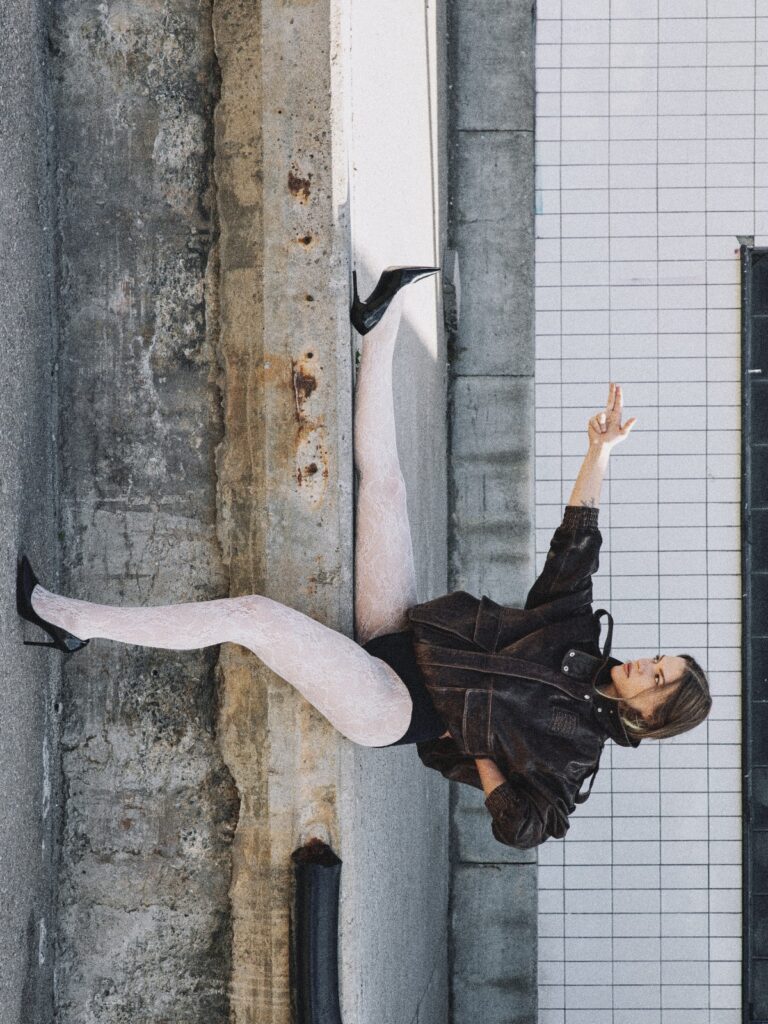
jacket Studio Constance
briefs FALKE
stockings Swedish Stockings
shoes DKNY
Året Var was born out of a realisation that Styrke and her partner, Sanna Sikborn Erixon, also a musician, had that no one else was doing this kind of project, so it had to be done by them. The progg band, whose name translates roughly as “the year was,” draws from a very specific music scene in Sweden in the 70s: highly political, with a particular lyrical and sonic style. “I have such deep nostalgic feelings for that music,” Styrke says. “I didn’t grow up in that era, obviously, but I grew up with the music.” Their debut album, Året var 2026, came out just before the Swedish election in September. “We knew from the start we wanted the album out this year, and preferably before the election,” Styrke says. “I feel like mainstream music has been extremely unpolitical for the past few years, and that is dangerous. It’s the artist’s job to put words to what we’re experiencing as humans, and there are so many things in our society to feel concerned about. That needs to be reflected in the music people listen to. Not talking about something is also a political choice. If there’s anything I want this music to inspire, it’s that your voice matters.”
Towards the end of our conversation, Styrke reflects on what brought her to this moment in her career. “I’ve reached a point in my life where just chasing success doesn’t cut it anymore. It has to be right for me. It has to give me something.” She thinks for a moment. “I’m trying to become better at channelling an inner world that you can’t see and making it visible.” She also wants the music to be a canvas for people, open enough that they can dream up their own story. “That’s what I love about music: it allows you to have vivid images and stories of your own that live with you when you listen.”
On November 20th, she will perform “I thought this story wasn’t about me” live for the first time, in an abandoned heating plant. It is a fitting setting, somewhere between a burial and a rebirth. Much like the woman who made it, the story is still unfinished. “I feel like this album is never finished with me.”
The album ends with “Save Me.” I ask who she is asking to save her. “Everything,” she says. “It’s surrendering. After all the resistance and the battling with yourself and your inner demons, at the end, you’re just turning your face toward the sun coming up, facing a new day. It’s the end of this story, this cycle. An end, but also a rebirth. Whether someone is coming to save you, or whether you save yourself, we don’t know.”
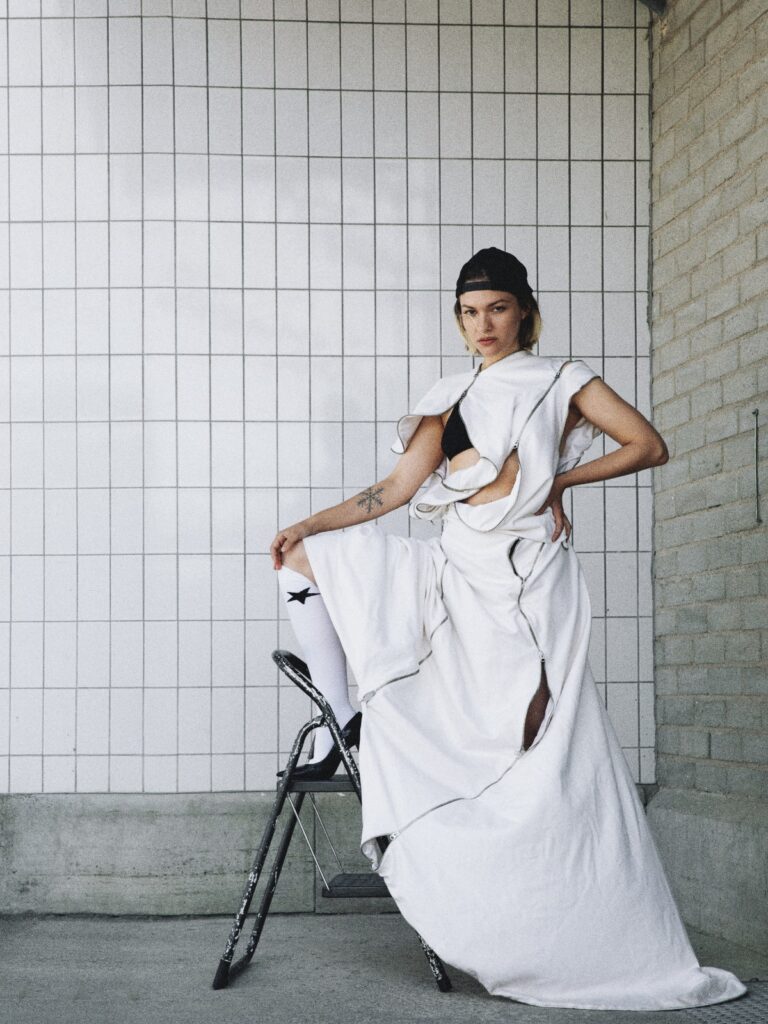
dress Emil Hauberg Briering
bikini top SKIMS
sock Core RD Knitting co
shoes DKNY
cap Tove’s Own
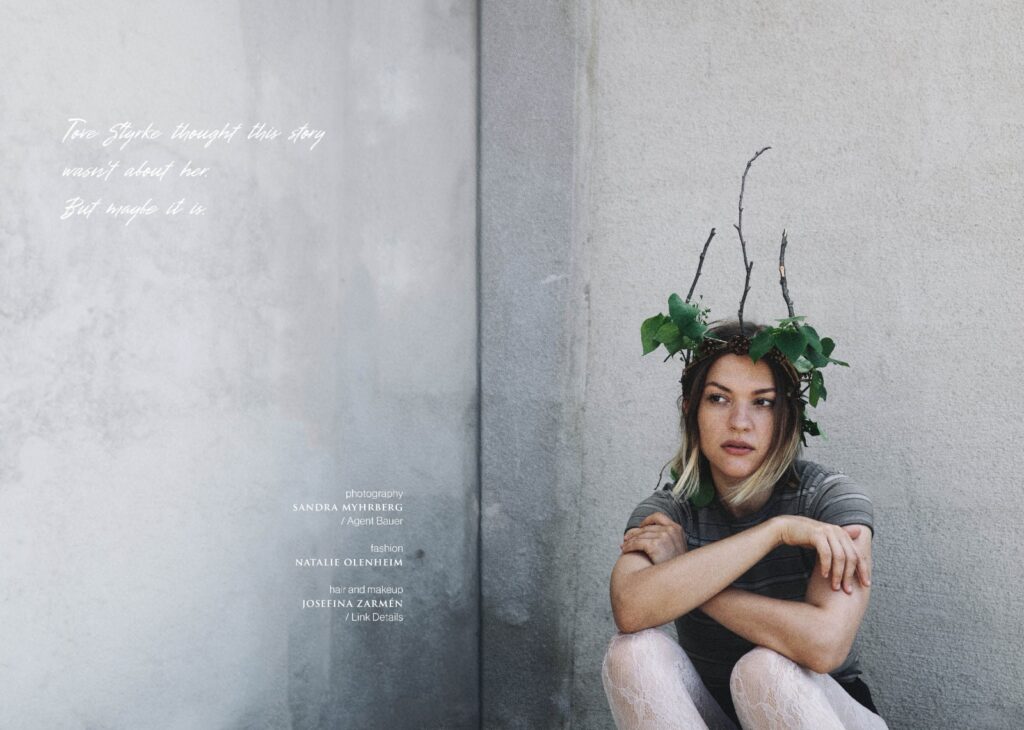
t-shirt HOPE Stockholm
stocking Swedish Stockings