What the Mind Protects: Elin Fiorentino on DIAGNOSIS and What Comes Next
Text by Natalia Muntean
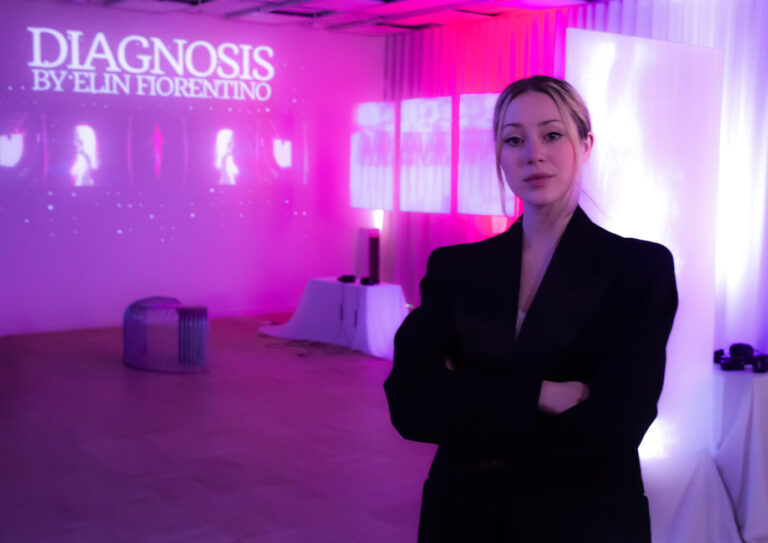
“I want people to leave with less shame and more compassion, both for themselves and for others,” says Stockholm-based artist Elin Fiorentino about her debut solo show, DIAGNOSIS. Eight video works, each one a different trauma response: dissociation, flashback, altered perception, were built from saturated colour and glitching texture into a space designed to materialise the ways of an altered mind. For Fiorentino these trauma responses are not pathologies, but more of an evidence of the mind’s own intelligence at work.
Natalia Muntean: DIAGNOSIS mapped eight distinct trauma responses: intrusion, dissociation, flashback, altered perception. How did you decide which symptoms to portray, and was there one that proved the most difficult to translate?
Elin Fiorentino: It was less of a conscious decision, more of an observation of what felt most present and persistent to me at the time. But the most difficult piece to translate was ‘Perceive Or Receive’. Unlike something more tangible, such as flashbacks or intrusive thoughts, altered perception or depersonalization affects the way reality itself is perceived as well as how you see yourself. I wanted to communicate that unsettling feeling of existing in a familiar world that suddenly feels foreign. Finding a visual language for something so internal and abstract was very challenging.
NM: You describe the mind’s symptoms and trauma responses as forms of intelligence rather than failures. Where did that understanding come from, and how does it shape what you want a viewer to take away from your work?
EF: It comes from being an observer of my own mind and experiences. During the period that inspired DIAGNOSIS, it became clear that I wasn’t consciously choosing these reactions. I could intellectually understand that I was safe, while my body and mind would respond as if I wasn’t. Even though it was very difficult to navigate at the time, I was able to observe my trauma responses and see them as adaptations designed by the brain to protect me. Which, to me, translates to something fundamentally human, a form of survival intelligence, rather than something broken.
Seeing the symptoms this way allowed me to study what was happening rather than being consumed by it. Instead of asking, ‘What’s wrong with me?’ I wanted to focus on understanding what my mind was doing. That shift in perspective became an important part of both my healing process and the development of the work itself.
This perspective is also what I hope viewers take away from DIAGNOSIS. I want people to leave with less shame and more compassion, both for themselves and for others. I believe understanding trauma responses and identifying when they occur in yourself or in others is an important step towards creating a safer world.
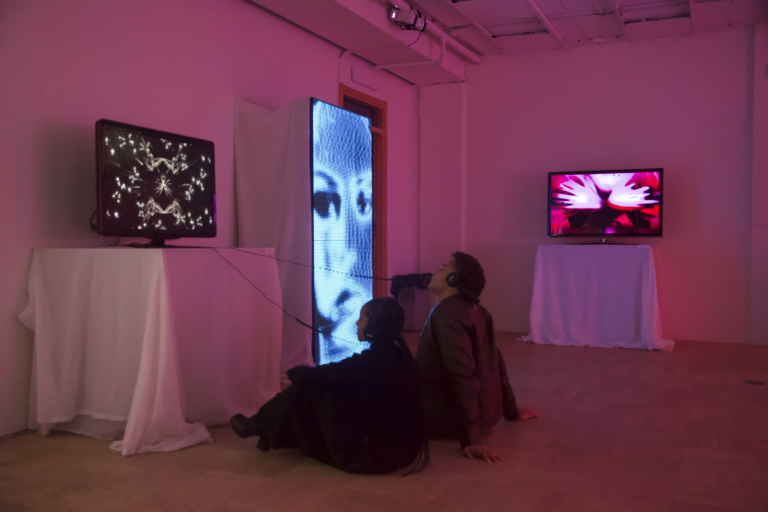
NM: Your visual language is very specific: bichromatic saturation, pixel aesthetics, organic abstraction colliding with pop references. Was that a deliberate construction, or did it show up intuitively?
EF: My visual language mainly unfolded over time intuitively. There are aspects of how I express myself creatively that tie back to the first paintings I ever made, which is something I can´t really explain. But I think it also took form through experimentation and allowing myself to explore different tools and techniques that interest me.
I think finding your voice in any art form really comes down to repeatedly doing, trying, failing and obsessing over it. I´m not one of those people who like to know exactly where I’m going before I start. I love it when there is an aspect of exploration into the unknown.
With that said, I think personal taste inevitably shapes the direction of the work too. I tend to be drawn to visuals that feel nostalgic, surreal or emotionally resonant. I love abstract and fractal geometry, high contrasts, bright colours, particles and find a lot of inspiration through cinema. Each of these elements resonates with me for different reasons, and over time, they have naturally become part of my visual language and the world I want to exist in.
NM: You perform live as a VJ as well as making exhibition work. How do those two sides of your practice relate to each other?
EF: I always aim to create an emotional experience and communicate something internal, whether it’s in the form of an installation or a live performance. But despite the intention being the same, they do also feel like parallel forms of expression to some extent.
My exhibition pieces function more like moving paintings or worlds to step into. I spend more time in the creative process and have more freedom in expression and combining different disciplines.
When vj-ing, the work emerges through a dialogue between myself, the music, and the surrounding environment. Performing live taught me to let go of perfectionism and to trust intuition. In a live setting, there is no time to refine or second-guess decisions. You’re constantly responding to the music and atmosphere, anticipating movement, and trusting your instincts.
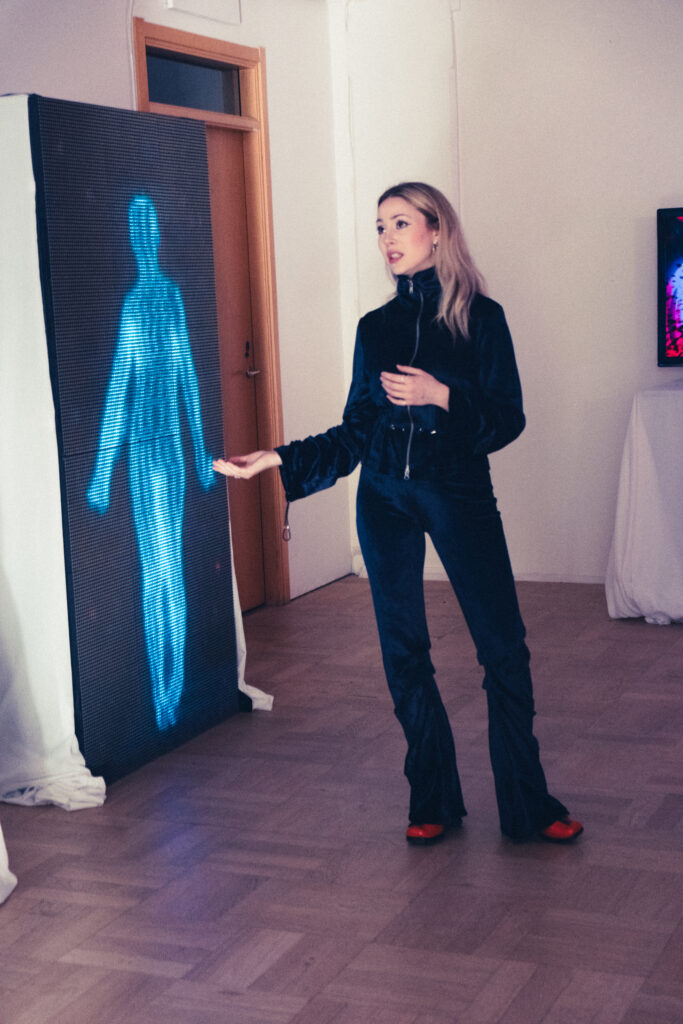
The experience changed the way I approach video art altogether. I tend to tap into this approach when I work with installation, too. Focusing less on how something should look and more on how it makes you feel and what it communicates. There is something magical about letting go of control and just allowing yourself to express. It’s in those moments of freedom where you create with the most honesty.
NM: DIAGNOSIS was your first solo exhibition. What did making it clarify about where your practice is heading?
EF: I always had a vision of creating space for reflection, conversations and bringing people together. It was one of the things that felt the most important to me with this exhibition. Making the room itself become part of the conversation. Which it did, and I feel very grateful for that. It became clear to me that it is possible and important to follow the ideas you hold, especially if they appear impossible. Always find a way to follow through regardless and don’t be afraid to ask for help. Most people will likely not get it, but the ones who do will care enough to help.
Looking ahead, I’m curious to explore unexpected contexts and environments for digital art, expanding beyond traditional exhibition formats. I also seek to do more collaborations across different disciplines in the near future. I hope to see more space for art in Stockholm, and think we need to create more places to meet, connect and be inspired. Contributing to the creation of those spaces through my own work is a direction I see my practice moving towards.
NM: What are you working on now, or thinking toward?
EF: Right now I’m working on a couple of new projects that will be exhibited later this summer. Which I’m really excited about. In a time where the world feels very saturated with uncertainty and worry, I’m thinking toward healing, connection, empathy, and empowerment. I hope my works encourage people to look inward, embrace vulnerability, connect with themselves and find strength in self-expression.