Why Keith Haring still feels so relevant
As a 1989 Keith Haring work arrives at auction in Stockholm, the artist’s unmistakable visual language is having another moment in fashion. With Louis Vuitton revisiting his imagery, Haring’s work once again moves between the worlds of art, fashion and popular culture.
text Astrid Birnbaum
A dancing figure reduced to a few black lines. A radiant baby. A barking dog. A heart. A cross.
Some artists are recognised before their work has even had time to become an image. Keith Haring is one of them.
Haring created a language that could be read immediately. This autumn, one of his works from 1989 arrived in Stockholm.
Untitled will be offered at Bukowskis’ Contemporary Art & Design auction in October. Painted in acrylic on canvas, the 61 by 61 centimetre work is framed by a red border and set against a bright yellow ground.
Haring’s characteristic black figures move across the surface alongside a group of dolphins, while an anchor shaped like a cross hangs above them.
It is recognisably Haring, energetic and playful. Yet the longer one looks, the less simple the image becomes.
Haring made the work in 1989, during the AIDS crisis and only a year before his own death. The knowledge is difficult to separate from the image.
His work appeared in downtown New York in the early 1980s, when the distinctions between art, music, nightlife, fashion and street culture were becoming increasingly porous. His drawings on the black advertising panels of the subway became a form of public communication. They were temporary, exposed to thousands of people.
From there, the images travelled. Into galleries and museums, onto posters and clothing, into public murals and eventually into the Pop Shop Haring opened in 1986. He was interested in the circulation of art as much as its status as an object. A work could be encountered in the street, on a T-shirt or in a museum.
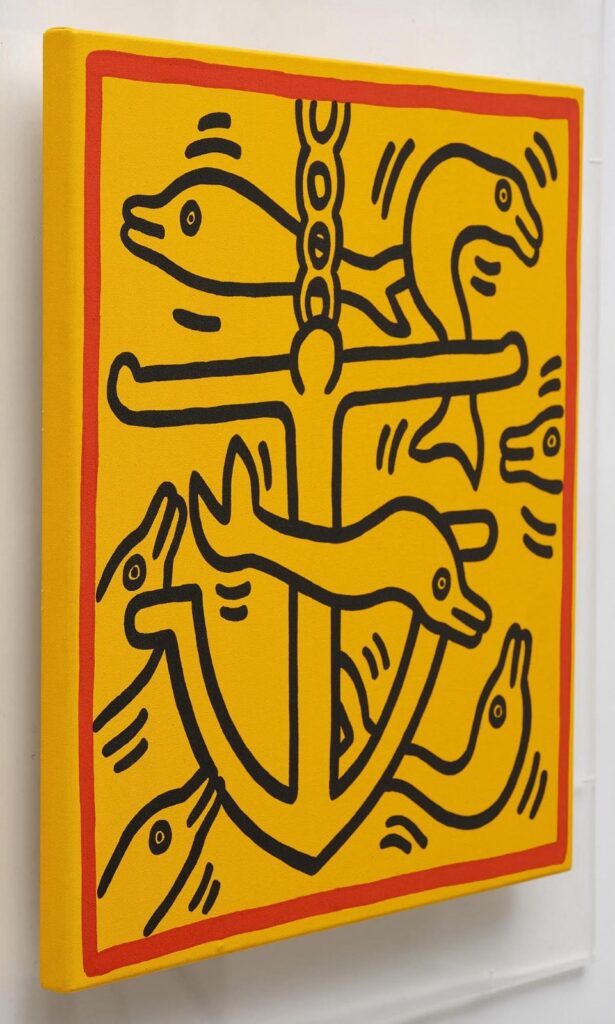
image courtesy Bukowskis
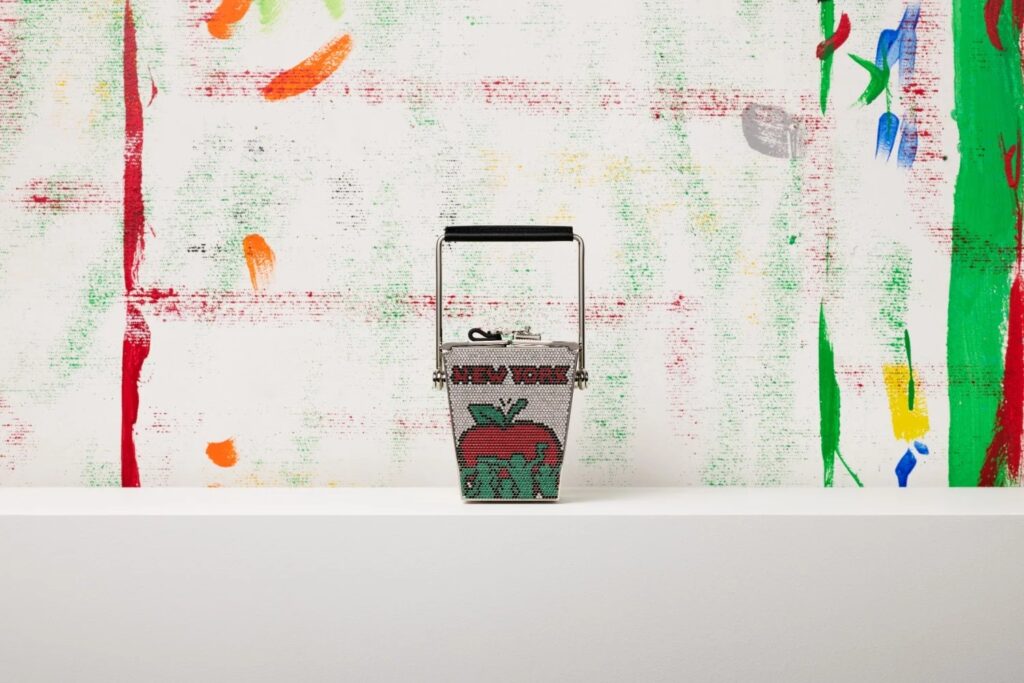
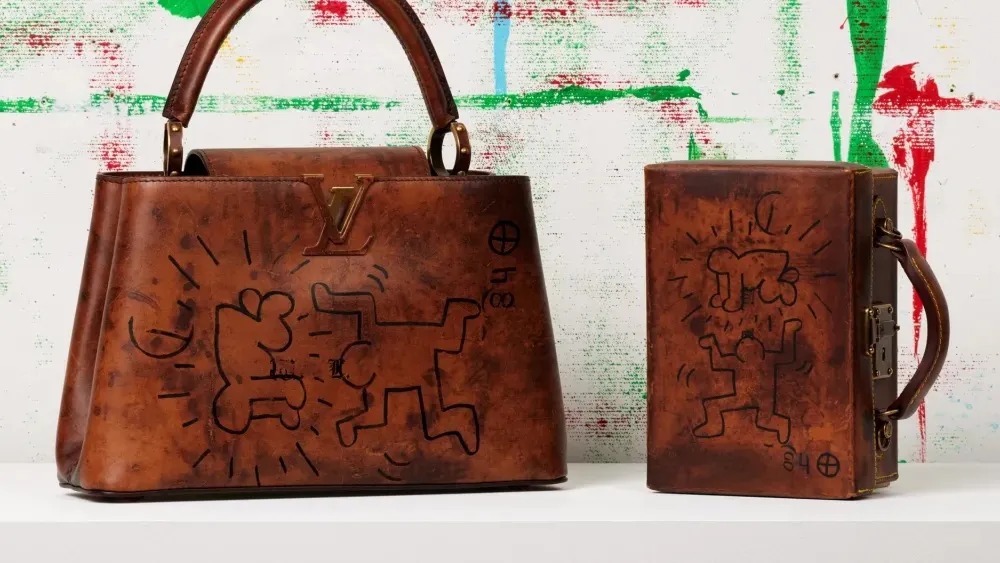
More than three decades after his death, that movement feels almost prophetic. Haring’s imagery has become part of a visual culture in which the same image can exist simultaneously as artwork, fashion, merchandise and cultural reference.
Now, Louis Vuitton is returning to Haring. The fashion house is working with the Keith Haring Foundation on a new Artycapucines collection featuring his imagery. The project follows the discovery of a vintage Louis Vuitton trunk in the brand’s archives that Haring had drawn on in the 1980s. His work was
subsequently incorporated into the house’s Cruise 2027 show, and the new collection brings his recognisable figures and motifs into the language of contemporary luxury.
The timing is striking. As Untitled comes to auction in Stockholm, selected pieces from Louis Vuitton’s new Haring collection will be unveiled at Art Basel Paris in October, where they will be presented at the house’s booth alongside Artycapucines designs from previous editions.
The pairing may seem surprising only if one thinks of Haring as belonging exclusively to museums. He never really did.
His practice was always concerned with movement between contexts. His images could be political without becoming illustrations, commercial without becoming advertisements. They retained their particular energy wherever they appeared.
Back in Stockholm, Untitled offers another way of looking at that journey.
Removed from the screen, the campaign and the world of fashion, the painting becomes very physical. The yellow ground is still yellow. The red border still holds the image in place. The black lines retain the speed with which they appear to have been made. It is a work from the final years of Haring’s life, but it does not
feel frozen in that period.
Perhaps this is the strange achievement of Haring’s visual language. It belongs unmistakably to its time, yet continues to generate new contexts around itself, all the time.
The images have travelled a long way from the New York subway, and they are still moving.
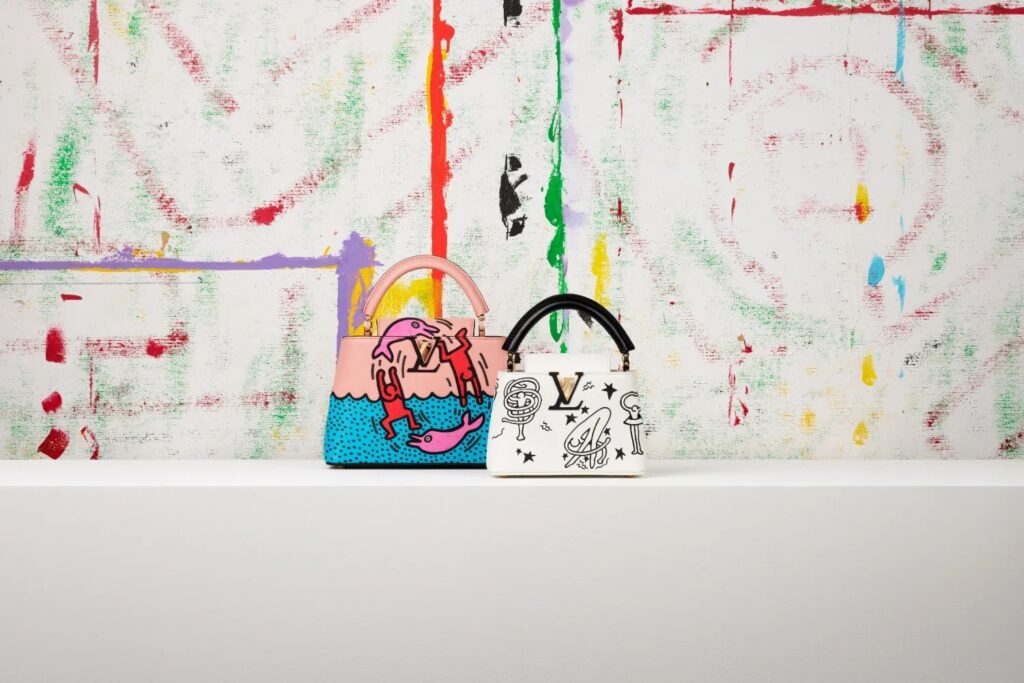
image courtesy Louis Vuitton