“All dreams are experiences,” says Simone Haack. The Berlin-based painter writes hers down, sometimes bringing a lingering feeling into a painting. She is also interested in how dreams unfold: a walk through a forest might lead to an elevator that takes you into another world, or you might suddenly become someone else. Such transitions offer possibilities she can explore through paint.
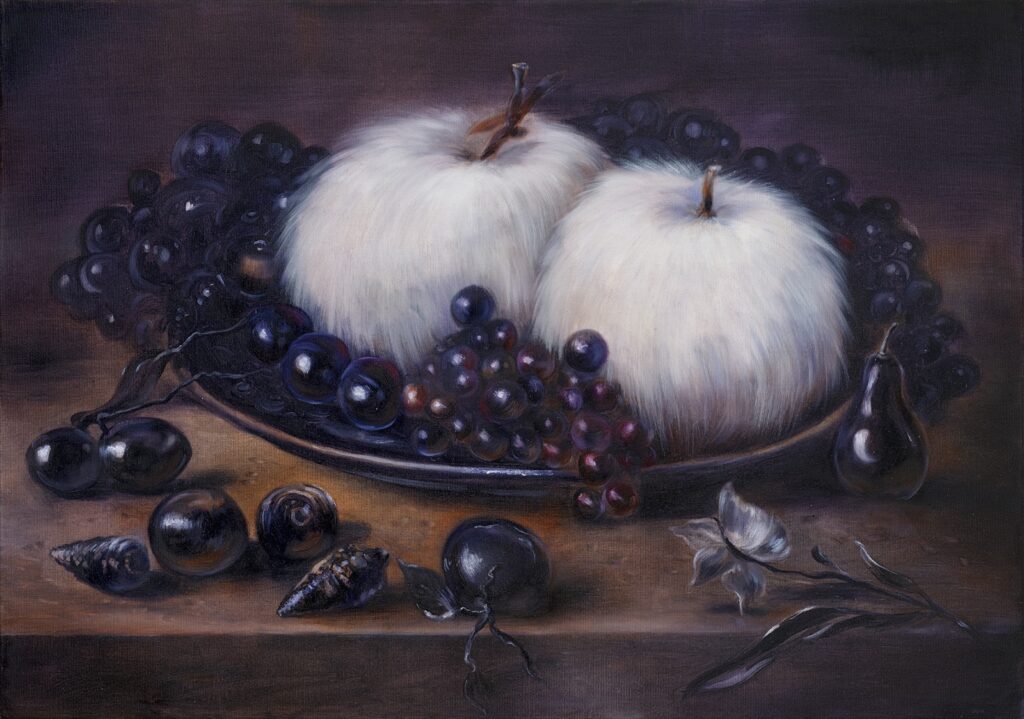
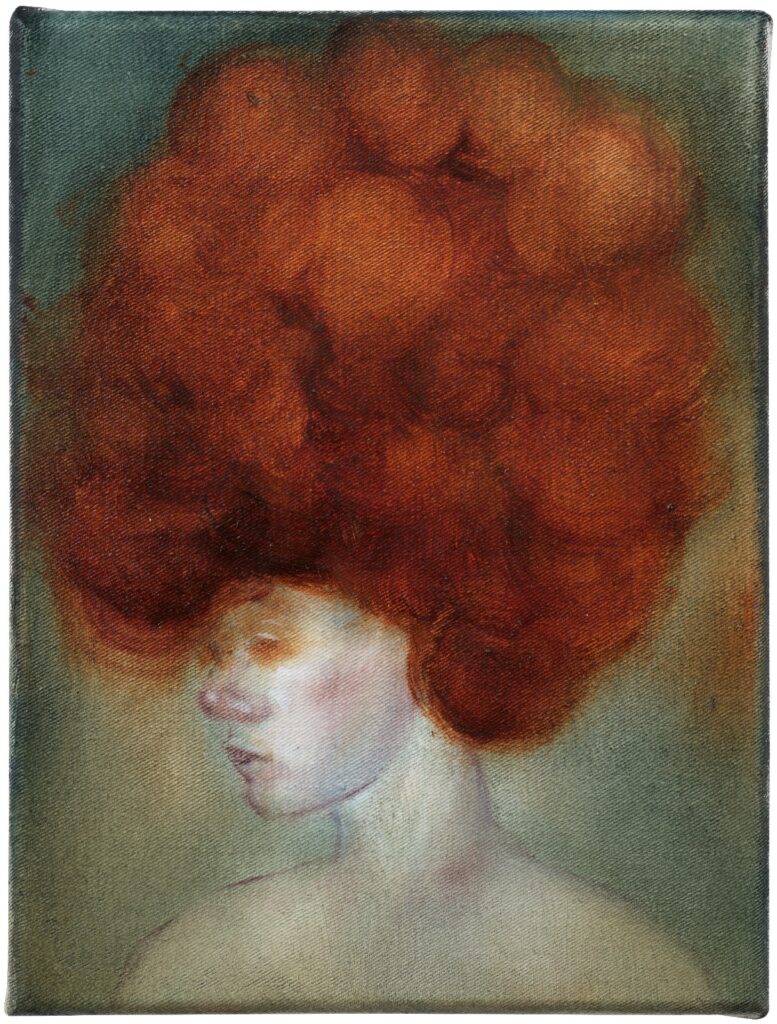
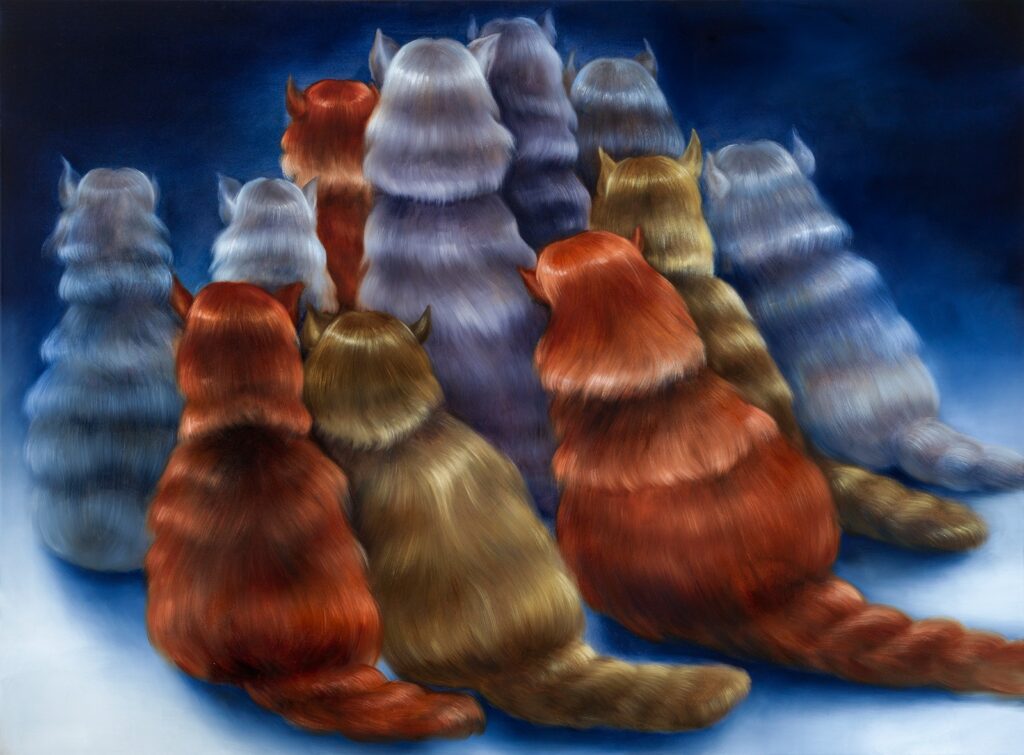
Her exhibition Les Fruits du mal, on display at CFHILL Gallery in Stockholm, brings together fruit, figures, animals and landscapes. Hair appears on fruit, while pears are painted “with a feeling of a portrait,” as she puts it. Drawing on her background in figurative painting, she moves between subjects without treating each as a separate undertaking. “I don’t think now I make a portrait, or now I’m painting still life,” she says.
image courtesy CFHILL Gallery
The exhibition’s title began with a painting of hairy fruits against a landscape. After finishing it, she was searching for a title when Charles Baudelaire’s Les Fleurs du mal came to mind. Replacing flowers with fruits was initially a play on words, but the association gave her something to pursue beyond that single work.The reference to Baudelaire became more than a title, transforming the fruit she paints into something physical. “It’s a little bit evil, maybe it’s a little bit toxic, but at the same time it’s beautiful.”
Hair also gives the painter a practical question to work through. “I’m interested in what’s happening, for example, if I put hair on a tree and make it a landscape,” she explains. “It’s interesting to myself to see what happens when I put it somewhere else or on a fruit.”
Some of these encounters begin before she picks up a brush. Working in Photoshop, the artist draws from an archive of images to prepare collages. “I combine really unexpected things that you would never think would go together,” she says. Here, the logic of dreams becomes a way of working, giving her a starting point she might not otherwise have imagined.
Preparing an image does not settle every decision that follows. When it comes to judging how much a painting should reveal, her answer is brief: “It’s all intuitive.” Her choices can begin with colour and form, but the viewer brings another perspective. “You read it because you try to find out something about the person,” she says, “and that something is what’s interesting to me.”
This exchange between the painted surface and the viewer connects subjects as different as a body and a piece of fruit. What passes between them does not need to have a precise explanation. “I charge the surface or canvas or the forms, maybe a body or a fruit and somehow, it goes to the viewer.”