Hannah Blitz Heyman Lets the Silver Decide
Text by Natalia Muntean
At fifteen, Hannah Blitz Heyman stood at an archaeological site and watched a guide pull a golden earring from the earth. That moment has stayed with her ever since.
Now working from Stockholm, Blitz Heyman makes jewellery that takes the long view of metal: from ore in a mountain to something worn close to the body, processed as little as possible along the way. A graduate of CRAFT! at Konstfack, her practice sits at the intersection of jewellery and object-making, the work resisting anything too smooth or too resolved.
NM: What is the first piece of jewellery you remember falling in love with?
HBH: I visited an archaeological site when I was fifteen, and after digging for a while with no success, the guide showed us some objects that they’d found. After looking at some cracked pots, he pulled up a shiny golden earring with a tiny winged figure on it. The earring was shiny and had marks, but it was still an earring. The time passed between the maker and me was over two thousand years, but the metal remained. This notion has thrilled me ever since.
NM: And separately, do you remember the first thing you made that felt like yours, like the beginning of a language you recognised?
HBH: Definitely! It’s a ring made from castings of my house key. At that point, I had been a goldsmith apprentice for a few years, meaning slow processes and lots of patience. Casting jewellery felt so liberating. It was fast and allowed more shapes to take form. The ring is super sloppy, but reminds me of the importance of exploration for my making.
NM: You say art school is where your aesthetic found its foundation, but that before that, it was hard to know where your work fit. What did “not fitting” feel like – was it the work itself, or the context, or both? And what shifted?
HBH: The shift, I think, came from not working for someone else. Before art school, my time as an apprentice meant mainly producing work for my teacher and designing things reminiscent of hers. It took a while to figure out how to use the same skills for myself.
To some extent, I think I’ll always feel like I don’t fit in. It’s more of a state of mind rather than a factual reality. In the beginning, it was that my idea didn’t come across in the finished piece, and I had to develop tools of communication within my making. The feeling can be aspirational instead of defeat, because now I think that these tools are part of the Blitz Heyman expression. There will always be people who don’t connect to what I do, but I try to focus on the ones who like what I create and find spaces together with them.
NM: You describe your process as intuitive – do you ever lose a piece to the process, something that slipped away because you followed an idea?
HBH: Absolutely! But I try not to look at it as something I lost. It’s more of a stepping stone to arrive somewhere else. It’s never been any piece that I’ve mourned the loss of. The sense of being in a flow state while I work feels too good, and the initial idea still exists.
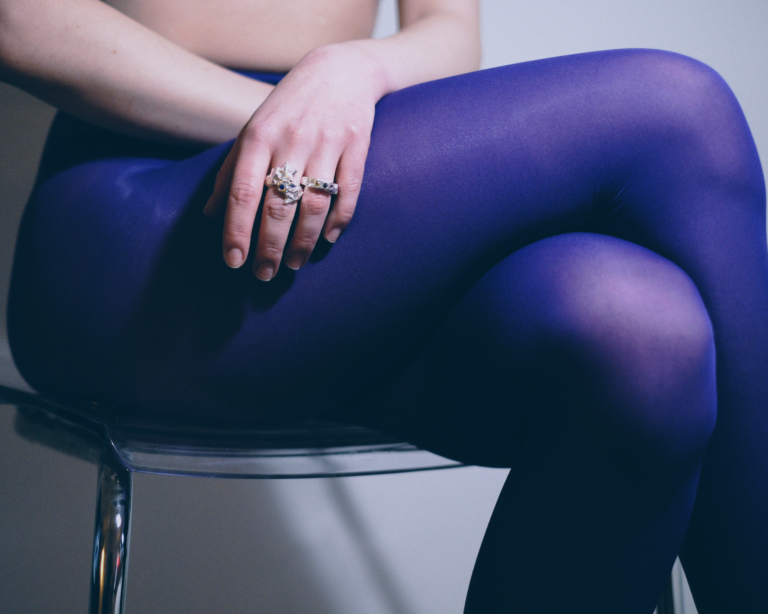
NM: The friendship heart necklace came from splitting a pendant at a friend’s request, almost by accident. What is it about friendship specifically, rather than romantic love or family, that feels worth marking with an object?
HBH: I never meant to call it a friendship necklace. Other people have given it that name. In all of my notes, the necklace is called </3 necklace. This makes more sense to me and also opens up the idea that the necklace is for more than friendship: just any type of relationship with another person you feel connected to. But it’s lovely to make something that people share with a friend, since there are no big life events that celebrate friendship comparable to weddings.
NM: Sand casting and silver seem central to your practice, but is there a material you haven’t worked with yet that you think about?
HBH: I would love to work with stones. But I can’t decide if I want to sculpt large ones or if I should study to become a geologist. Hopefully, there’s time for both!
NM: You talk about the wish that whoever wears a Blitz Heyman piece feels like an enhanced version of themselves, but who do you picture when you imagine that person?
HBH: I’m so thankful for every person who likes what I do and is able to buy a piece. Everyone has their own reason for buying a piece made by me, so I don’t have a specific person in mind. Blitz Heyman was born organically from my making and continues to evolve together with the people who wear my jewellery.
NM: Once something is made and sold or given away, do you stay curious about where it goes and what it accumulates? Or does the piece become separate from you at a certain point?
HBH: Being a jewellery lover, I know how much information can exist within a tiny object. And the amazing thing with working with precious metals is that they’ll probably outlive me. So when a piece leaves my bench, I’m like ”Bon voyage” and filled with excitement for what is to come.
Jewellery that people buy for themselves might be my favourite thing to make. They usually symbolise a big thing for that person. I’m working on a ring to celebrate a graduation that I’m super excited about! Of course, I wonder where a piece of mine ends up, but I can’t allow myself to be that sentimental about my work. Custom pieces never belong to me because the intended wearer is part of the process from the get-go. But then other pieces are harder to let go of. Usually, it’s the ones that connect me to an idea or a moment. So some become part of my personal collection.