
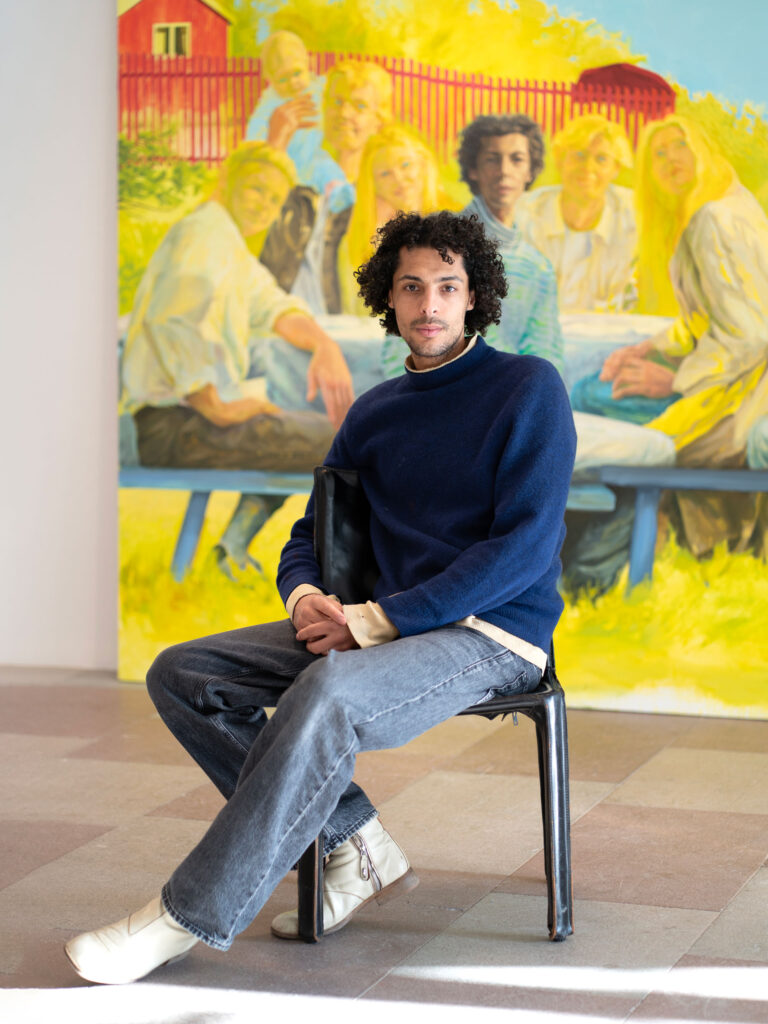
photography CFHILL
Noah Beyene’s Sweetish: A Yellow Reconstruction
March 6, — April 2, 2026
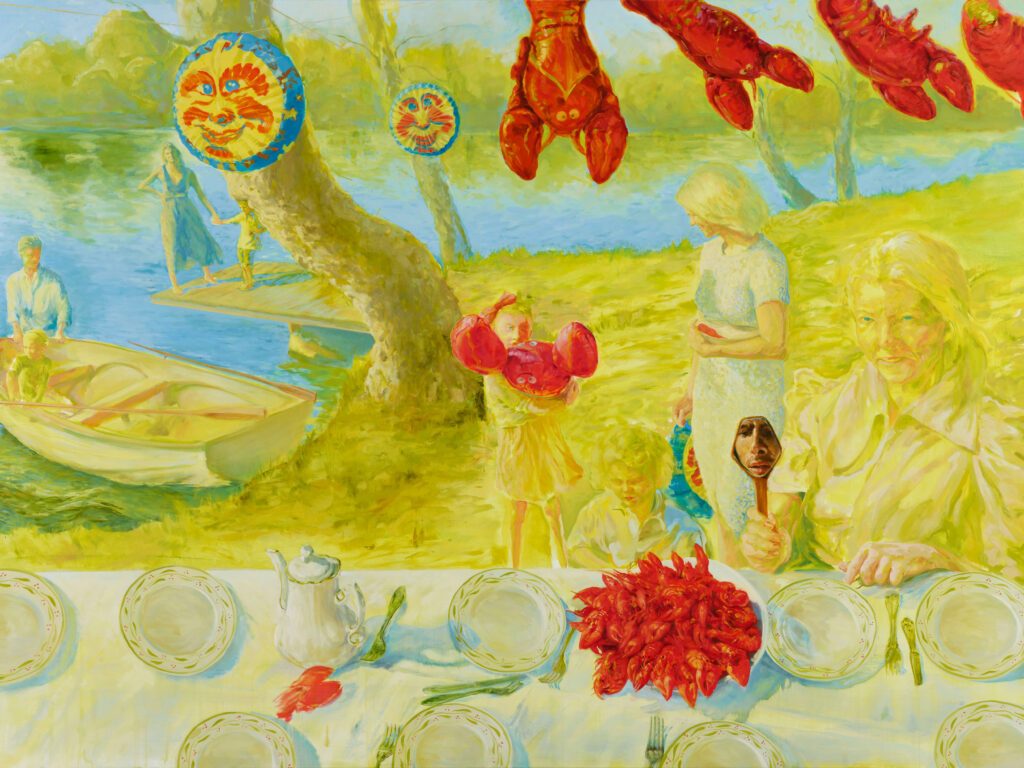
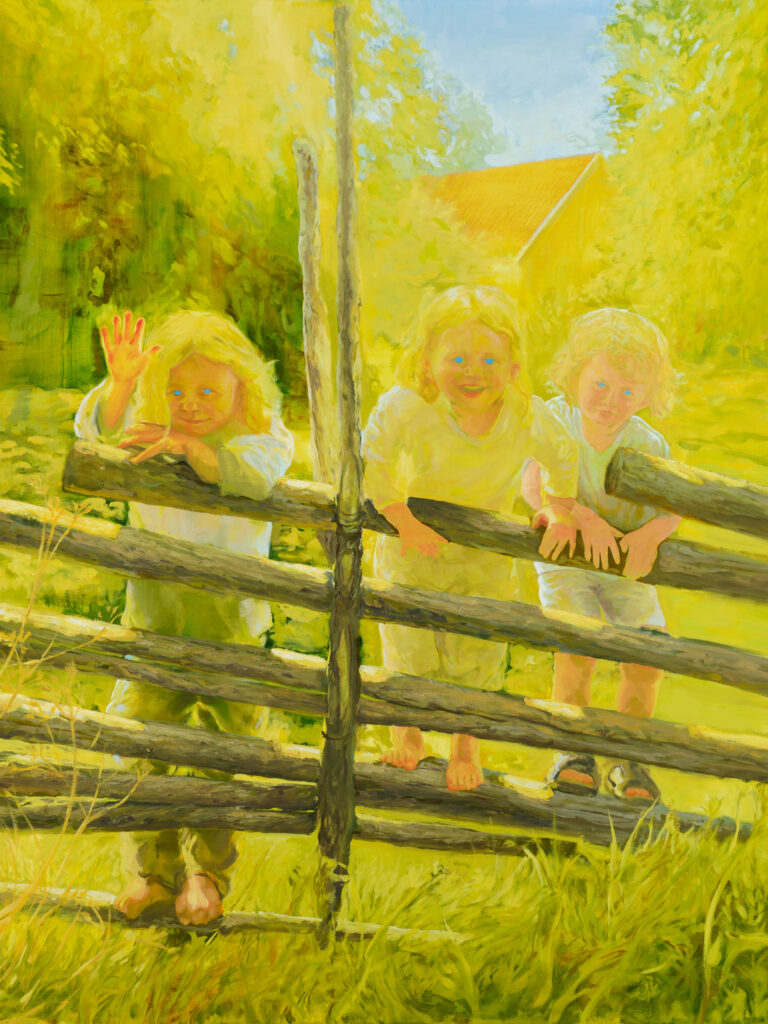
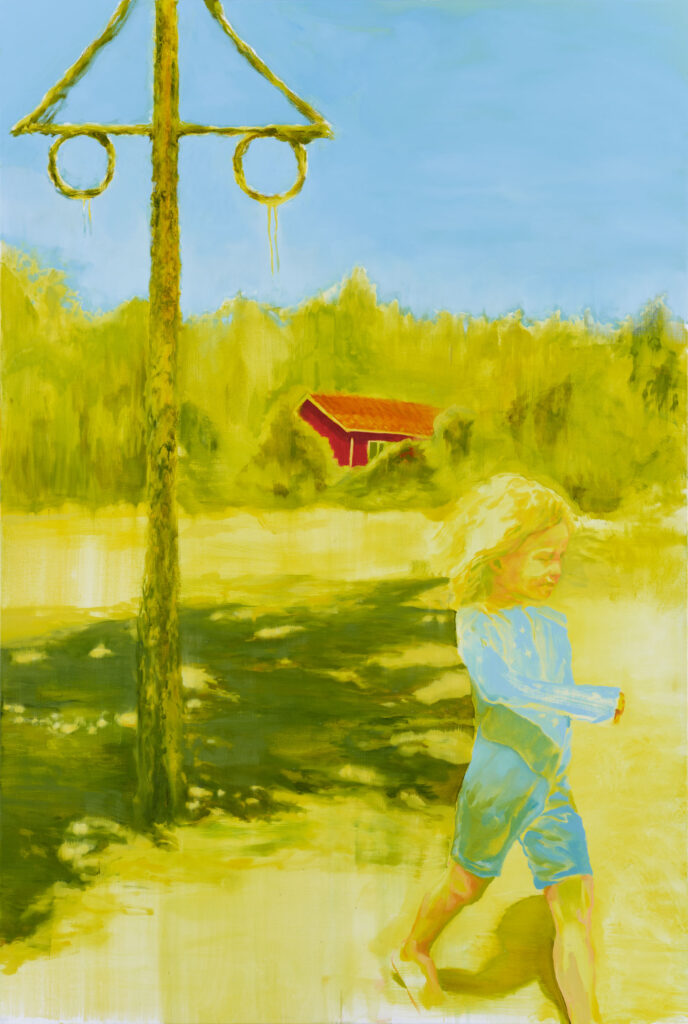
Sweetish marks Noah Beyene’s Swedish gallery debut. In this new body of work, Beyene revisits the imagery that has long defined Sweden’s national self‑portrait: sun‑drenched summer scenes, rural idylls, and the familiar motifs of Larsson, Nyström, and Zorn. But in his hands, these symbols are bathed in an intense yellow light that both softens and destabilises them, creating a space where nostalgia and unease coexist.
Through these paintings, Beyene examines how images of Sweden have been constructed, circulated, and mythologized; and how they continue to shape who feels included in the national narrative. The result is a series that is affectionate yet critical, intimate yet expansive, and deeply attuned to the shifting cultural moment Sweden finds itself in.
As he presents Sweetish in the very country whose visual identity he is questioning, Beyene reflects on childhood memories, the politics of nostalgia, and the complicated experience of being “Swedish.”
photography CFHILL
Sweetish is your Swedish gallery debut. What does it mean to present this work in Sweden, the very country whose imagery you are revisiting and questioning?
Sweetish is in dialogue with shifts that are taking place in Sweden, though many of those shifts are happening across the Western world more broadly. I didn’t begin the project knowing it would be shown in Sweden, but I’m very glad that what happened. It feels like the work has landed within a moment where these questions are particularly present in a Sweden with an identity crisis.
How do you hope Swedish audiences will read this work differently from international viewers?
It’s hard for me to say. When I set out to make work I try not to think too much about who will engage with it. I do like to think about how to implicate viewers, but that’s based more around my own experiences and feelings that arise as I’m making the work. I suppose, to some extent, my main focus is to make work that is engaging for myself first and foremost.
But I suppose for international audiences the work might play more directly on the idealised brand Sweden has built around itself. At the same time, the project connects to a longer conversation that has been going on in the arts for a long time, particularly in the UK and the US. That dialogue certainly exists in Sweden as well, though to me it sometimes felt quieter.
photography CFHILL
photography CFHILL
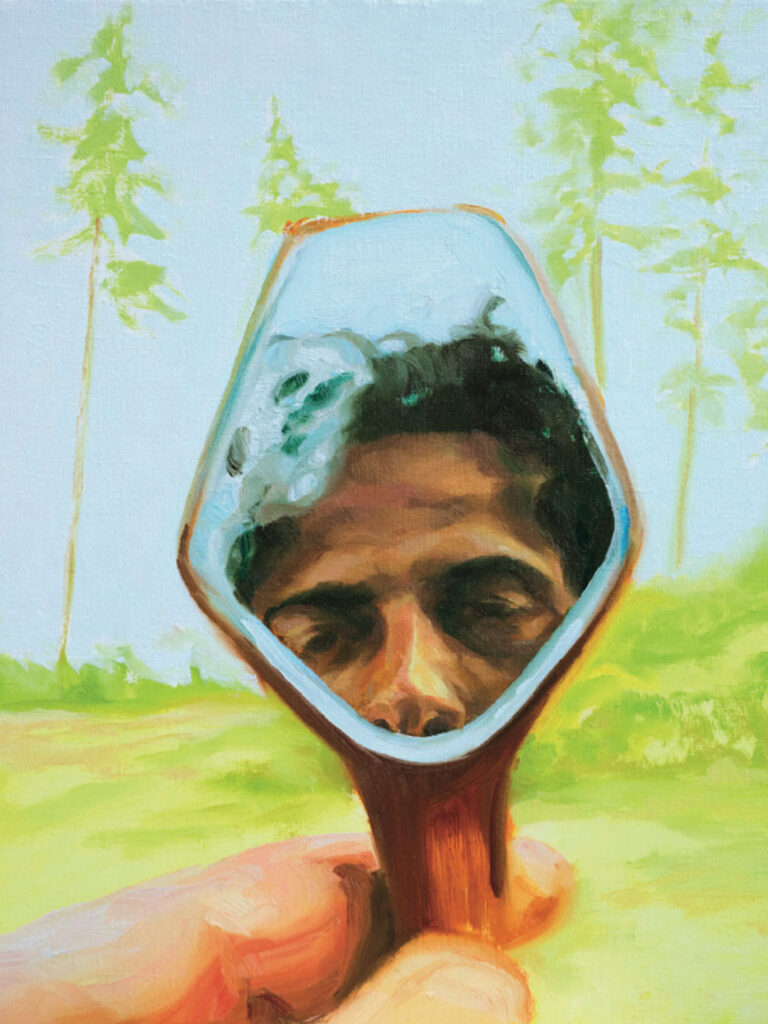
Artists like Carl Larsson, Jenny Nyström, and Anders Zorn helped shape the visual mythology of Sweden. Which aspects of their imagery feel most present in your work, and which did you want to challenge?
I became interested in the role artists have played in constructing a sense of national identity. I grew up surrounded by these images, especially Larsson’s work. As a child I never questioned them, and I’m not sure I would have if it hadn’t been for the ways they have been mobilised in nostalgic ideas of nation-building. The work went from a neutral part of the past, peripheral, to centre stage.
When I think about the state-sanctioned Swedish cultural canon, I read it as a project that aims to reinforce nostalgia while leaving little to no room for new voices to be heard. Many of those images idealise rural traditions that didn’t necessarily represent the whole nation even at the time they were created.
Part of this project was about claiming those images, to say that they belong to me as much as anyone else, while also exploring how they begin to feel when they are appropriated by politicians, and how that can shape who feels included.
Was there a specific childhood image or memory that became the emotional starting point for this series?
Many of Larsson’s motifs hung in my grandmother’s country house. My summers were built around reconstructions of these scenes that almost mirrored those paintings: crayfish parties, long lunches in the sun. That felt like a natural starting point because it’s something I know.
Your paintings are bathed in an intense yellow light that almost dissolves boundaries. Where does that light come from, conceptually or emotionally?
I was thinking about Nordic summer light, when the sun barely sets. Yellow became a way of approaching that atmosphere.
It’s also a fascinating colour because it has a very narrow tonal range compared to most other colours. I started thinking about children’s drawings, how instinctively we reach for yellow when drawing the sun. I wanted to utilise childlike intuition to illustrate the absurdity of what is going on.
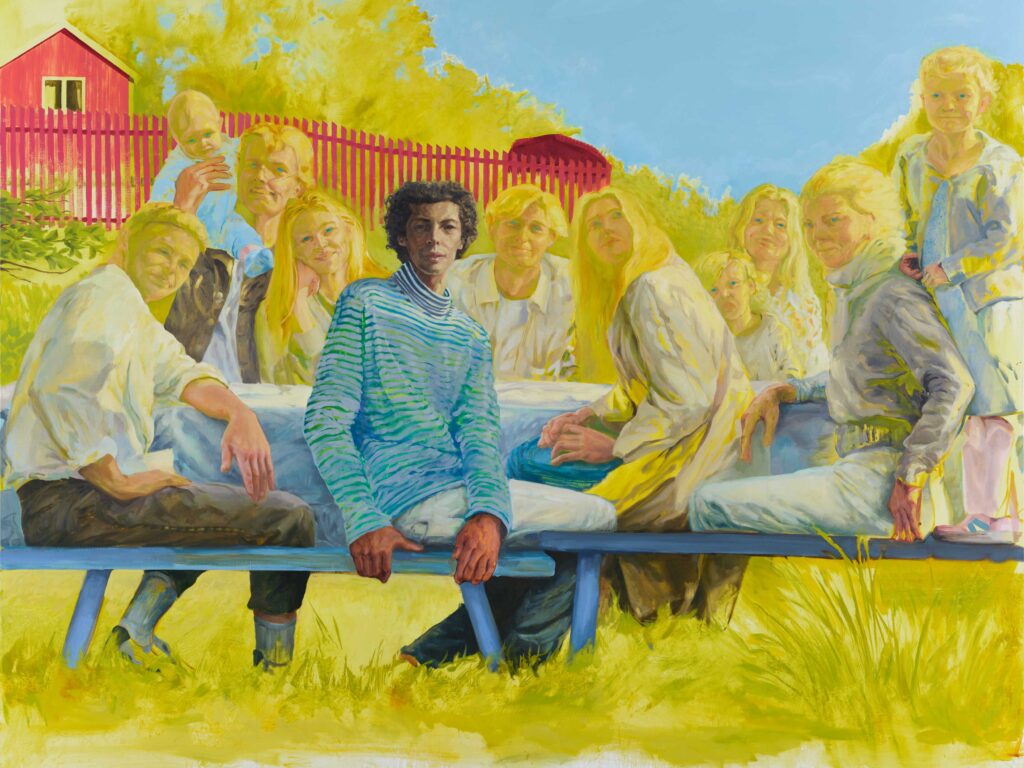
As the work developed, the yellow became a way to build a kind of exaggerated harmony, where subject and background almost melt together. The project deals with invisible forces—histories and ideas that shape how a nation imagines itself. Painting the environment in yellow became a way of visualising that atmosphere, and within that space I paint myself using colours closer to life. I stand out not because I exaggerate my own features, but because the surrounding idea of the nation has been pushed into this almost symbolic yellow.
The scenes feel both affectionate and slightly over-saturated, as if the idyll is about to crack. How do you use beauty to reveal tension?
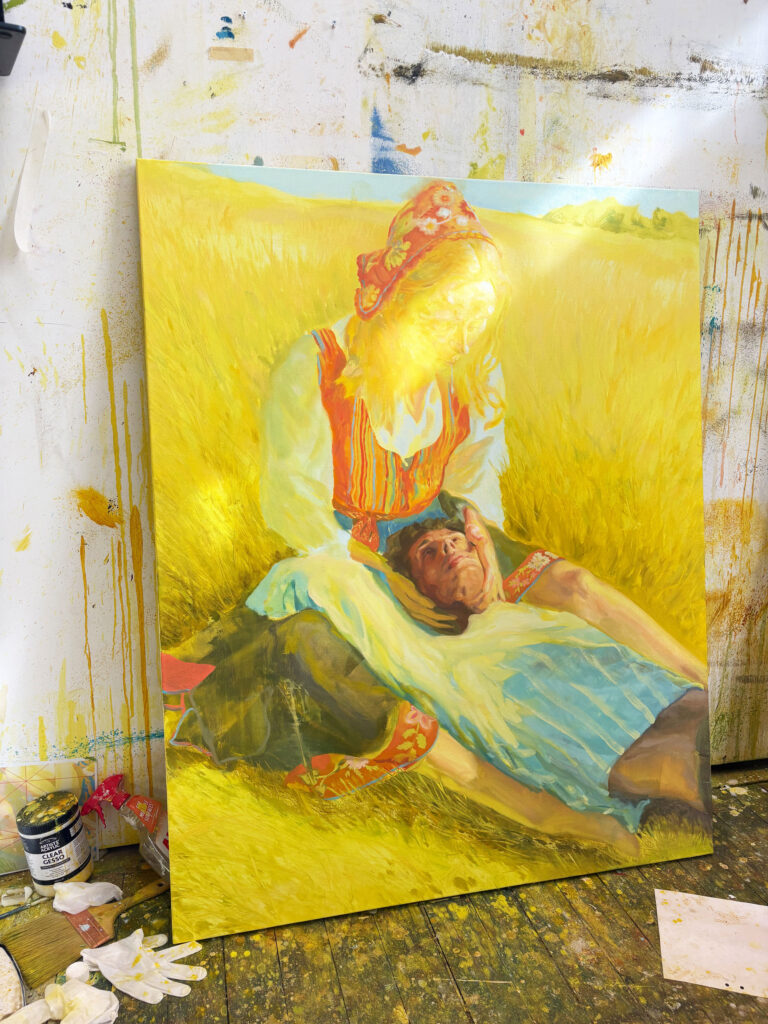
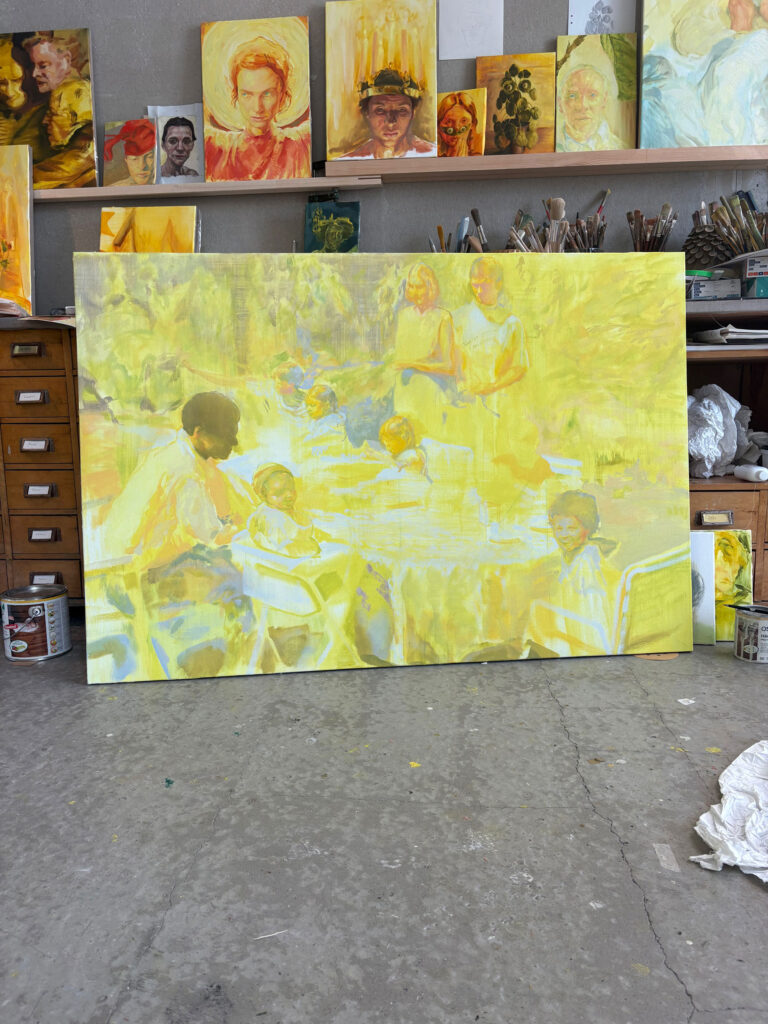
The project examines the idyllic. I wanted the paintings to feel almost weightless. Much of the paint is applied in very thin, transparent washes of oil, almost like watercolour.
That creates a sense of fragility, as if the image could dissolve at any moment. And if it does, the question becomes: what remains? Like a dream that becomes less vivid every time we try to remember it.
photography Noah Beyene
photography CFHILL
Your work revisits historical Swedish imagery through painting, a medium closely tied to that tradition. What does painting allow you to do with these images that other media wouldn’t?
It’s a difficult thing to be a painter. I can’t think of many human activities with a longer uninterrupted history. We’ve been making images since the dawn of time. It seems to be a necessary activity for us, a desire that insists on sticking around.
I often think of painting as a kind of language. It offers a vast vocabulary for describing experience and dealing with our existence. Because I’ve also worked with photography, I often compare the two mediums.
In painting everything is accepted as real. A distorted figure or an abstract space still registers as a reality within the painting. Photography, by contrast, carries the expectation of recording the world neutrally. When it moves beyond that expectation it starts to feel manipulated.
Painting allows me to construct a world that sits somewhere between a personal feeling and a shared reality.
When you think about the traditional visual image of Sweden, who appears in it — and who is absent?
I think it’s time we re-examine the image of Sweden. That doesn’t mean rejecting the past, but there were certainly moments in my life when I wished someone had already made these paintings.
If we can offer a wider range of experiences, perhaps we can also create a better understanding of one another.
Growing up with both Swedish and Ethiopian heritage, how did you relate to these canonical images as a child — and how do you relate to them now?
I loved them—and I still do. What I struggle with is when those images are appropriated by political agendas to assert a fixed idea of the nation that has already peaked, with no room for anything new.
It’s also worth remembering that many of the artists who shaped this imagery were themselves deeply influenced by international exchange. Artists like Carl Larsson travelled to Paris to develop their practices and brought aspects of modernity back with them. Larsson’s large frescoes in the staircase of Nationalmuseum Stockholm, for example, relied on highly skilled Italian artisans, and his work was also influenced by Japanese woodblock prints.
Culture progresses through exchange. Throughout history, the great artistic centres of the world have shifted—from Paris to New York and elsewhere—but they have always had something in common: they were melting pots where different cultures met and mixed.
The title Sweetish suggests something both affectionate and slightly ironic. How did the title emerge, and what does it capture about the project?
The title comes from introducing myself as Swedish while studying in London. It felt uncomplicated there; the answer was usually accepted without question.
I still get the same question in Sweden, but the same answer sometimes feels less straightforward. The “-ish” part of being Swedish has always been more present.
When I returned to Sweden after my studies, the experience felt somewhat bittersweet. Abroad, Sweden is often imagined as a harmonious utopia, a model society. But finding one’s place within Swedish society can sometimes feel conditional. Sweetish captures that tension.
photography Noah Beyene
photography Noah Beyene