
The New Doktor Glas, A Century Later
text Natalia Muntean
Christian wears
jacket Jeanerica
t-shirt Oscar Jacobson
trousers HOPE
Isac wears
leather jacket HOPE
trousers Tiger of Sweden
knit underneath and boots Oscar Jacobson
Thea wears
hat Jeanerica
top Malina
trousers Lisa Yang
earrings and bracelet Maria Nilsdotter
heels ATP
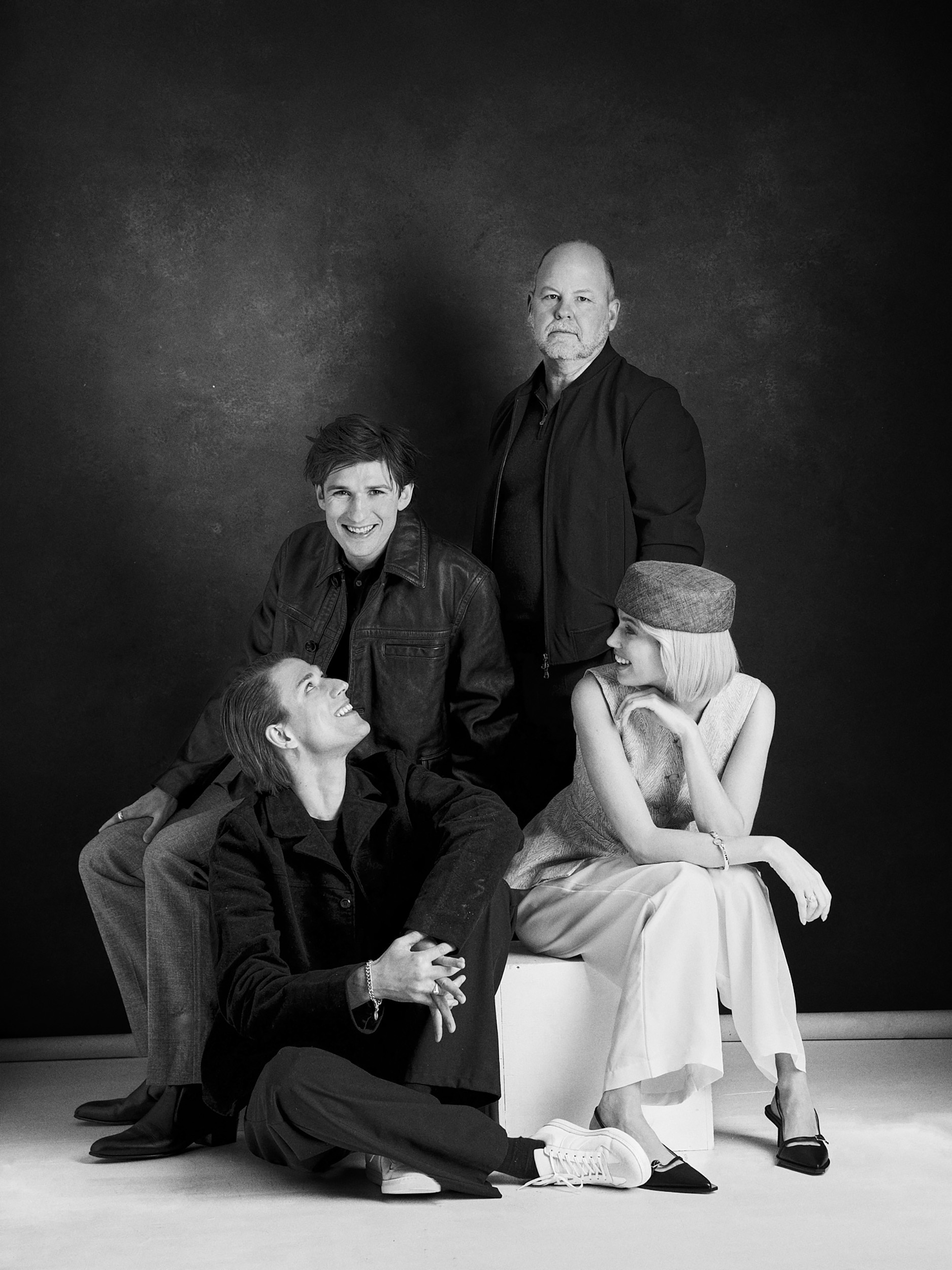
“I felt very comfortable failing,” says Christian Fandango about filming the new adaptation of Hjalmar Söderberg’s Doktor Glas. Premiering in Swedish cinemas at the end of February, the film, reimagined by screenwriter and actor Isac Calmroth and directed by Erik Leijonborg, brings Söderberg’s 1905 novel into the present day. It reframes the classic moral dilemma: who has the right to judge, and who decides what is justified?
The priest becomes a celebrated writer, private shame collides with public image, and Helga gains an agency largely denied to her in the original text. What remains unchanged are the questions at the story’s core: Who is guilty? Who controls the narrative? And how far can moral conviction go before it turns destructive?
Natalia Muntean: Dr Glas has been interpreted for over a century. When you started working on this version, was there something you all agreed needed to be very different from earlier adaptations, and maybe from the book?
Christian Fandango: We all agreed that we wanted it to be a modern take.
Isac Calmroth: And you can’t really help it. Everything changes when it’s modern, because it’s 100 years later. Even if sometimes we wanted to go back to the book and tried to, it doesn’t really work.
Erik Leijonborg: When Söderberg wrote it, it was very contemporary and really on the edge of moral questions, both for society and for the individual. Those questions are still exactly relevant today. If you want to take the temperature of Stockholm and the people living here, you can read that book at any time. For example, can I help a woman who has been raped? Can I take the life of the rapist? Is that morally correct? Is abortion morally right? In 1905, these boundaries were defined by strict, often oppressive laws. Today, we have the consent law. These questions will keep being asked as long as we’re human beings trying to figure out where the boundaries are. And then there’s the contemporary life we live – social media, being a public figure. These aspects felt very relevant to us.
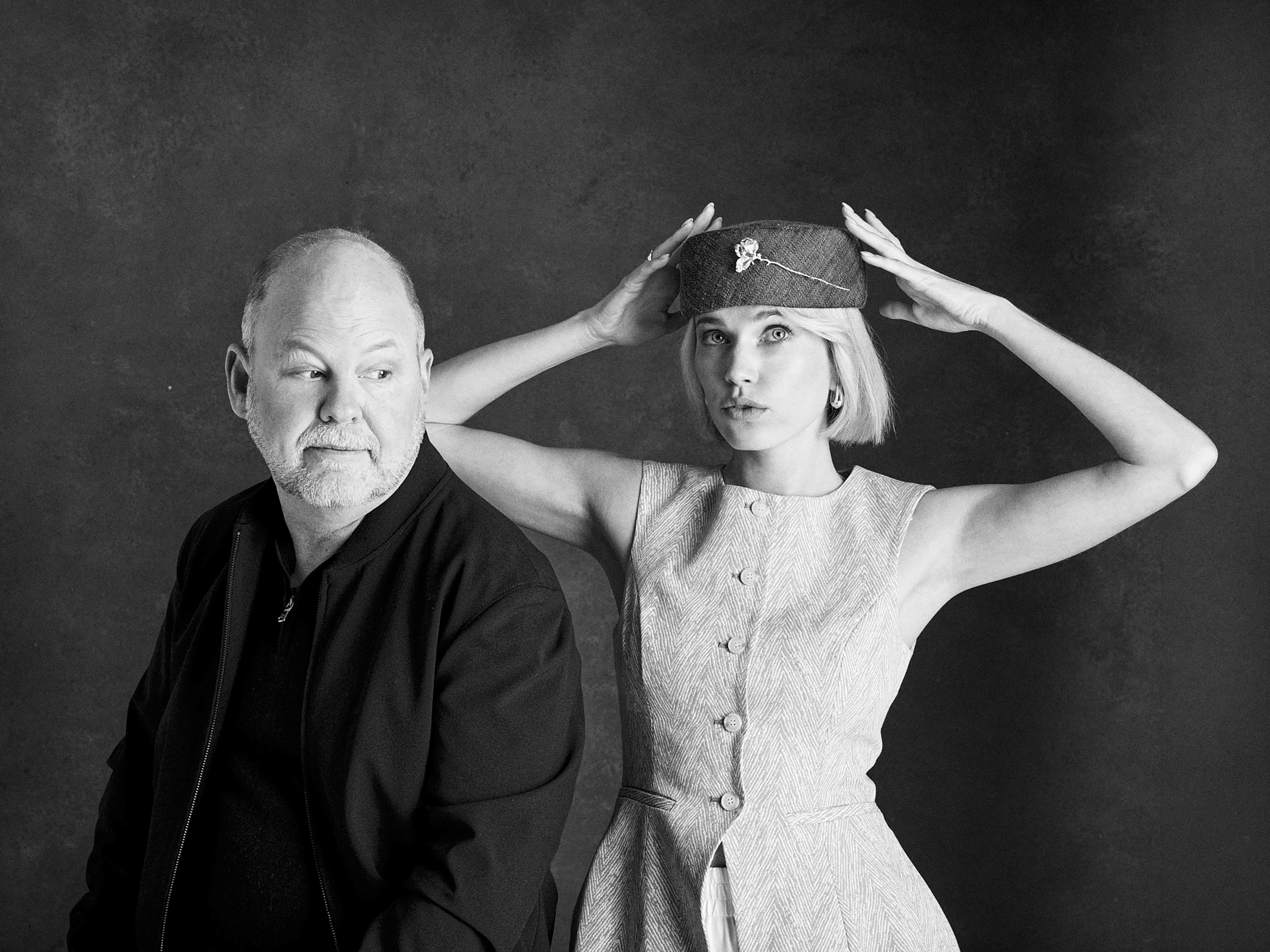
Thea wears
hat Jeanerica
brosch Ole Lynggaard,
top Malina
trousers Lisa Yang
earrings Maria Nilsdotter
Erik wears
total look Oscar Jacobson
NM: So you brought some of your own experience into the characters?
Thea Sofie Loch Næss: Maybe. But I think one obvious thing when writing something in 2025, compared to the book, is Helga’s agency. I remember when I was reading the original, I was looking for Helga, thinking, “Where is she?” She’s only viewed through the men’s eyes. She doesn’t really have agency. At that time, that was just how it was. You’re married, the man is king. In this new version, she’s afforded much more agency, and we see her as a real person.
Even though times have changed, and you can do whatever you want, there are still grey zones. Especially when you’re public people. When you scroll social media, you think, “Wow, amazing, happy lives.” But what’s actually going on inside a relationship? Sometimes it’s even harder to talk about because you’re protecting this perfect image. What’s more important to protect – your real self or the public persona?
NM: Do you think you have answered the question of who is guilty or who is the bad guy in this trio?
IC: I think we do and we don’t.
TSLN: We also all have different opinions, because we are portraying the characters. As an actor, I have to defend Helga at all costs to portray her in a real way. And so does Isac, and so does Christian. According to my character’s life, I’m doing everything right. So I believe that. I think for us, playing the characters, we all have this strong belief in our own character.
IC: Everybody wants a simple answer to who’s guilty and what actually went down. But the truth is probably very complicated.
NM: When choosing to portray the novel as a psychological thriller rather than a period drama – what did that shift unlock, maybe emotionally or morally?
IC: It really came when I reread the book and suddenly had this idea of doing it in a modern way. I called Erik and Christian, and later we called Thea, and we all agreed on this take.
CF: One of the big things was changing my character’s profession; he is not a priest but a writer. Once we nailed that, it kind of unlocked everything.
IC: In the original, the priest is the holy figure of that century. Today, we “pray” to celebrities instead, so we changed that. And then everyone was involved in the script. As a man writing, even though I wanted to create Helga as a complex character, I somehow still ended up with a version where she didn’t even have a job, so Thea came in with a lot of material and ideas. Everybody contributed.
NM: Thea, what else did you have to change from Isac’s script when it came to writing your character?
TSLN: I think it was more about finding nuances. Like, why is she still in this relationship? Does she have any friends? What is her inner life in a way that lets us understand and follow what leads her to do all these things? Writing it in a modern way also gives you a lot of freedom, because this is a classic Swedish novel that people hold very close and have strong opinions about. If we had tried to do it exactly the way the book is written, I feel like people would have focused more on how faithful it is to the book instead of the story. But when you move it to our time, you can’t really compare it one‑to‑one.
IC: People might still say, “But it’s not the same thing,” of course. However, it’s the same core. Otherwise, we wouldn’t do it. That would be disrespectful.
EL: Exactly. You can make an adaptation that, if you watch it with no sound, looks like the book, and you think it is the book, but then you realise nothing is there. You see the story, but you don’t feel the emotions you had when you read it. That’s what’s hard about adapting.
NM: A lot of the original novel lives inside Gabriel’s head. Isac, how did you manage to translate his desire and his emotions?
IC: That was really hard for us. It was a big challenge. We didn’t want to spend too much time in his head, because that’s the novel. In my first outline, there was a lot of Gabriel walking while we hear a voiceover. And if you see that in a movie, you’ll probably fall asleep. So we had to find another route. We want to understand him, but we also want to stay interested in him. So you have to read between the lines a bit.
CF: We just get to follow him and see what happens, and start understanding him before he even does certain things.
TSLN: I think what’s interesting, and maybe the biggest difference from book to script, is: who owns the narrative? Who holds the point of view? I feel like that keeps shifting through the movie. Now we’re with Helga, and things seem horrible. Then we’re with Patric,k and everything seems great. Then we’re with Glas. As a viewer, hopefully, you become the one who really holds the narrative. You can slip a little into Helga’s mind, a little into Patrick’s, a little into Glas’s, but you’re never fully with just one person.
IC: It’s three main characters, honestly, more than just one.
NM: You mentioned in an interview, Isac, that it was heavy to play Gabriel. What was the hardest part to sit with?
IC: In my mind, as an actor, you’re supposed to feel like you’re doing the right thing. But Gabriel, as a person, never feels that. He always thinks he’s doing the wrong thing. He hates himself, he’s constantly doubting, and that’s in the book, too. I tried to keep his backstory close to the original, so he’s always overthinking, always circling these thoughts. A lot is going on in his head, a lot of self‑hatred. And it sounds silly, but if you spend the whole day on set second‑guessing yourself and being full of self‑hatred in every take, it’s very easy to come out of a scene thinking, was that a bad take? When you’re playing a “nice guy,” you get some sort of confidence. But with Gabriel, I just felt very insecure.
NM: Was it easy to let go of that after the workday was over?
IC: I went to Italy and sat in the sun. I got a tan, ate some pasta, and it was fine. I came back to my normal, semi-secure self.
NM: You’ve also said you had to “kill the book” to adapt the novel. What did you have to let go of, besides the period‑drama parts?
IC: That was mostly a dramatic way of saying it, but it’s also true in a sense: we’re changing it to modern times, and we have changed so much that you can’t rely on the book anymore. You can’t really compare it, and I think that’s a good thing, because we’re making a film. If we tried to reproduce the book, we could never match it. It’s a perfect book. So now we’re not trying to be the book. We’re doing our own thing, and that’s nice.
NM: But maybe the emotions are the same?
IC: Exactly the same. The themes, too. A woman caught in a relationship with a man, that happens all the time today, just in different forms. It’s a hundred years later, and it’s not necessarily through marriage in the same way, but it’s still there.
Christian wears
t-shirt Oscar Jacobson
knit Lisa Yang
trousers Tiger of Sweden
necklace Ole Lynggaard
Thea wears
dress MALINA
shoes Sania d’mina
earrings Ennui Atelier
Isac wears
jacket & trouser Tiger of Sweden
t-shirt CDLP

Thea wears
jacket Lisa Yang
dress MALINA
shoes Sania d’mina
earrings Ennui Atelier

NM: Helga is often seen through the eyes of the men. But who is Helga when no one is watching her?
TSLN: I think she’s extremely lonely. That’s part of why she goes to Dr Glas, a stranger, for help. You would hope she would have a strong community, talk to her girlfriends, and we’d all understand, but I don’t think she does. She’s tried so hard to build this life and she’s created something that looks perfect, like what she dreamt of. But she’s incredibly unhappy in it, in her life and in her relationships. With Dr Glas, I think what they recognise in each other is this self‑hatred, this feeling of being stuck in a body and a world you don’t want to be in, and not knowing how to get out. Change is scary. Leaving is scary. She struggles a lot with that, but it still feels easier to keep the facade up and just keep going.
NM: Do you see her more as a victim, as a strategist or something in between?
TSLN: She’s all of it, and I think that’s really important – that she’s allowed to be all of it. It’s something we kind of say in the film: can’t a woman be everything at once? We don’t have to define her. We all have experiences that put us into different boxes. She’s really just trying to get out of an abusive relationship. Maybe her way of doing that isn’t the best, but it’s what she believes is available to her.
NM: In this version, she seems free, successful and admired. How did you portray that contrast between her facade and her entrapment?
TSLN: You have these scenes where she’s with her husband, on a photo shoot, everything looks great. And we all do that more or less, but nobody knows how we feel inside. She has become very good at putting on a hard front because it protects her. Maybe that’s why she doesn’t have many friends: if someone gets too close, they might see the ugliness she feels inside. So she keeps everyone at a distance. She can seem perfect and pretty, but if you loved her or got close, she thinks you’d see she was ugly. That’s how she feels about herself.
NM: Christian, how does being a writer instead of a priest change the power your character holds over Helga?
CF: I don’t think the profession itself holds the power. It’s more me being this perfect, famous guy from a famous family, very successful, loved by the public. On the outside,
I seem perfect, so she should be happy to be with me. No one suspects it might actually be unhappy and dysfunctional. In the public eye, Helga might be the one people see as the problem, the trouble. That gives him a bit of power over her.
NM: Did you approach playing this character as a villain or as someone entirely reasonable?
CF: Not a villain at all. There’s no such thing with Patrick. He’s a loving, warm, happy, nice father who might be a little narcissistic and very confident, but on the inside, he’s not that secure; his self‑confidence is actually quite low. You have to be the devil’s advocate, like Thea said, and I have really tried to do that.
IC: We also rewrote the character a bit. In the beginning, Helga says, like in the book, this awful thing about him, that he’s abusing her. So we tried to go against that. When you meet him, almost all his scenes are nice, even silly. You laugh at him because he’s a bit narcissistic, maybe, but he’s not this obviously scary guy.
EL: Complexity in a character is always important and interesting. I think that’s part of what comes with a psychological thriller: we’re demanding more of ourselves, making the characters complex instead of easy clichés. Complexity is one of the main tasks: to take care of these characters, make them come alive and be interesting, to actually build the story on. That was so interesting with the script, and with working with these three actors, because it was great and fun to be behind the camera watching what was happening. I could use all the takes – every one of them had something. It’s a privilege to work like that, because you can never fully predict or control what will happen when you have a well‑written scene with subtext.
We also saw in the edit that all three characters could flip into clichés or become too much if we added just one extra line. But if we removed too much, we risked some people in the audience not understanding the character because the complexity flies over their heads. That balance is really interesting.
CF: Sometimes it’s all about one word.
NM: How do you make those choices?
EL: It was a very collaborative process. In this group, we did it together. I double‑checked with the rest when it mattered. And it’s not me being polite or worried about bringing in Thea’s, Isac’s or Christian’s experiences. It made everything richer, better, and perhaps more complex. That was a lovely way of working for me. I feel like we’ve removed our egos.
CF: They still shine through sometimes, but then we’re honest about it.
Christian wears
t-shirt Oscar Jacobson
knit Lisa Yang
trousers and shoes Tiger of Sweden jewlery Ole Lynggaard

Isac wears
jacket & trouser Tiger of Sweden
t-shirt CDLP
watch Tudor
NM: Sounds like group therapy. If the story were told from Helga’s point of view alone, what do you think the movie would become?
TSLN: Then it would be a horror film, a psychological horror. The way she looks at Patrick is with hatred. She sees a monster where everyone else sees a really charming, fun, hot man. For her, the world is kind of scary and unfair. I think it would be much more intense. Maybe I wouldn’t want to be in that universe… or I would, but it wouldn’t be a comfortable experience.
IC: We actually talked about making the film from Helga’s perspective. But then it wouldn’t really be a thriller; it would be more of a gritty drama. That would change everything.
EL: I even made a poster called Helga a long time ago, before we started shooting.
NM: Do you hope the audience leaves the cinema with answers or with discomfort?
CF: Honestly, I think people are going to walk away with answers, but they’ll definitely be different answers.
TSLN: And discussions, I hope. My favourite thing is seeing a good film and then going out to eat, and continuing to talk about it. It opens up space for a conversation that can grow into bigger discussions and thoughts. That’s what you want when you put your soul into something: to hope it can spark something else in someone.
IC: For sure. Something that lingers. We wanted to make an entertaining film that you would want to rewatch just because it’s a good experience. It’s thrilling and even fun at times, but you still get the essence.
NM: What was the best moment while working on this project, and what was the most challenging? Whoever wants to go first.
CF: The most fun? Everything was fun. It felt like one long day of shooting. I can’t really separate the days. It was just one long, intense, fun day.
TSLN: We had one day of shooting in this apartment in Stockholm, top floor, in the middle of a really hot summer. There were windows everywhere, but we blocked out the light because it was supposed to be night. So you’re in this hot box of darkness, like 40 degrees. That whole day, we had all our hardest scenes, at least Isac and I. Heavy emotional scenes, monologues, fighting, everything. At one point, you’re just like, “I’m not in my right mind right now.” You become like a little kid, running around delusional, exhausted, and overheated. But it’s also the best feeling in the world, because there aren’t many jobs where you can be extremely silly and playful and also feel such intense emotions with your friends.
CF: And at the same time, we felt we were making something really special and important.
TSLN: It was fun, and it was hard. And it was hard because I always laugh when I’m nervous. Isac and I had to do this sort of staring contest, a lot of tension, and I’m there trying not to laugh.
IC: But it’s really nice to work with people you know well. You can go really deep, but sometimes you also cringe a bit. We can all laugh at each other. Sometimes I’m like, “I’m playing doctor with Thea. She knows I’m not a doctor. I’m just stupid Isac.”
EL: The most challenging day for me was the huge masquerade party – hundreds of extras in costume in a castle. That was challenging, but I really enjoyed it as well. The most fun day was shooting the key moments with the three of them recording together, all of them totally crazy, each taking part in different things. That’s one of the best scenes. I could be in that scene over and over again, like a play. I would watch it every night. It’s so funny and also scary at the same time.
NM: What’s one thing, or maybe a lesson, that you take away from this project?
TSLN: Make movies with your friends..
photography Sandra Myhrberg / Agent Bauer
fashion Jahwanna Berglund
makeup Elva Ahlbin
hair Tony Lundström / MIKAs Looks