In Conversation with Diana Orving: Celestial Bodies at Millesgården Museum
text Natalia Muntean
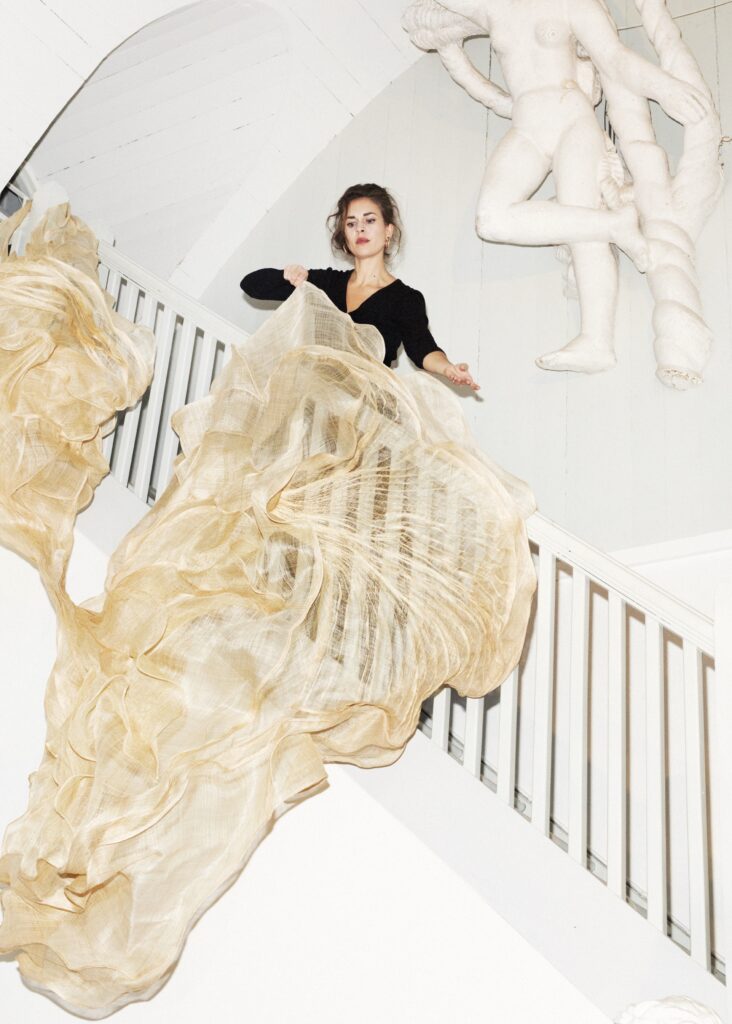
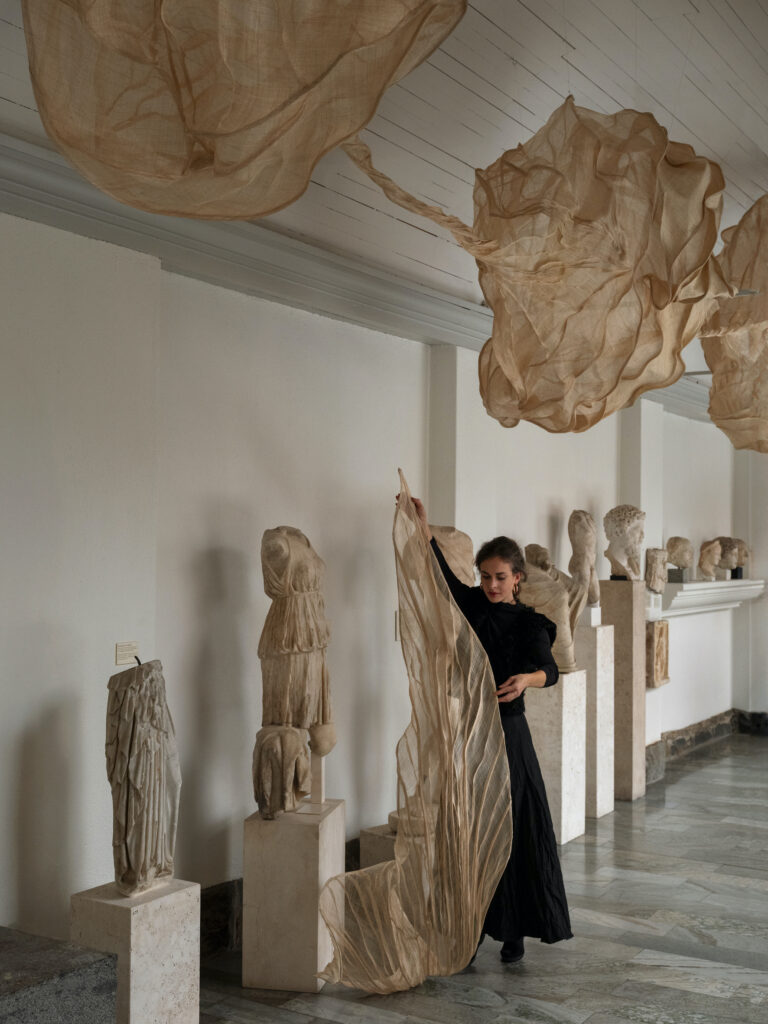
What happens when the sculptures of Carl Milles encounter the fluid, porous textiles of Diana Orving? To launch the &Milles exhibition series at Millesgården Museum in Stockholm, the inaugural presentation features Stockholm-based artist Diana Orving, whose exhibition Celestial Bodies introduces textile sculptures into the world of Milles’s mythology and astronomy. Working with silk, linen and repetitive stitching, Orving creates “organic beings” that seem to defy gravity. In this exhibition, she reflects on the spirit of the site, the vulnerability of her materials and her belief that the human body is our first universe.
Natalia Muntean: The &Milles series is framed as a dialogue across time. In your site-specific response, were you in conversation more with Carl Milles’s artworks, his themes of mythology and astronomy, or the spirit of the place he and Olga created?
Diana Orving: For me, the strongest dialogue was with the spirit of the place itself – the atmosphere Carl and Olga Milles shaped through a life lived alongside art, nature, belief, and curiosity.
Rather than responding directly to individual sculptures, I was drawn to what exists between them: the air, the height, the light, and the sense of upward longing embedded in the former studio. Early on, I understood that my work needed to inhabit the upper zones, ceilings, thresholds, and in-between spaces, responding to the building’s own vertical rhythm.
Knowing that Milles observed the stars from a small tower room made something click. It felt like entering a place already oriented toward the sky. The works grew out of that shared sense of wonder, rather than from a desire to echo Milles’s formal language.
photography Märta Thisner
NM: Why did you choose the title Celestial Bodies for this exhibition?
DO: The title carries a dual meaning that felt central to the exhibition. Celestial bodies refers both to planets and stars, and to bodies as vessels – human, animal or imagined.
Throughout the exhibition, bodies appear in states of becoming: drifting, hovering, suspended, or transforming. Everything alive is in motion, slow but persistent, and I try to capture that sense of movement in my sculptures, as if they are not truly still, only momentarily paused. The title holds a tension between intimacy and immensity – between being grounded in the body and reaching toward something unknowable.
NM: There’s a contrast between your soft forms and Milles’ solid bronze and stone. Is this a conversation about contrasting worldviews, or did you find an unexpected softness in his work, or a hidden strength in yours?
DO: I experience it less as a contrast and more as a dialogue between different kinds of permanence. Milles’s materials speak of endurance, gravity, and monumentality, while my textiles speak of breath, vulnerability and change, yet they carry their own strength.
There is a quiet tenderness in Milles’ figures, particularly in their upward reach or moments of suspended movement. In my work, strength lies in time: in the accumulated labour of stitching, folding and installing. The dialogue unfolds somewhere between weight and weightlessness.
NM: You explore origin, memory and the subconscious. When creating for this specific site, did you feel you were weaving your own memories, responding to the memories held in the Milles home or tapping into a more collective or mythological memory?
DO: It was a layering of all three. My hands carry embodied memory – gestures and repetitions built up over decades of working with textiles. At Millesgården, I was also surrounded by another life’s devotion to making, belief, and imagination.
Beyond that, the site holds something archetypal. For me, mythology functions as a form of collective memory, a way of holding experiences that resist rational explanation. The works move within that shared subconscious space, where personal experience meets something older and more universal.
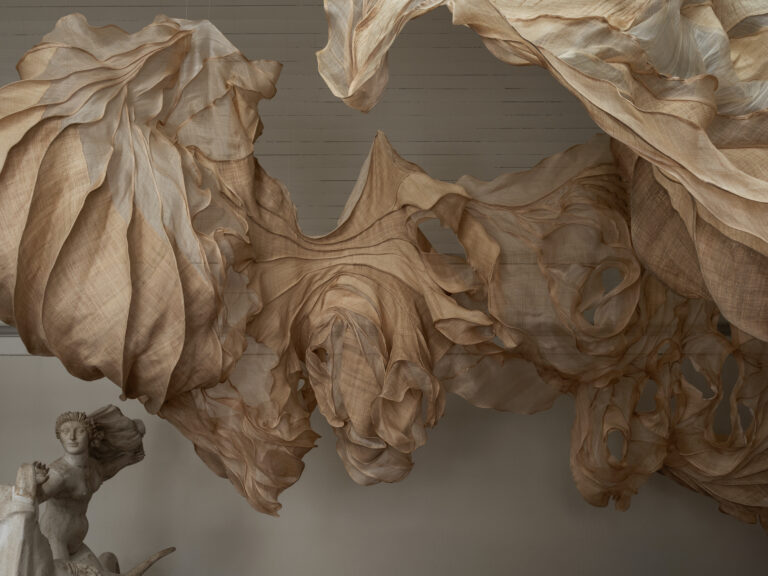
photography Erik Lefvander
NM: You work a lot with themes of the body and memory. How do those ideas connect to the cosmic themes in this show?
DO: I think of the body as our first universe. It’s where we first encounter gravity, rhythm, expansion and balance. When I work with cosmic themes, I’m not thinking of space as distant, but as something reflected within us.
Memory functions like a constellation – fragmented, non-linear and constantly shifting. The sculptures carry that sense of internal movement, suggesting that both bodies and memories are always in motion.
NM: What is your favourite material to work with and why?
DO: Textile, without question. It carries time in a very direct way. Every stitch records a decision, a hesitation, a breath. I try to give the material a body, a presence and an internal movement, as if guiding it to speak in its own language.
Its lightness allows me to work at a monumental scale without losing intimacy. Textiles can hold vulnerability and strength at once, which feels essential to my practice.
NM: As the first artist in the &Milles series, you are setting a tone. What do you believe is the role of a contemporary artist when entering into dialogue with a historic legacy and collection like this one?
DO: I believe the role is to listen before responding, not to illustrate the past or position oneself against it, but to allow a conversation to unfold.
A historic collection isn’t static; it continues to breathe through new encounters. Contemporary artists can activate these spaces by introducing uncertainty, tenderness, and alternative ways of knowing, adding a new layer rather than overwriting what already exists.
photography Erik Lefvander
NM: What do you hope people feel or think about when they walk between your textiles and Carl Milles’s bronze sculptures?
DO: I hope the exhibition opens a quiet, generous space for reflection – on fragility and endurance, longing and belief, and on life as something constantly unfolding.