Chellis Baird Redefines What a Painting Can Be
text Anna Mikaela Ekstrand
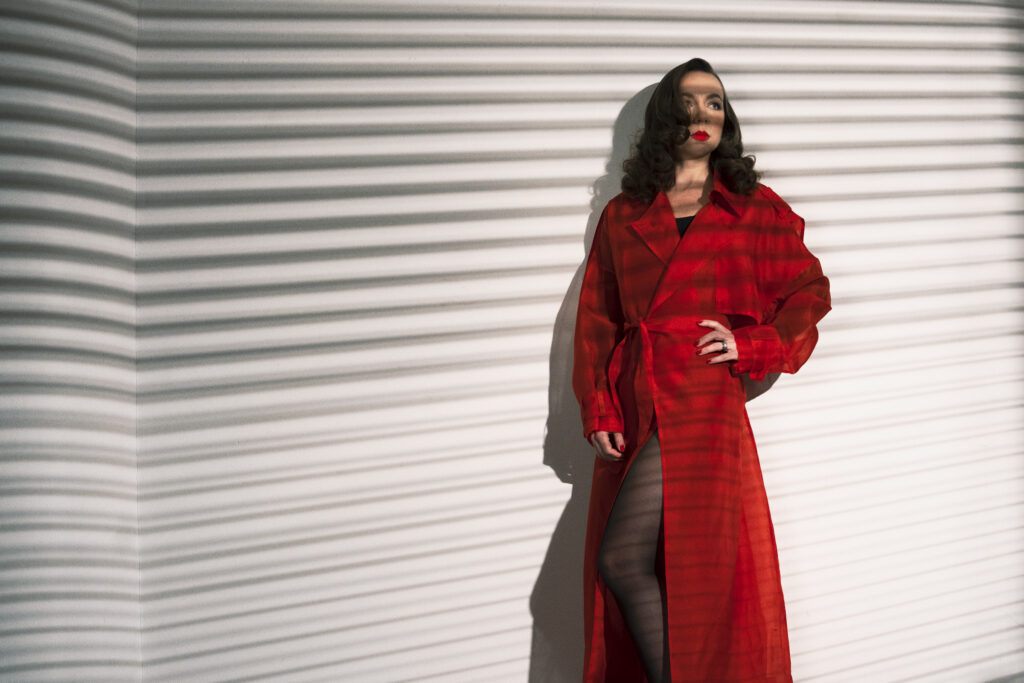
body suit Capezio
tights Falke
trenchcoat Lapointe
heels Christian Louboutin
Over the past decade, of showing at prestigious galleries, institutions, and the odd member club, her work has been presented by leading galleries in New York and Paris. We visited her Long Island City studio to talk about how her work pushes boundaries by combining dress, movement, and the mechanics of fabric in new ways.
“After visiting the Museum of Modern Art, in my late twenties, I remember standing in front of a Barnett Newman painting and starting to cry. It was at that point that I knew I was going to share my art with the world,” Chellis Baird commented in a 2023 interview. In her early twenties, she was living in New York and working as a designer at Ralph Lauren, making her own art when she was off the clock. A dream for many, but she hadn’t quite made it yet. Hailing from a South Carolina textile town and educated at the Rhode Island School of Design—known for fostering cross-disciplinary education—Baird not only had a deep understanding of fabrics and their innovation from the get-go, but a passion for continuing to push their boundaries. Movement is deeply embedded in her practice, dancing ballet multiple days a week, she sees it as a hobby, but when a principal dancer from the New York City Ballet saw her, he likened her to a professional. She’s a Type A creative.
When Baird transitioned into making art full-time, living her dream, she literally painted the town red. The Touch of Red at the National Arts Club is among the many exhibitions that centered on her signature hue, red. Her works are sculptural paintings, or painterly sculptures—twisted, draped, and bound fiber that is dyed and painted. They are hard to pinpoint because she has created her own artistic language. Arguably, she is the leading artist who is moving the needle in fiber, painting, and sculpture, all wrapped up in one. She is also preparing for a museum presentation at the Bo Bartlett Center from August through December 2026, with a larger gallery footprint, she is thinking more expansively about spatial rhythm, duration, and how viewers physically move through and between the work. “I am especially interested in using color as atmosphere and shadow as a structural force,” she explains to me on a sunny afternoon.
Baird has had an extraordinary year with a major solo show in Paris with RX&SLAG and several shows with Hollis Taggart in New York, and during Miami Art Week, marking a significant expansion of her gallery presence. It’s really a big break, but to Baird, it feels less like a sudden opening and more like time finally cracking the pavement. We are in her Long Island City studio. The studio is a daily ritual for the artist, for her creation is a form of breath, like her ballet practice. Correcting me, she explains that rather than a breakthrough her work is a continuation of ongoing discipline, diligence, and an obsessive devotion to her craft.
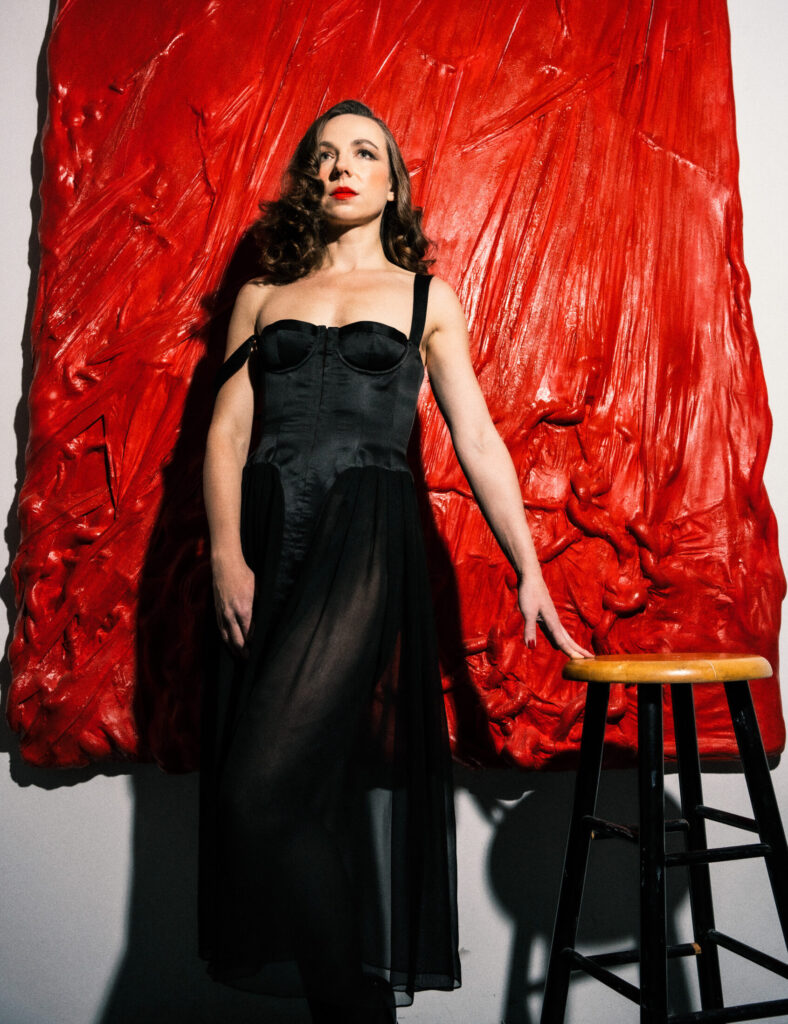
dress Emma Krikorian
heels Christian Louboutin
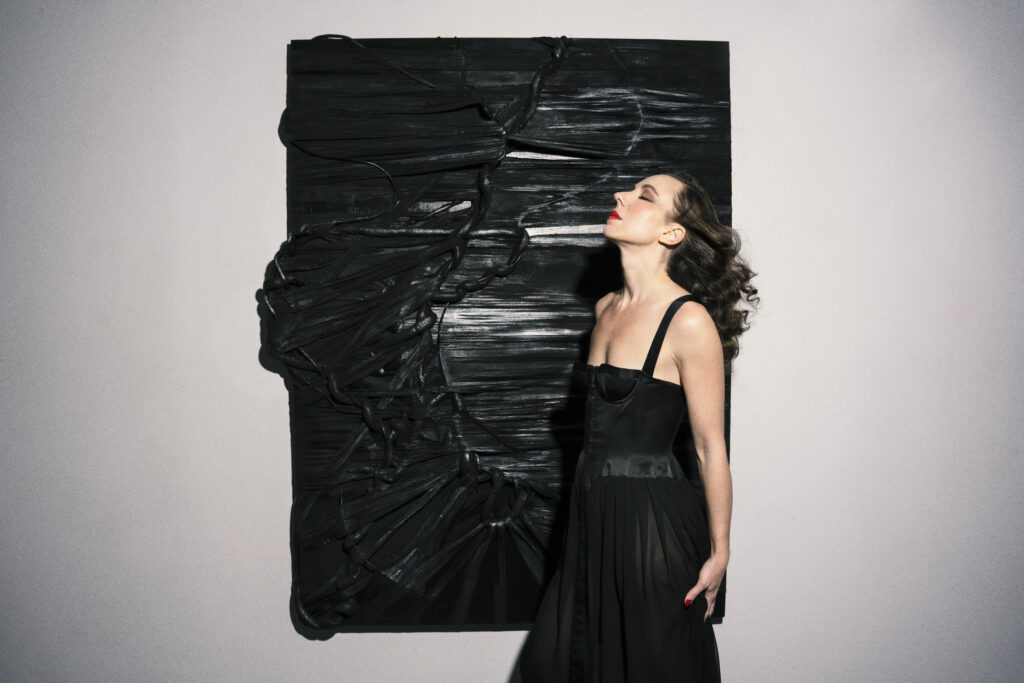
dress Emma Krikorian
heels Christian Louboutin
All around us are pieces from different times in Baird’s artistic career, finished and in progress, as a testament to her hard work. Her sun-drenched studio is filled with reference material as well—fabric and color swatches on hand and many museum catalogs on fashion, textiles, and art tucked away in various places. To avoid high shipping costs, ahead of her show in Paris, the gallery set her up with a local studio where she constructed a new choreography of making. Keeping a sketchbook recording color formulas, fabric techniques, title ideas, and personal notes.
As she temporarily was away from her husband and very young children, Paris gave her a greater freedom, a fluid daily structure. Working under an intense deadline, the long, focused days, often seven to ten hours, and then moving through the city at night, dancing or lingering over late dinners, reminded her of her student years at RISD, when time felt expansive and porous. This sense of freedom and the city’s material palette and chromatic range — living near the Picasso Museum and the Centre Pompidou — deeply informed what became her most colorful body of work.
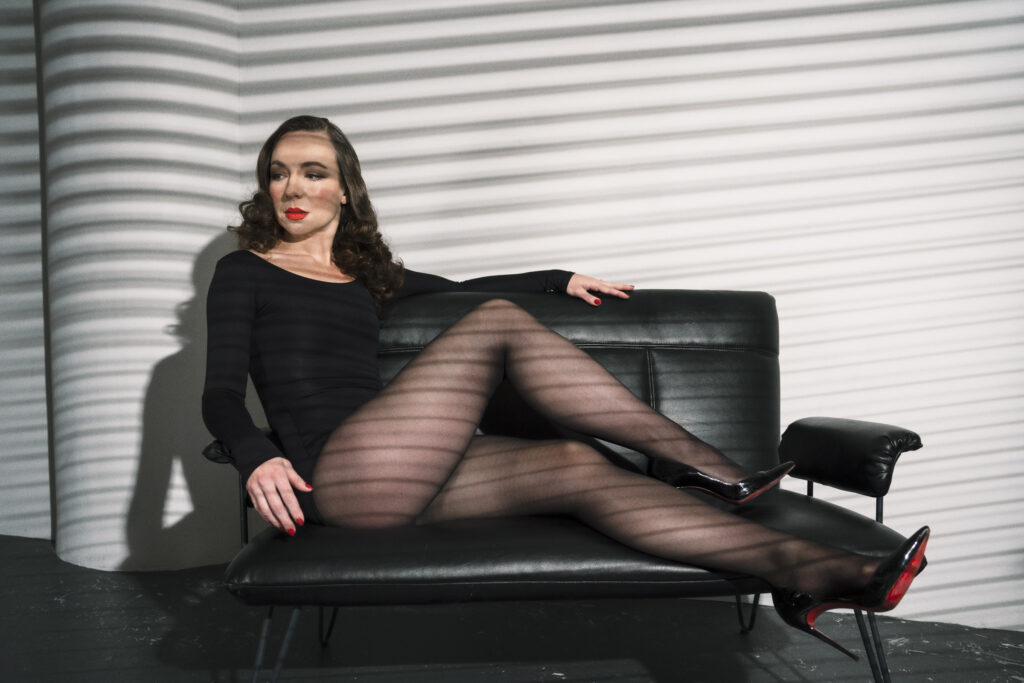
body suit Capezio
tights Falke
heels Christian Louboutin
Embodiment, being in one’s own body, is spoken about when it comes to performance, but not often discussed when it comes to painting or sculpture; however, this grounding and playful aspect of the body is present in the art-making process. Sartorial experimentation helps guide Baird; sometimes she cosplays when she makes work—wearing period-style clothes to feel connected to her lineage and labor. “Clothing shifts posture, tempo, and emotional tone,” Baird explains.
At other times, she dresses formally to slow her gestures. Through these actions, the studio becomes a private territory where she can experiment with identity without external scrutiny. “Overall, the body is one of my most important tools; knowledge lives in muscle memory, in gesture, in rhythm, which is why I wear specific fabrics or silhouettes to harness a mood,” she continues. Having formerly worked as a clothing designer and now exploring textiles, Baird has a sophisticated understanding of fabrics, and her work delves into their composition, movement, and history.
“High heels, for example, create elegance through precariousness. They reorganize the body’s relationship to gravity and time. These tensions, structure and softness, constraint and freedom, directly inform how I sculpt material,” Baird explains. In Paris, she began using the heel of a stiletto to create physical ruptures in the canvas, a gesture that is both elegant and violent. Acclaimed craft historian, Glenn Adamson described her piece Lace III, 2024 as representing the DNA of his group exhibition Drop, Cloth, as her work reveals rather than conceals the substrate, one of the conceptual bases of his show.
This new monochromatic body of work explores lace, explores lace’s open weave, while expanding the idea of the canvas by revealing the support structure (substrate) underneath. The exhibition featured twenty-five artists and was presented by Susan Inglett and Hollis Taggart and co-curated by Severin Delfs. Baird explains, “Conceptually, the substrate relates to inherited domestic labor, quilting traditions, fashion history, and gestures passed through generations of hands.
Fabric carries touch. It remembers. I come from a lineage of maker women who sewed, built, repaired, and sustained.” By exposing these support systems, the work opens the door to thinking about identity and culture as constructed through layered supports that are essential.
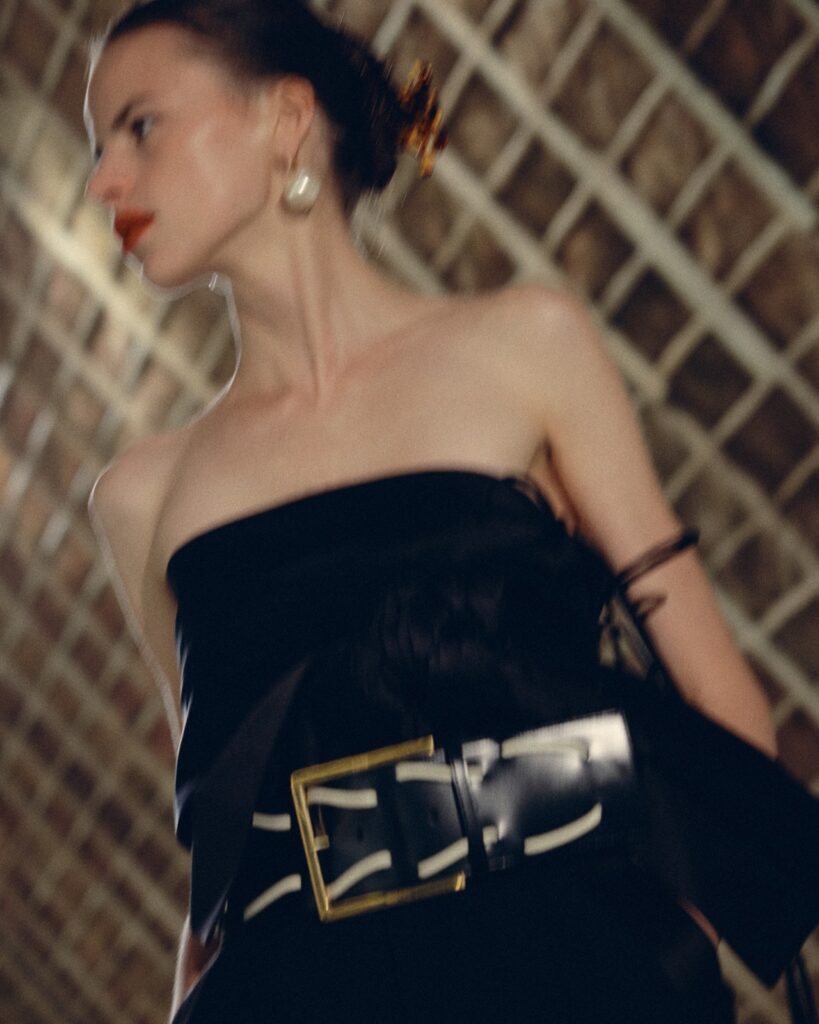
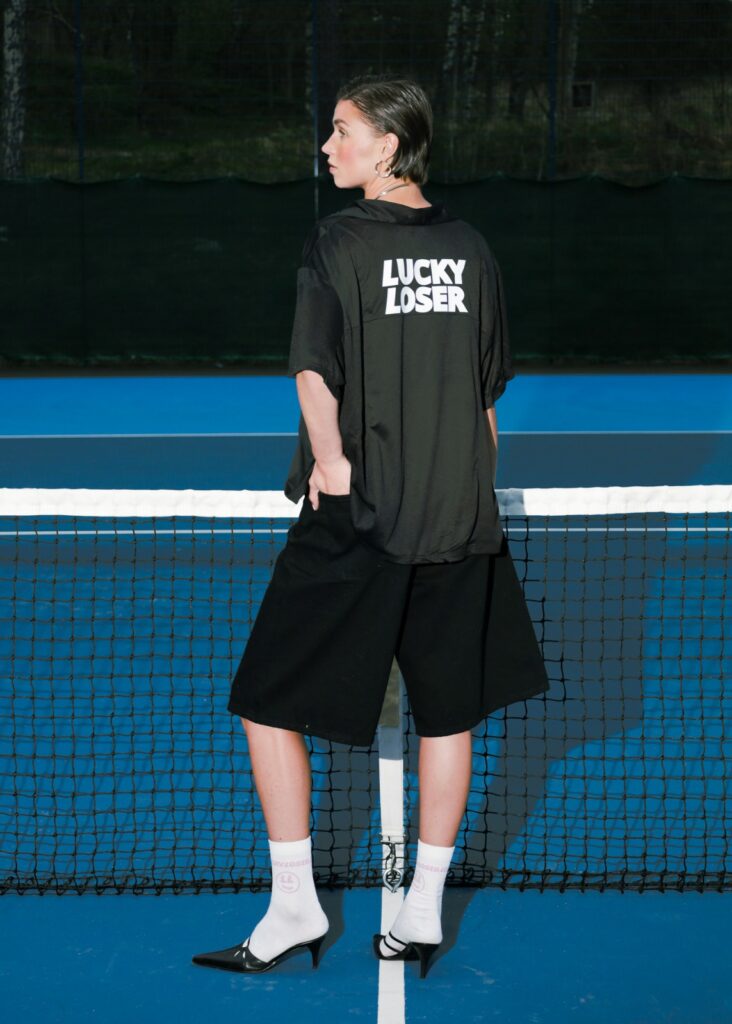
Overall, it is hard to place Baird’s work as it blurs the line between painting, sculpture, and textile — reimagining painting as something built rather than applied. Many of her pieces physically extend beyond the traditional frame, challenging the two-dimensional surface. To accompany this interview, Baird creatively directed a photo shoot—shot by Milan Lazovski—that is both performative and confrontational, mirroring her intermedium approach to making. Her aim was to extend the studio into performance, exploring authorship and visibility of the artist as both maker and material, allowing space for fantasy. “My work itself exists somewhere between fantasy and reality, stitched together through the vocabularies of fiber and fashion, dance and gesture, painting and sculpture,” she explains, continuing, “for me, the frame has always felt like a suggestion rather than a fixed boundary.”
Art can shift the way we look and understand the world around us. Baird is interested in making the viewer work by slowing down their perception; the knots, tension, and repetition that are built into her work nod to duration and physical labor. This hybrid language challenges inherited hierarchies of craft versus fine art, softness versus structure, decoration versus meaning—divisions that she is set on dissolving. In life, we are often battling with both our inner voice and external forces.
Baird’s new body of lace work emerged by accident during a moment of experimentation with release rather than control, opening up an entirely new energetic field—”allowing fragility and structure to coexist rather than forcing resolution.” Structurally, lace derives its strength from its openings, what is not there, and Baird has found new breath within these spaces to soar.
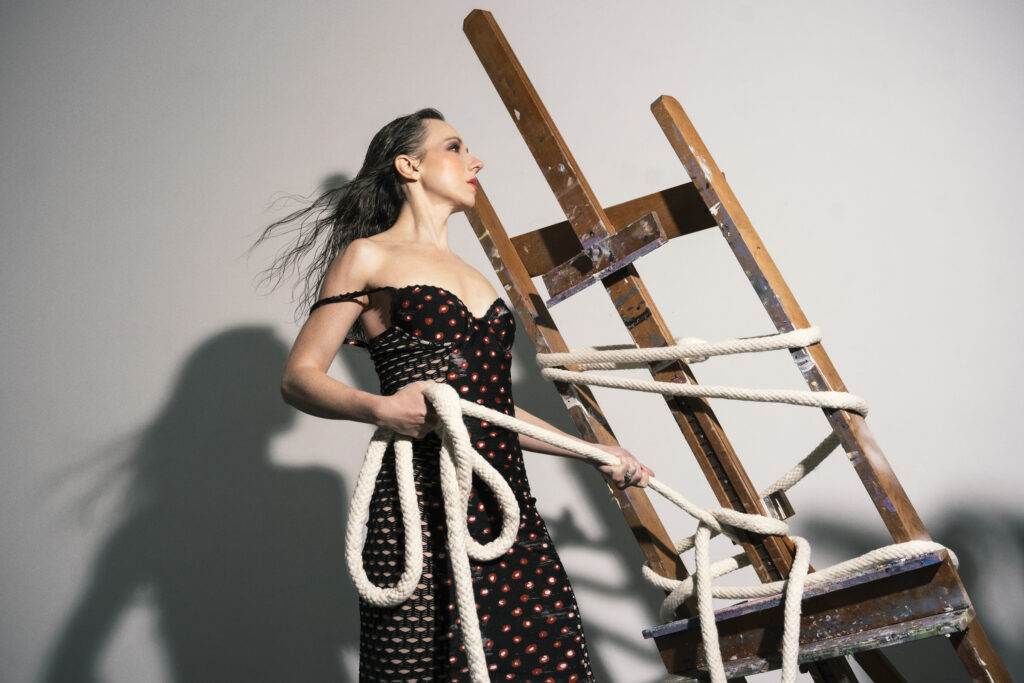
dress Jean Paul Gaultier
shoes Maison Ernest Paris
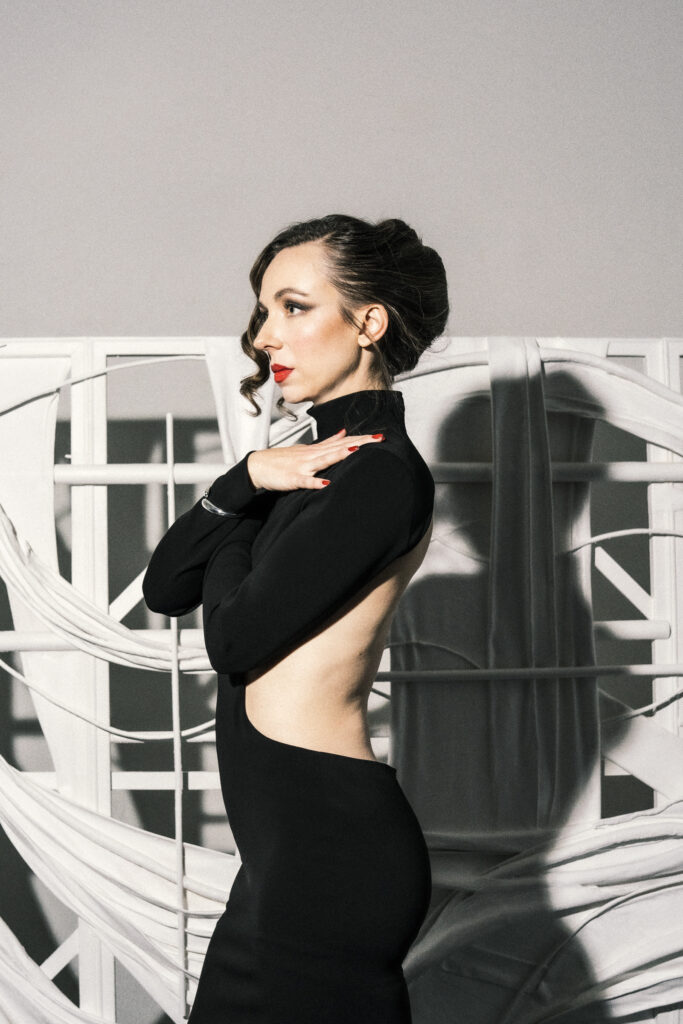
creative direction & artwork Chellis Baird
writer & producer Anna Mikaela Ekstrand
photography Milan Lazovski
styling Natasha Bock
hair Yetunde Egunjobi
makeup Isabella Margaret Diana
lighting assistant Taryn Noonan
producer & set runner Daria Baulina
set assistant Kyle Hoenes
special thanks & advisory support Frayda Resnick
dress MÔNOT
heels Schutz
jewelry Stylists own