Klara Wirsén Suchowiak Feels Owned
text by Natalia Muntean
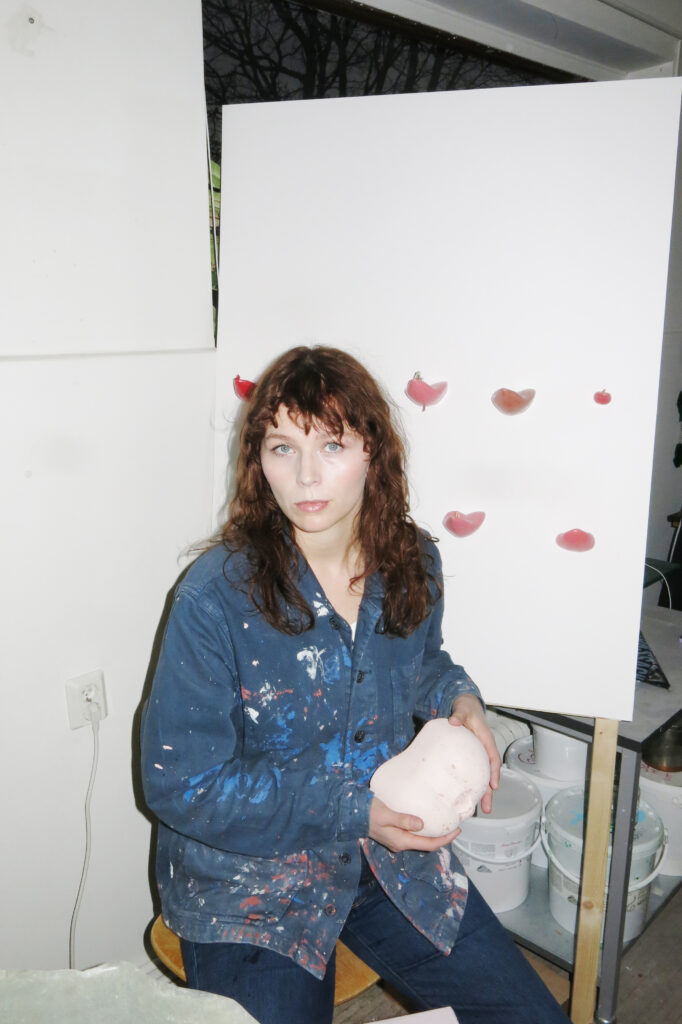
“The things you own end up owning you,” says Klara Wirsén Suchowiak about ÄGD, her solo exhibition at WAY Gallery in Stockholm. Wirsén Suchowiak is known for her tactile, sculptural explorations of the body as both site and narrative. Trained at Beckmans College of Design, Gerlesborg School of Fine Art and Nyckelviksskolan, has previously shown at venues such as Liljevalchs Spring Salon and Värmlands Museum. Opening on March 5th, the exhibition looks at experiences of parenthood, desire and vulnerability and turns them into unsettling, seductive and humorous encounters that invite both emotional and physical engagement.
Natalia Muntean: The title ÄGD (OWNED) is very powerful and direct. Can you talk about the decision to use this word?
Klara Wirsén Suchowiak: I am owned. Owned by life, owned by the artistic process, owned by my paycheck, owned by the social structures, owned by capitalism, owned by the gender roles, owned by my family life, owned by my children.
NM: The exhibition highlights the “contradictory experiences of parenthood”, desire, care, vulnerability and excess. How do you balance these opposing forces in a single work or installation? Was there a specific piece where this paradox was most challenging to capture?
KWS: In my latest work, “My sister’s milk,” I have been working with real breast milk that I’ve collected from different people. The milk sprays out from sculpted breasts and a baby’s mouth, in a large fountain placed on a dining table.
Breastfeeding is like dynamite; it’s a subject everyone has strong feelings and opinions about, even if they might not dare to admit it. The body is political, especially bodies that do things like lactation. In this work, I have explored and wrestled with the many different emotions and positions that come with breastfeeding itself. On the walls around the fountain, tongues are sticking out. They are artworks that stand on their own, but they can also be interpreted as observers.
In the piece, I have a combination of materials that present a discrepancy. The milk is beautiful, white, and frothy. The breasts and the baby’s mouth are cast in a smooth stone composite, and the fountain itself is made of fibreglass and epoxy. The colour and texture of the fibreglass make me think of some kind of toxic boat construction, something you don’t want close to your skin, something you don’t want to touch. Yet the baby and the breasts lie there in the middle, gurgling and spraying.
On March 5th, at 16:00, everyone who is breastfeeding is welcome to help me inaugurate the fountain by spraying their milk into it. We’ll see if anyone later dares to drink from it.
NM: You work with a wide range of materials, from stone to textile to found objects. Could you give an example of how a specific material was essential to express an emotion in ÄGD?
KWS: For a long time, I’ve had a vision of creating an artwork where the feeling should be like the sensation you get when a hair is caught in your throat. You pull out something fuzzy, invasive, from your glossy, gagging mouth.
That feeling inspired me to create the works called “:P,” which are several tongues of different materials and sizes sticking out from the walls. Some of the tongues are smooth and glossy, others are filled with lots of small objects – babies, metal pieces, etc. And some of the tongues are covered with textile fibers so they are hairy and soft like velvet. The tongues hang next to each other like trophies, or perhaps like spectators in the room. So in this installation, the encounter between different materials was important. I wanted to create a clash between shapes and materials that gives me a physical reaction.

NM: You mention the viewer as a “recipient.” What is it that you hope viewers will receive from this installation?
KWS: I hope that those who encounter my works feel something. What that feeling is, I don’t want to control.
NM: You mention using found objects in your practice. Are there any incorporated into ÄGD? If so, what was the story or previous life of that object, and how does its history resonate with the themes of the exhibition?
KWS: The sculpture “Domestic” is like a large body, but also a house at the same time. The house is furnished with countless dollhouse furniture, toys, and small things I’ve collected throughout my life. Together, these objects create a house where the parents have lost control, it’s incredibly messy, and no child is sleeping; all the kitchens are on fire. The house and the body have become one, and it is very heavy to carry. The objects in the house come from many different places: from my own old toys, flea markets, my parents’ home, travels, dumpsters and some I’ve been given because people know I collect things. The searching and collecting is something I see as part of the process. And as we know, the things you own end up owning you, and I will probably end up as a hoarder like the ones you see on TV.
NM: You’ve created several public artworks with your mother, Stina Wirsén. How does that intergenerational collaboration influence your approach to themes of parenthood and the body?
KWS: I have been creating for as long as I can remember, next to my siblings and parents. That’s how we spend time together and how we communicate best, by making. Other families might play soccer or sing or cook; we have always sat next to each other with pen and paper. So, making art with my mother wasn’t really something new; the only new things were the scale, the materials, and the fact that the works would be received by others. Our artworks deal with themes like family, body, care, and vulnerability, but in a public space. How can we make forms radiate those qualities? That’s what we are working on. We made our first sculptures a few months after I had given birth to my first child, so I think I was in a place where I really needed to understand who I was now, as a mother, and also what had happened to the relationship between my mother and me. So making the first sculptures was a way of understanding that shift in our lives and in our relationship.
NM: You describe giving form to “inner landscapes and states of mind”. What does that translation process look like in the studio?
KWS: I start with a feeling or a memory of a state of mind that I want to explore, and then I have to find the right material. I would be practical if I just had one material and kept returning to it. But instead, I have to find the right one. And that has taken me to some weird and amazing places and encounters. But it’s more important to get it right than to stay in what I already know. But it is a very messy process, and sometimes I feel like I am walking and working in circles. When I’m lucky, the material itself inspires a memory or a feeling, then I just have to give it the right shape.
NM: This is your first solo exhibition. How does it feel to gather these explorations of parenthood, the body, and materiality into a single space that is entirely your own?
KWS: It feels very exciting to show all the works together. I’ve worked with these themes for years. WAY gallery is the perfect space to gather the pieces together and to create a space of my own.