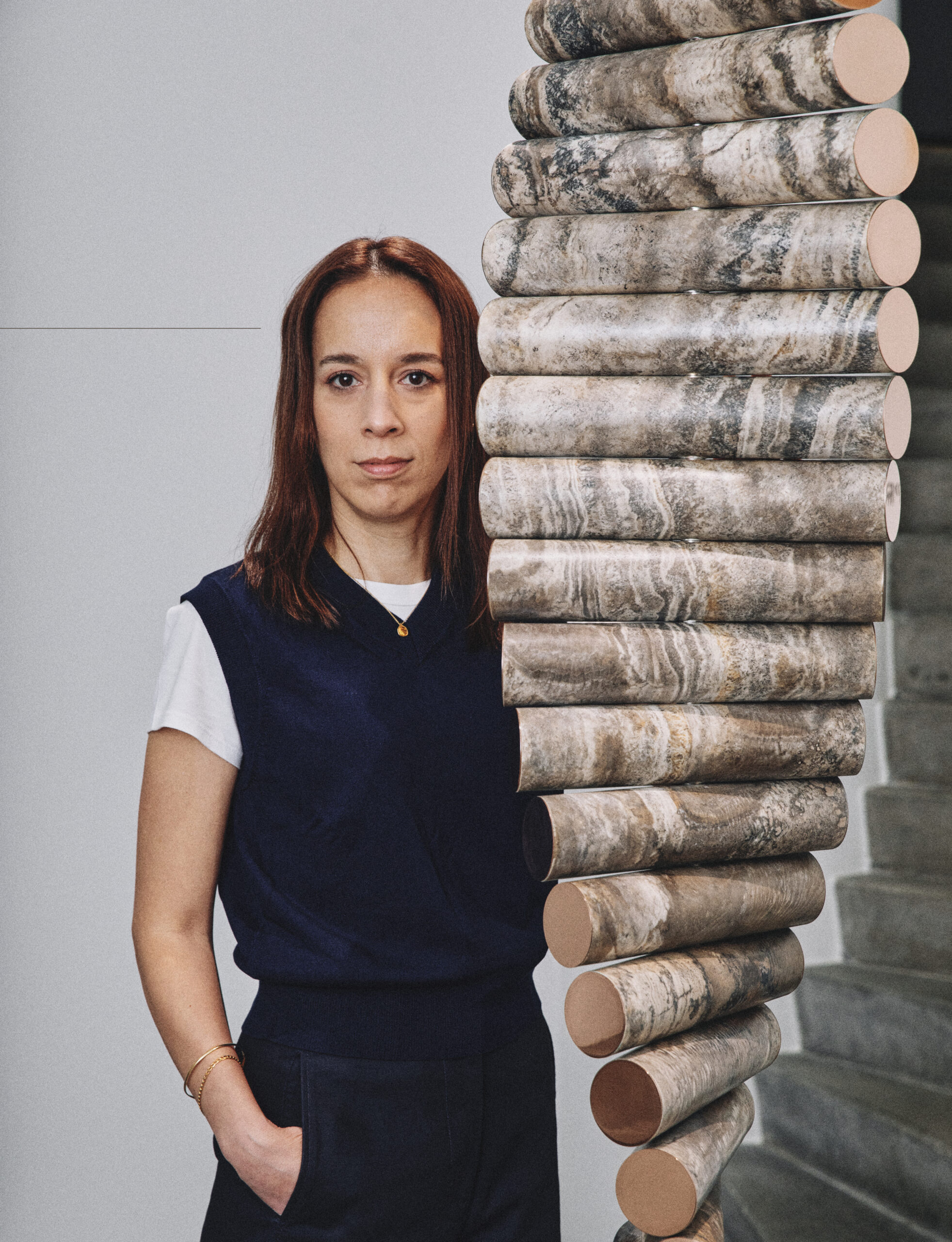
Earth Drill, 2025, Crater Fantasia travertine, copper, steel, 242 x 32.5 x 32.5 cm (column), 3 x 60 x 60 cm (base)
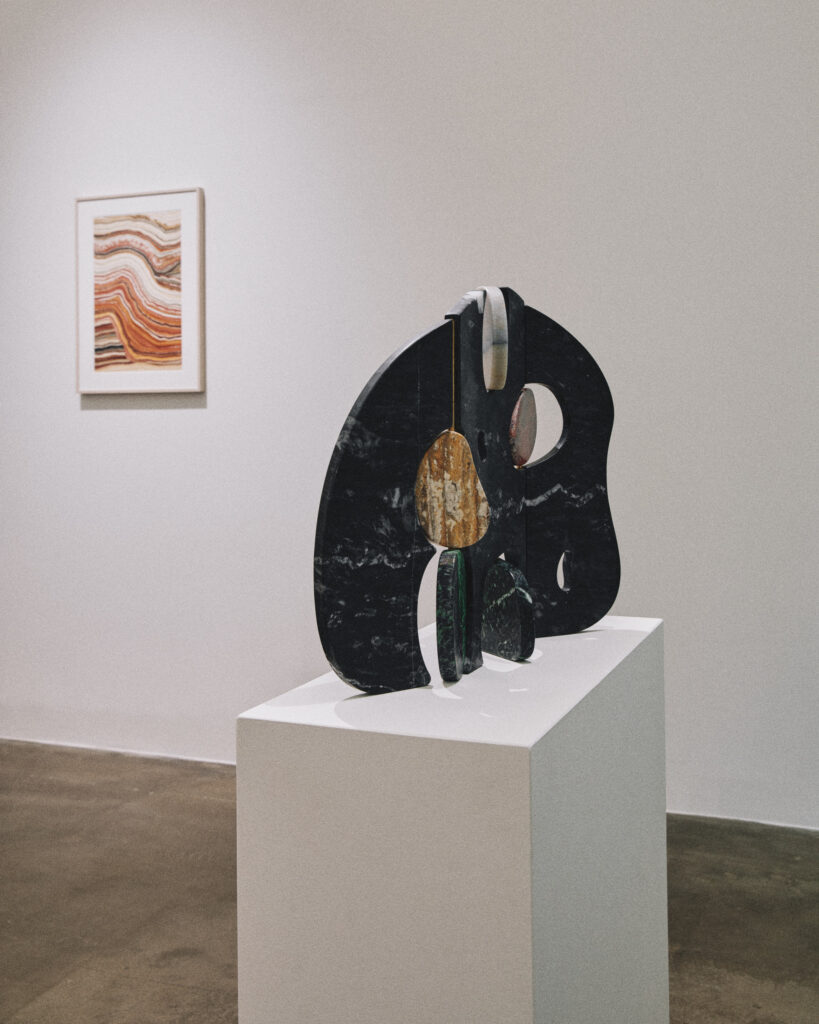
Left Lamina II, 2025, watercolour collage on cotton paper, 59.4 x 42 cm unframed, 66 x 48.6 cm framed
Right Model after Noguchi’s Shrine of Aphrodite N.3, 2025, travertine, marble, granite, quartzite, anyolite, bronze, 46 x 60 x 2 cm
Natalia Muntean: Mineral Rising redefines monumentality as something modular and impermanent. What drew you to this idea of monumentality as fragile or changeable?
Elena Damiani: What drew me to this idea was the understanding that geological forms, often perceived as fixed, are in fact always in transformation. Stone carries the memory of pressure, rupture, and reassembly; it embodies change over vast timescales. Nature itself organises through fragments and modular assemblies: layers, clusters, and self-contained units that combine, break apart, and recombine, generating continuity through constant change. In my work, I strive to convey this vitality by creating forms that remain open to reconfiguration. In Mineral Rising, the idea of monumentality lies not in permanence but in resilience, in the ability of matter to reorganise, to hold memory within its fragments, and to remain in motion.
NM: In Strata Belt, the travertine modules suggest both geological folding and human construction. How do you balance the industrial and architectural references with the natural processes that inspire you?
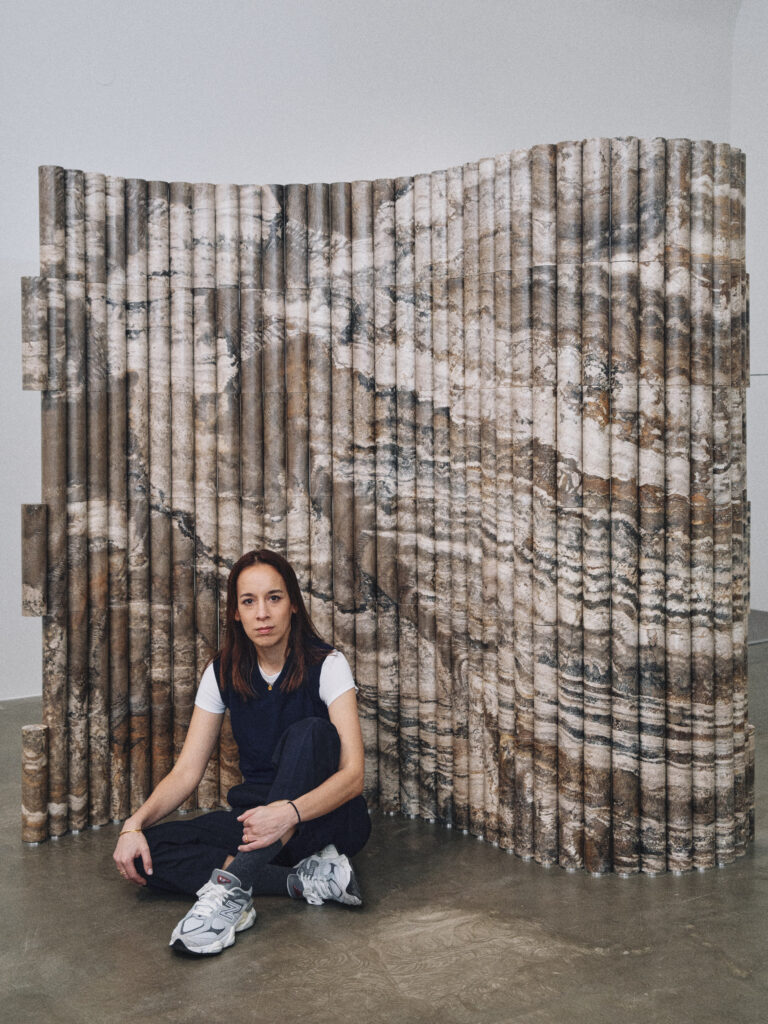
ED: Strata Belt operates at the intersection of geology and architecture. Its modular structure recalls natural processes, folding, stratification, and tectonic shifts, while also referencing principles of design and assembly. The work doesn’t oppose these registers but proposes their simultaneity: structure as both sediment and architecture, fragment and whole.
The piece also draws on Alvar Aalto’s room divider, reimagined in stone, a material rarely used for flexible structures. I often work with references that span architecture, Earth sciences, design, and land art. Rather than standing as counterpoints, these references generate a field of associations that inform both form and concept. In Strata Belt, they converge in a sculpture composed of repeated units that can be reconfigured into different shapes, reflecting both geological transformation and structural design.
NM: Your work often moves between scales, from intimate collages to monumental public art. How do you decide the scale a project demands?
ED: Scale emerges from context and intention. It really depends on the character of the project, whether it is conceived for an institution, a gallery, or a public space; the work must respond to its surroundings. Sometimes this means creating partitions or large sculptural forms; other times it calls for smaller pieces that invite close reading of the materials.
I have always been interested in scale models because they shift our perspective, allowing us to observe space as a representation from the outside. With stone, scale also connects to time: massive forms shaped through slow processes coexist with sudden ruptures caused by singular events. Ultimately, scale emerges from both the ideas and the materials, and is shaped by the kind of spatial and temporal experience the work seeks to activate.
NM: Do you consider your work a form of storytelling about the earth’s memory, or more as a material investigation?
ED: I don’t see my work as telling a story in a linear sense. It’s more about activating the memory embedded in materials, fragments of deep time that resist tidy narratives. Geological matter records traces of past events and processes that can suggest a narrative, but one that is fragmented, open, and continually unfolding, almost deeper than language.
Manuel DeLanda’s notion of history as a nonlinear assemblage of flows and ruptures resonates with my approach, as does Tim Ingold’s view of materials as always in flux. Stone, for me, carries both memory and movement. My work proposes reflection on the Earth’s memory through material investigation, using fragments, layers, and reconfiguration to evoke this unstable, non-linear temporality.
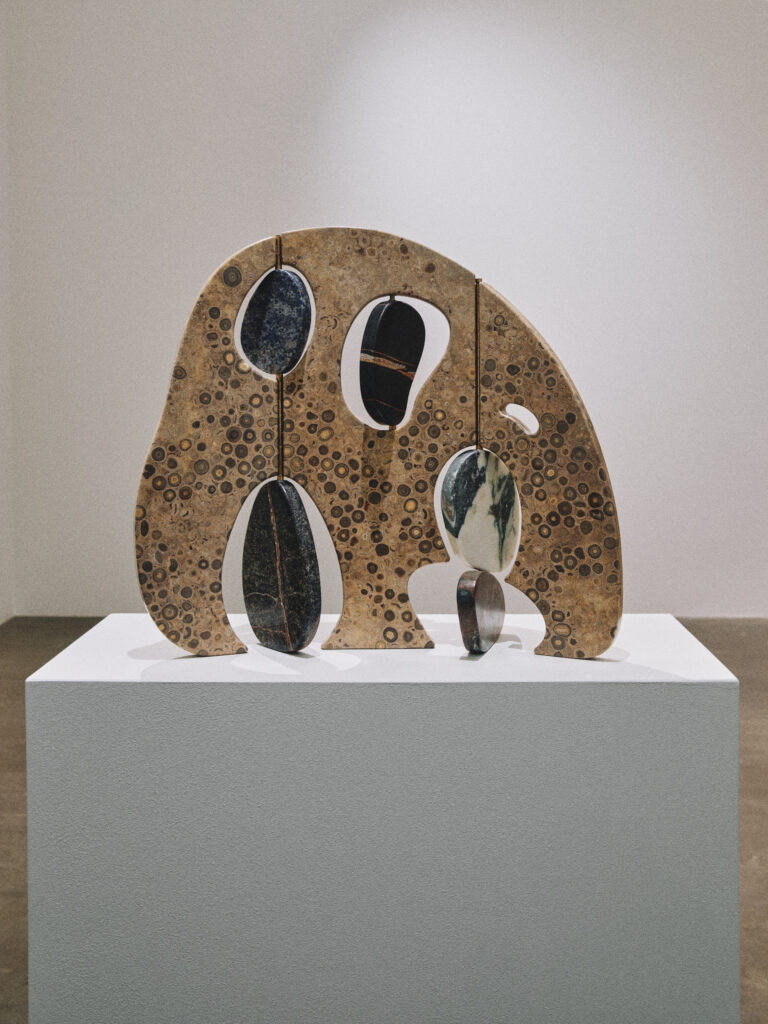
Model after Noguchi’s Shrine of Aphrodite N.2, 2025, travertine, marble, granite, bronze, 46 x 54 x 2 cm
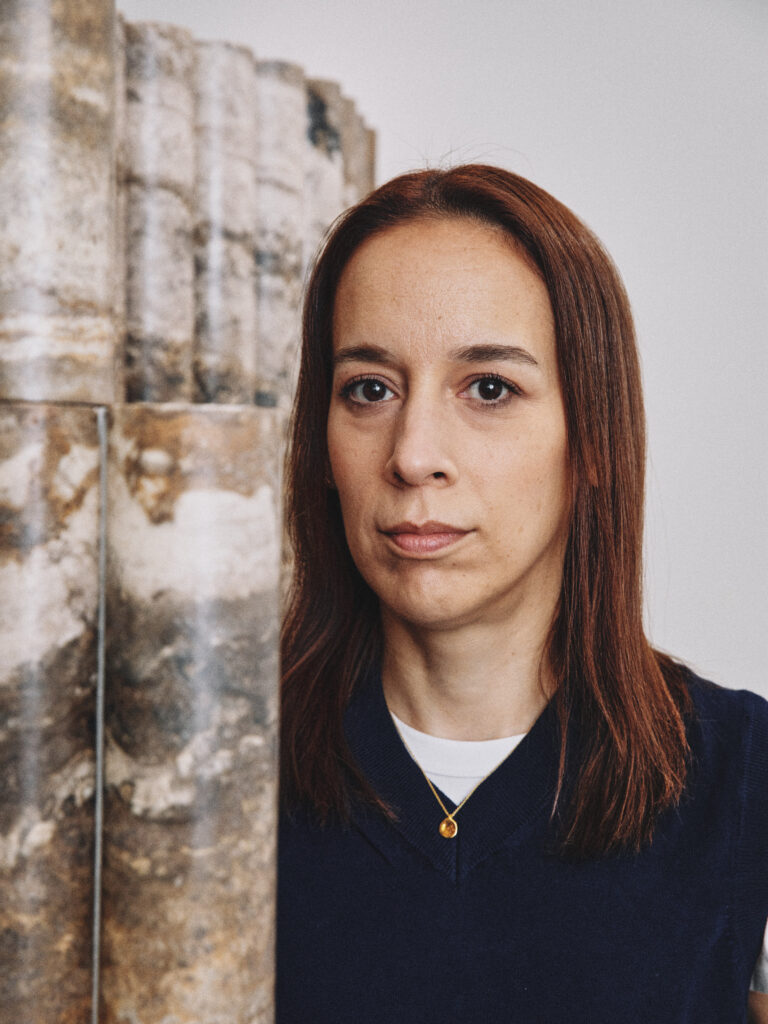
Strata Belt, 2025, Crater Fantasia travertine, stainless steel, 180 x 252 x 6.7 cm (extended) / 180 x 200 x 56 cm (curved)
NM: When working with geological forms, do you ever feel you are collaborating with forces that extend beyond human history?
ED: I wouldn’t call it a collaboration, but I do feel that in working with these materials, I am engaging with forces that far exceed human history. Deep time is inscribed in the stone, and I hope the works place viewers in an encounter with that abyss of time, something vast, fragmented, and still unfolding, which the material itself makes evident.
NM: Your pieces embody both fragility and weight. Is holding these contradictions central to your practice?
ED: Yes, that tension is central. Weight and fragility are not opposites but coexisting qualities in geological matter. Stone can hold immense density yet reveal fractures and porosity. This reminds me of erratic stones. These glacial boulders, carried by ice and left in improbable positions, are sometimes perched on the edge of a cliff or a smaller rock, as if about to collapse, yet somehow held in balance. That image reflects a balance I seek in my work, where stability and fragility remain inseparable aspects of the same form.
NM: Your background in architecture often surfaces in the modular and spatial aspects of your work. Do you still think like an architect when you approach sculpture?
ED: I studied architecture but never practised as an architect. What it gave me was an introduction to methodologies of research and project development, how to work with a team and develop a project while responding to changing conditions and contexts. Those tools have stayed with me and continue to shape the way I approach sculpture, especially in relation to space, materials, and context. They become especially relevant when working on projects closer to architecture, such as public commissions that engage directly with urban environments and landscape, or in installations that relate to an already existing architectural language.
NM: In past interviews, you’ve said you question science as absolute truth. How does this scepticism inform the way you approach research for your artworks?
ED: Challenging the notion of science as absolute truth does not mean rejecting knowledge; it opens a space to question what is presented as fact. I treat scientific material not as fixed truths but as frameworks for exploring relationships, processes, and temporalities. By focusing on methods rather than outcomes, I engage with partial and contingent truths, leaving room for the unknown and for alternative readings.
I am especially interested in the forms of research and representation that science uses to construct its claims. In my work, reflection and questioning carry as much weight as knowledge itself.
NM: At Frieze, artworks are often encountered in quick, fleeting moments. How do you hope audiences engage with your works, which are so rooted in deep time and slow transformation?
ED: My work isn’t about immediate impact; it tends to unfold slowly, revealing itself through time and repeated looking. In a context like Frieze, I hope viewers pause and take a closer look. Even a brief encounter can open space to reflect on memory, materiality, and natural transformation, and perhaps invite a slower, more attentive way of seeing.
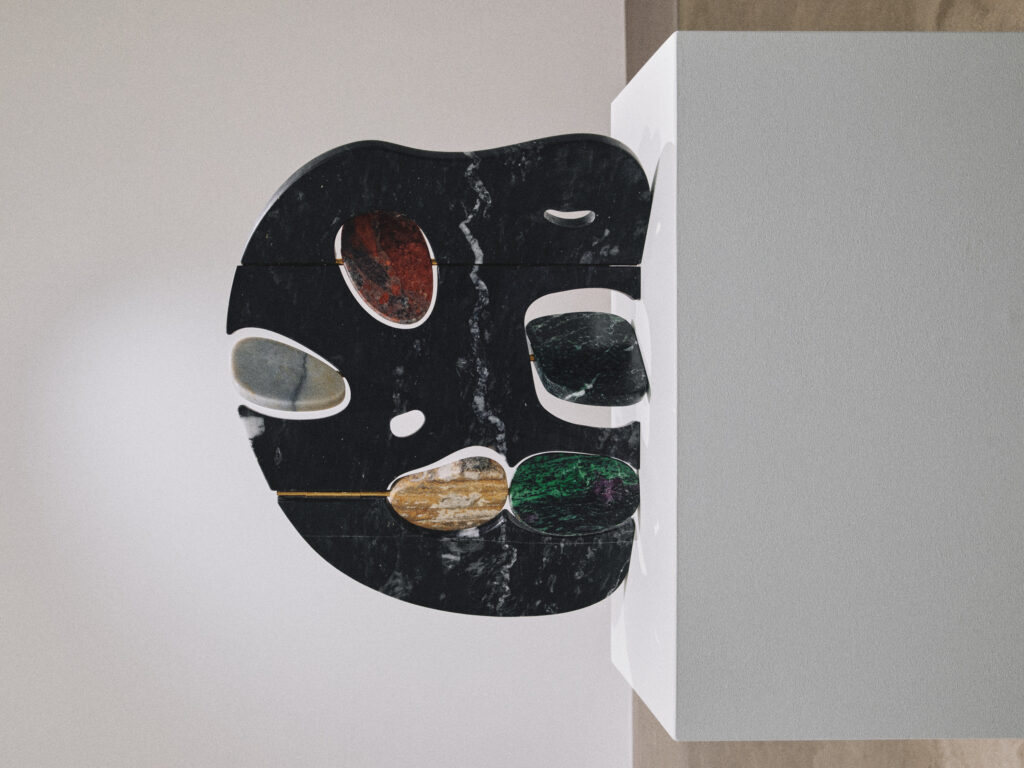
Model after Noguchi’s Shrine of Aphrodite N.3, 2025, travertine, marble, granite, quartzite, anyolite, bronze, 46 x 60 x 2 cm
NM: Galerie Nordenhake has shown your work in different contexts over the years. How do you collaborate with them on deciding what to present in an art fair booth?
ED: Working with Nordenhake over the years has created a dialogue grounded in their deep understanding of my practice. Deciding what to present depends on whether the booth will feature new or existing work. When it is new, we start a conversation about what could work best in dialogue with the other pieces and with the context of that fair.
Art fairs are challenging, especially for works like mine that are heavy and sometimes require reinforced walls or special conditions for installation. These practicalities are part of the conversation. Because Nordenhake has a clear direction, the booth naturally forms a coherent group of works while allowing each piece to hold its own presence in such a condensed environment.
NM: Do you view fairs like Frieze as a place to experiment, or as a stage to consolidate your artistic trajectory?
ED: It depends on the context. In the galleries section, the focus is more on consolidating ongoing directions and presenting a selection of works within a dense environment. In curated sections, there is more room to experiment or to frame the work in dialogue with a specific theme.