
Ulrika Lindqvist: You first released Weird Fucks in the magazine Bikini Girl in 1980. How has the response, both critically and from readers, shaped your perception of the novel over time?
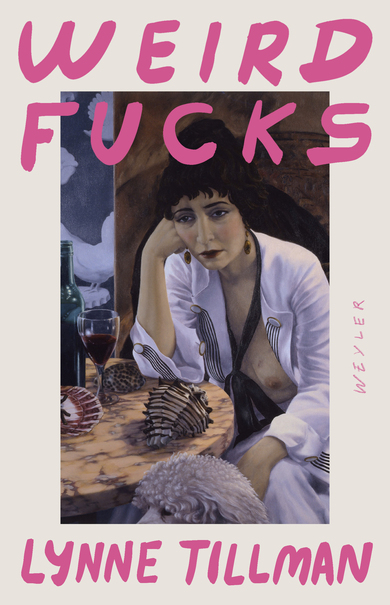
Lynne Tillman: In 1980, “Weird Fucks” was published in a pink magazine called BIKINI GIRL, edited by Lisa Baumgardner. Lisa and Bikini Girl were associated with Club 57, a punk place. Weird Fucks, in manuscript was 62 pp in manuscript but it was printed in 7 pt type on very wide pages, so it almost disappeared in the mag. Very disappointing. It didn’t circulate well, maybe 500 or 1,000 copies. No one really saw it. So I’d say it wasn’t published, in a way. I gave readings from it, so if people knew about it, that’s how, and not from reading it themselves. Other people did artist or limited editions, I’d call them; Jim Haynes did one from Paris. Again, no visibility or distribution in the usual sense. In New Her- ring Press (2014), a small, indie press, published it in its correct form, that is, with a few changes I made. Artist Amy Sillman did the amazing cover and all the illustra- tions – a beautiful book, but again in a limited edition. So, there was little to no response to Weird Fucks until Peninsula Press published it in 2022. Oddly, it became a bestseller, which amazed me. Then responses came, reviews, social media, emails, the lot of it. Artist Hilary Harkness’s cover, based on her Stein/Toklas series of paintings were also amazingly helpful to the book. Wild and fascinating and gorgeous.
So, responses, yes, finally. I had little perception, in the way you mean, before then. I believed it could appeal to contemporary readers. I wrote it with an eye to univer- sals, and by that I mean, things and events that happen again and again in people’s lives. In 1980, maybe, maybe fewer guys would have read it. Now, it’s a novel that has crossed over that arbitrary, highly gendered border. Thankfully.
UL: What a journey Weird Fucks has had! Also,
the cover is really amazing. I think Weird Fucks is very contemporary, it aligns with authors like Sally Rooney, Ottessa Moshfegh and Emma Cline, but you wrote it so long before.
Maybe that tells of the timeless troubles of being a young woman? Or just a young human?
LT: Of being human, and young, and a young woman, and a man who has sex with a woman, maybe one he’s just met, etc. Sex is universal. There are different ways to do it, and queer women and men also relate to Weird Fucks, because the weird is the situations and conditions of encounters around sex. What’s most important,
I think, is the style of Weird Fucks. It took me two years to write it, my first longish thing, and every word was considered closely. Style was very important. I wanted it to be tough and also lyrical. I mostly left room for readers.
UL: Now that Weird Fucks is being translated and reaching entirely new audiences more than 50 years after its original release, what is it like to witness the novel take on this second life?
LT: It’s really having its first life.
UL: And finally, that is! You have written several other novels – No Lease on Life was a finalist for the National Book Critics Circle Award in fiction. Have these other novels started living their first lives earlier, and how does that experience differ from the one with Weird Fucks?
LT: Let’s see, I’ve written six other novels, starting with Haunted Houses and, most recently, Men and Appari- tions, which is very much about young men. Peninsula Press is giving them life in the UK, and I hope other foreign presses will consider them. And they all had first lives in the US, and a few were published in the UK in the early 1990s, but they had a very small impact, very few readers. Weird Fucks became a bestseller.
None of the others have…yet.
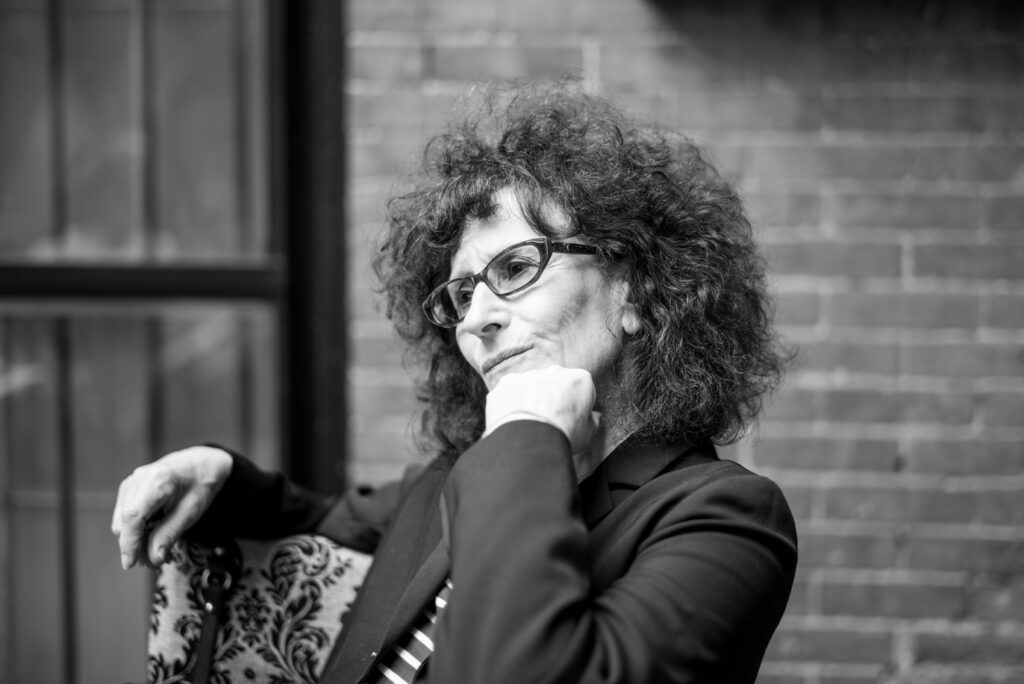
photography Craig Mod
UL: What was the inspiration behind Weird Fucks? Did any particular events, ideas, or themes inspire you more during the writing process?
LT: The sexual revolution, the pill, feminism, questioning gendered roles, these were changing — and still are — and I didn’t see fiction that, to my mind, took on what was happening, how girls, women, boys, men were being affected. The novels that did represent young women’s lives were, for me, not interesting formally, as writing, and were usually too sentimental, and too much about women as victims of the changes. The birth control pill was revolutionary, when you realise that over millennia, women couldn’t control their pregnancies. Having unwanted babies enslaved women to their bodies. We couldn’t talk at all about gender without the pill allowing women this very urgent freedom.
UL: That’s really a big change for women, in society as well as in personal lives. Do you have any artists or authors whose work inspire you?
LT: Oh, too many to mention, really. In fiction, most important, Jane Bowles, her stories and her one and only novel, Two Serious Ladies. Reading it opened
up a uniquely written world in which her girls and women characters stretched the bounds of female representation. Her writing is stark, unsentimental, and often hilarious. Bowles is very smart, very different — her dialogue, no one writes anything close to its unusual brilliance. Bowles’ mind, her language, her way of seeing human beings… Kafka, Thomas Mann, Colette, Jean Rhys, Joseph Roth, Flaubert, again, too many. Visual artists, four going back into history, Caravaggio, Velázquez, Courbet, and Matisse. dead contemporary painters: Peter Dreher, Susan Rothenberg… I’ll leave it there. And there’s installation and sculpture and video…. Photography: Diane Arbus, Robert Frank; Pictures Generation, including Cindy Sherman, Barbara Kruger, Laurie Simmons, Stephen Shore, and newer photographers, etc. Film: Ozu, Hitchcock, Chantal Akerman, Agnes Varda, Fassbinder, Suzanne Bier, many others.
I haven’t even mentioned doc filmmakers. Warhol radically changed the way I think about art, and I’ve written several essays about his work. Actually, I don’t think about work inspiring me; it’s more that I’m intrigued by other artists and thinkers’ ideas, by visual composition as it relates to writing, and by concepts. I write many essays on art and culture, and I don’t know if you’re aware of that. In 2026, Zwirner Books is bringing out a collection of them, many of them, called Paying Attention. Too many to count.
UL: I didn’t know that. Can you please tell me more about the art of writing essays and how you chose which ones to include in Paying Attention?
LT: That’s a hard question. I started out writing fictional essays, using a character I named Madame Realism. Initially, Art in America published many of them. Kiki Smith and I did the first Madame Realism as a chapbook. Kiki did the drawings. I chose to write as a fiction writer alongside contemporary art, not as an art historian, which I’m not. I chose to make the writing as important as what I had to say about art, film, theatre, etc. I do each of these art and culture essays differently. The writing doesn’t hold to one style. It’s very hard to explain briefly.
But writing that way has affected, I’m told, other writers, both in fiction and essays; there’s a field in anthropology called ficto-criticism, but I don’t hold to that concept. Still, not about writing, and anyway, anthropology has always involved narrative writing. Usually, I’m commissioned to make pieces by artists, galleries, and museums.
Recently, I’ve written on Susan Rothenberg, Arnold Kemp, and now I’m in the middle of an essay on Louise Bourgeois. I had a column for six years in Frieze magazine, out of London. Paying Attention will be a book of many pieces in many styles and in many approaches. Maybe you’ll read it one day.
UL: Weird Fucks made me think of weird places, with the main character in the novel meeting all of these characters in different places. What do public spaces like restaurants mean to your storytelling?
LT: Great question. I could go on and on. For women, and in particular, writing about women, the freedom to be in public, not to be chaperoned, not to be barred from clubs or bars, the freedom to be ALONE in public allows me opportunities, odd scenes, curious adventures, to invent and use randomness and chance for characters, and to play with coincidences. Even servants had a day or a half-day off. And weird things could happen outside the home, outside domestic lives.
UL: That’s so true, it’s really a lot about freedom to be able to be in public places. Talking about places, where do you prefer to do your writing? Any special places or rituals that lay the ground for your writing?
LT: My routine or ritual is making a pot of tea, then carrying the teapot and cup and a little pitcher of milk on a small tray to a little table near my computer. I do some emails, respond to messages that need the info right away. After two cups of tea, I might start looking at something I’m working on. It all depends. I don’t write in cafes or diners. Too much distraction. I need quiet. Music’s OK. But once I’m concentrating, I don’t even hear it.
UL: What happens next, aside from the publishing of Paying Attention? Are there any specific themes, works of art or ways of life that you want to explore?
LT: I’m writing a novel called Stella. I love the name and its associations. It’s been hard for me to find the time, lately, so much else has come my way – fortunately, because the fees are the main way I make money. I suppose you could say it’s about rejecting certain and the usual ways of living, alienation, flaws in thinking, conversations… it changes as I write it. I find ideas as I go along. My writing is character-driven, idea-driven, and human problem/issue-driven, if I can put it like that. I’m not so interested in plots or immediate casualties. The idea of fate in the sense of one’s psychology that affects decisions, say, ones you don’t know you’re making, and from that, consequences.