
The Postcard, Reimagined
text Natalia Muntean
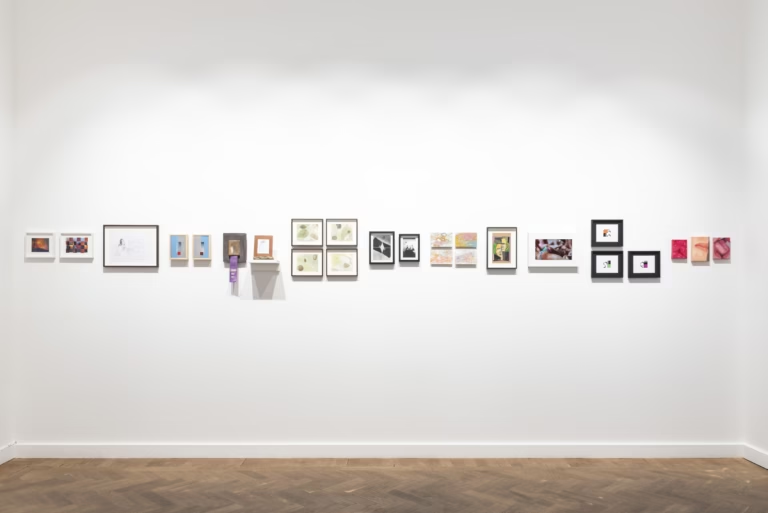
What can a postcard hold? A memory, a gesture, a point of contact, or an entire conversation. At Saskia Neuman Gallery, The Postcard Exhibition brings together 67 artists whose works explore the postcard not just as an object, but as a form of care, critique, intimacy, and distance. In an age dominated by instant digital communication, the postcard becomes almost radical in its slowness: a physical image that demands a hand, an address, and the willingness to wait.
Across the gallery, these small works form a network of voices and visual correspondences, each postcard becoming a greeting and an invitation to reflect on how images travel between people. Four artists from the exhibition reflect on how the mass-produced meets the deeply felt in the postcards they’ve created.
Niklas Delin
Postcards can be described as a “gesture in motion.” What was the essential gesture you wanted to capture with your work for this exhibition?
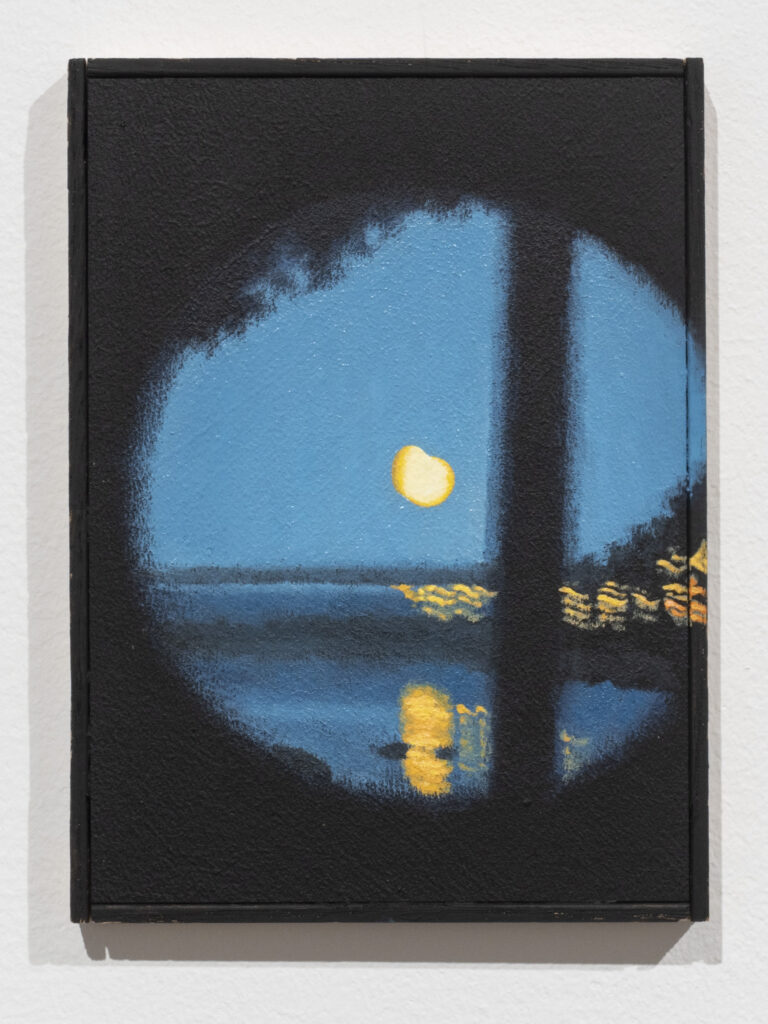
Niklas Delin: I view painting as something ongoing, in motion. It is a figuration of time in a way. It is constantly happening while also referring to something that has already happened- the act of painting it, or the moment it depicts. Much like a postcard is an object of the present, when you receive and read it, and at the same time an object of the past, when it was written and sent.
You often start your paintings on a black foundation. Did you do the same for your postcard? What “lighter shade” or light did you bring out of the darkness for this small work?
ND: The painting Blood (Moon) carries a lot of darkness. I usually cover the first black layer with the darkest shade of colour I can find in my motif. This one depicts a scene seen through a pair of binoculars, where the darkness surrounding what was seen through the lens was truly black, so I kept it. I think what interested me the most about this specific motif was the distortion, the element of unfocus, the lack of a determined border between light and darkness.
Your work explores the “interplay between light and darkness.” In your postcard, does the light feel like it’s fighting the darkness, or are they peacefully coexisting?
ND: I don’t know, I was going to say peacefully coexisting, at least they need each other. But I think perhaps none of the alternatives is correct. The darkness is always there, beneath the light. And even the darkest parts are just a different level of light.
The postcard can be seen as a paradox, both a mass-produced, somewhat clichéd object and a uniquely personal message. How did you engage with this tension in your work?
ND: That’s life, I suppose. Everything we see, someone else has already seen, yet to us it can hold personal meaning. This is also a recurring aspect of my work; I paint scenes that aren’t unique to me, on the contrary. But the fact that I choose to paint them, and how, still says something about who I am.
If your postcard could be mailed, who would you send it to, and what would that gesture mean?
ND: Someone close to me. I think a postcard can and does convey a lot; it can show something you’ve seen, it is a piece of the place you have been, a short message that describes a longer period of time. The gesture itself, sending a postcard to someone, says a lot. It is an act of care.
Susanna Marcus Jablonski
Postcards can be seen as a “gesture in motion.” What was the essential gesture you wanted to capture with your work for this exhibition?
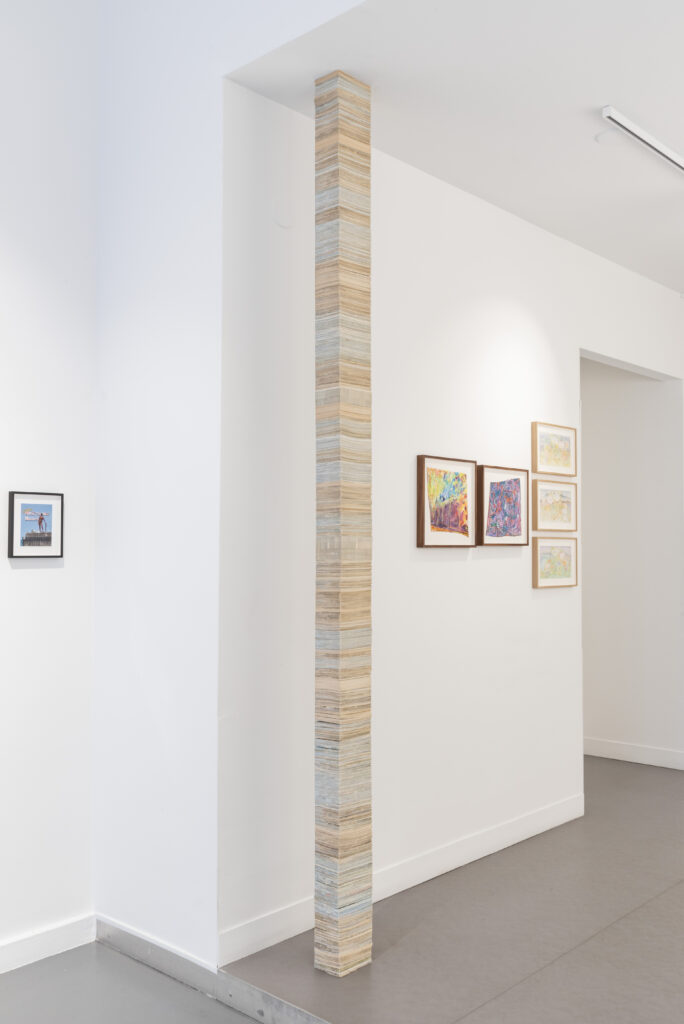
Susanna Marcus Jablonski: I approached the postcard the way I usually approach a material: thinking through its historical, political and material value, and then imagining how I could either deepen or shift some of those pre-established ideas by working with it as a sculptural material. In this case, it led me to work with them in a very concrete way, creating an architectural addition to the gallery. The sculptural ‘gesture’, I suppose, is that transformation: balancing these thousands of objects in one vertical mass.
Your work explores “material and conceptual” permanence. What material did you choose for your postcard, and what memory or feeling were you trying to make permanent with it?
SMJ: The work is called The 60s and the 70s and the 80s, and it’s an archive of postcards from that era, stacked floor to ceiling, ten thousand images of towns and landscapes from across Sweden. All the layers of time and place that make up the national imagination are in there – lakes, snowy landscapes, buildings, cultural rituals, they’re all pressed together to create a sedimented cross-section of peak Sweden, as well as an architectural pillar.
You often play with the size of objects. How did working on the small, intimate scale of a postcard change your usual sculptural process?
SMJ: For me, scale is a medium, and my usual approach manifests in this work: compressing these small parts together until they are perceived as a unified large object.
The postcard can be seen as a paradox, both a mass-produced, somewhat clichéd object and a uniquely personal message. How did you engage with this tension in your work?
SMJ: Postcards speak to the idea of a world in common. It’s the idea of communication as a ritual, a small ceremonial bridge between places and moments in time – these ideas have always drawn me in. The pre-framed image is also interesting: the view of a place that’s chosen to represent a culture and an identity, and the private message on the verso. I engaged with that by treating these small, intimate paper objects as a collective mass. Both the personal message and the standardised image sit directly on top of each other, and the sculpture becomes a new object, with a new set of horizons.
If your postcard could be mailed, who would you send it to, and what would that gesture mean?
SMJ: I’m sending a few thank you cards to Svenska Vykortsföreningen Uppsala, who generously donated this remarkable archive for me to work with, and Viktor Berglind Ekman, who collaborated with me in bringing the sculpture to life. And to Hugo, to Ingrid, to Santiago, Kamil and Francisco. A gesture to acknowledge that all artistic processes depend on the hands, histories, and support of many people, often behind the scenes.
Josef Jägnefält
Postcards can be seen as a “gesture in motion.” What was the essential gesture you wanted to capture with your work for this exhibition?
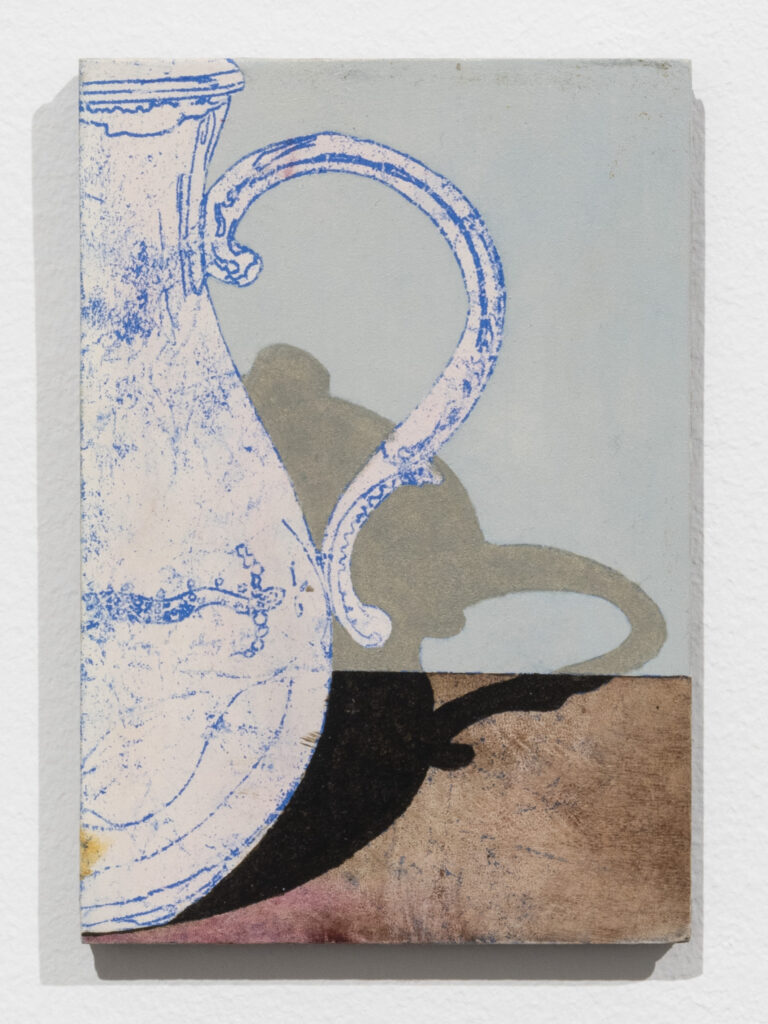
Josef Jägnefält: I wanted to capture the moment when the hand hesitates – halfway forward, halfway backwards – as if the paintings were small motors convincing the gesture to continue its path. The essential movement was thus the slight tremor between intention and action: a gesture that does not quite know whether it is progressing or remembering.
You say art is a “tool for social change.” What kind of change is your postcard a tool for?
JJ: Change can mean shifting one’s perspective a few degrees, enough for the familiar to appear slightly displaced, somewhat surprising. The shift is minimal but cumulative – like placing a grain of sand on a scale until the balance tips.
Your work mixes painting, design, and research. What different skills did you use to make this one postcard?
JJ: I looked, I traced, I erased, I rearranged, I compared, I doubted, I verified, I painted, I corrected, and finally, I stopped.
The postcard can be seen as a paradox, both a mass-produced, somewhat clichéd object and a uniquely personal message. How did you engage with this tension in your work?
JJ: I approached the postcard as both testimony and inquiry. The paintings in the show, Witness I, II, and III, each follow a different motif, yet all orbit this idea of seeing and being seen. A postcard shares something essential with a witness: it inhabits a limbo between the intimately personal and the openly public. It carries a quiet tremor, a desire both to hide and to reveal.
If your postcard could be mailed, who would you send it to, and what would that gesture mean?
JJ: I would send it to the future occupant of the place where I am sitting right now (my studio), someone who will never know my name, but will inherit this precise pocket of air. The gesture would be a whisper across time, acknowledging that every location contains multiple inhabitants layered like sediment.
Jason Bailer
Postcards can be seen as a “gesture in motion.” What was the essential gesture you wanted to capture with your work for this exhibition?
Jason Bailer: For me, the essential gesture was about committing to a single mark, a moment that can’t be undone or edited. A postcard doesn’t give you the luxury of endless revisions, so whatever happens on the surface stays there. I wanted the work to hold those small risks: the slips, the shaky edges, the places where something unexpected happens. Because of this, I did the work in a single sitting and with no revisions.
You honour the craft you learned from your family, while critiquing elite culture. Does your postcard feel more like a well-crafted, “working-class” object or a refined, “art world” one?
JB: Using a postcard as the surface for this work felt essential because it’s an everyday object – accessible, familiar, and tied to a form of communication that’s quickly disappearing. A canvas signals the white-walled gallery; a postcard carries lived memory and the imprint of an ordinary life.
I grew up in a small rural town in the Midwest, where being “good” at art meant accurately recreating what you saw. I entered grad school as a portrait painter shaped by those expectations and left as a sculptor intent on questioning them. I didn’t make another realistic painting for fourteen years because I was attempting to disconnect from those ideals.
Painting this postcard is a way of returning to that foundation without being confined by it. It lets me honour the craft I inherited from my family while also questioning the hierarchies that divide “high culture” from the so-called working-class or everyday. The gesture becomes both personal and critical: an embrace of the skills and memories that formed me, and a reclaiming of what “good” art can mean, on my own terms.
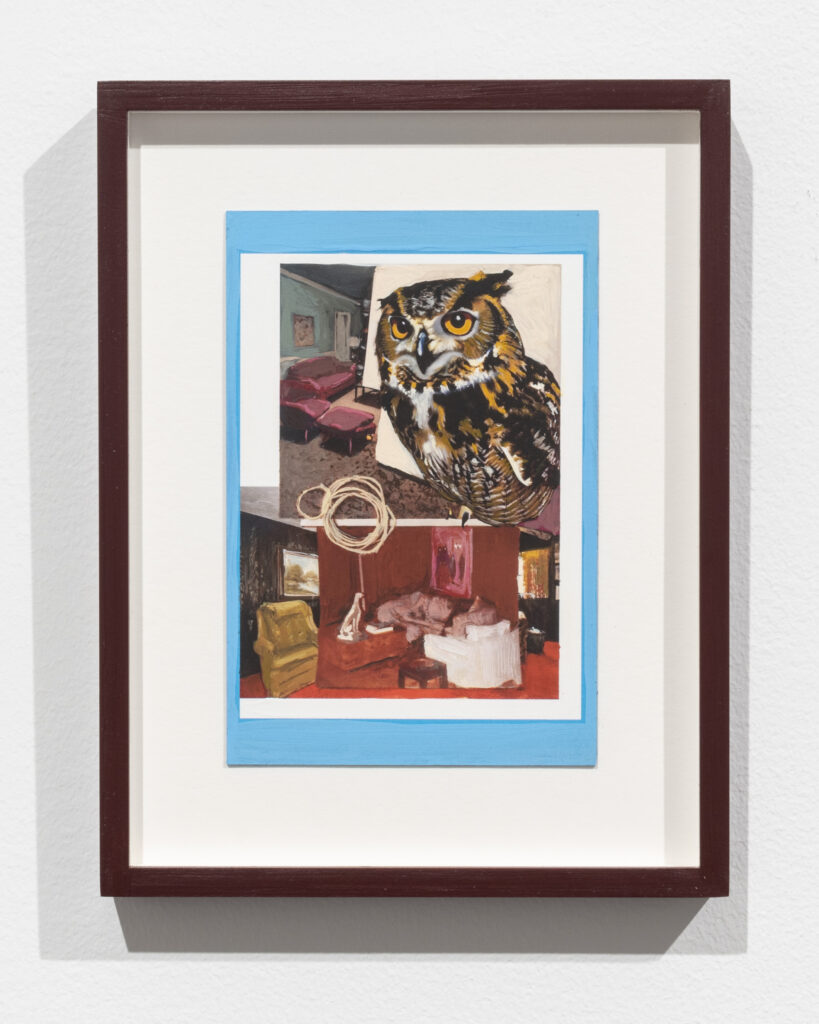
Your work creates “hybrid totems” from furniture parts and tchotchkes. Did you approach your postcard as a miniature sculpture? What small, found object or image did you use?
JB: I approach painting the same way I approach making sculpture: as a composition built from discrete actions that, together, become something greater than their parts. This piece began as a colour study for a painting in my recent New York solo exhibition, which explored false memory – the way the mind fills its own gaps and constructs a nostalgia that may never have existed.
The composition combines photographs of middle-American domestic interiors with AI-generated imagery produced through a custom model trained on my own personal archive of memories. That merging of sourced and fabricated material parallels the process of making my hybrid totems, which similarly blur distinctions between found elements and constructed forms. The painting invites viewers to consider which components derive from lived memory and which are produced through technological processes, echoing the broader questions of how memory, material and culture intersect and shape one another.
The postcard can be seen as a paradox, both a mass-produced, somewhat clichéd object and a uniquely personal message. How did you engage with this tension in your work?
JB: For me, the tension plays out in two distinct ways. First, the original postcard contains a second painting on its reverse, an image known only to me and the gallery. I sent the work without instructions for display, fully aware that the decision of which side to present would shape how the piece functioned. When the gallery chose to frame the work and show only one side, the other image became a kind of concealed message, present but withheld from public view. That act of selection introduced a layer of intimacy and privacy into an otherwise mass-produced format.
Second, I created a printed edition of the postcard and mailed it to family and friends. As these reproductions move through the postal system, anyone who encounters them can see the second image, while remaining unaware that the “original” painting, now framed in the gallery, is hiding its counterpart. In that circulation, the postcard oscillates between the personal and the widely distributed, between something singular and something reproduced. The postcard becomes both a public artefact and a private transmission, mirroring the questions of memory, disclosure, and omission that run throughout my practice.
If your postcard could be mailed, who would you send it to, and what would that gesture mean?
JB: It’s in the mail, and it’s being sent to those I love.